Rewrite
Lead ImageWriting a Letter: Akerman Ballet, Act I by Collier SchorrPhotography by Collier Schorr
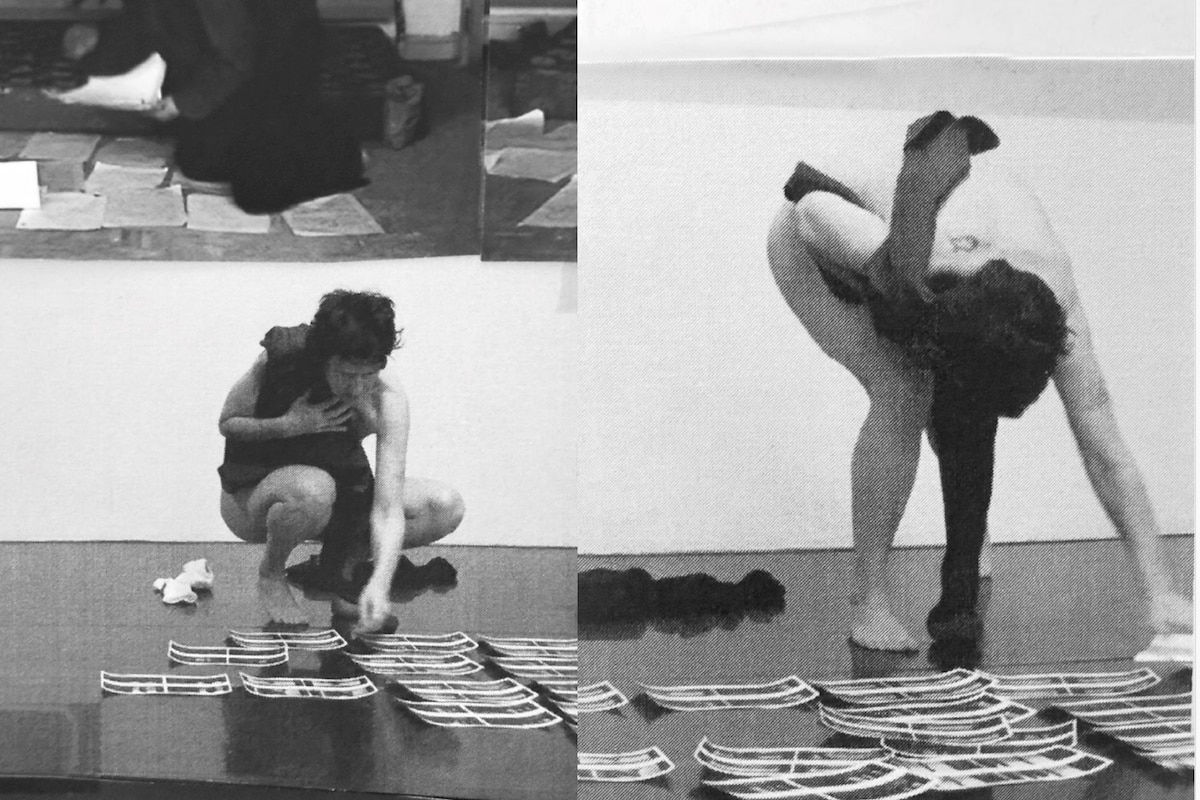
In 1974, Chantal Akerman made her feature film debut with Je Tu Il Elle, an enigmatic triptych starring the 24-year-old Belgian filmmaker as a listless woman in search of meaning and human connection. It is a stark examination of routine and the breaking of it, and features an uninterrupted lesbian sex scene entirely radical in its intimacy, vulnerability and rejection of eroticism. Among the film’s many admirers is Collier Schorr, who over the course of six years has adapted it into a ballet that draws on its themes of transparency, sexuality, shame and love. The American artist and fashion photographer learned to dance for the purpose, acting as both director and part of the dance troupe as she and her team committed the dances to videotape.
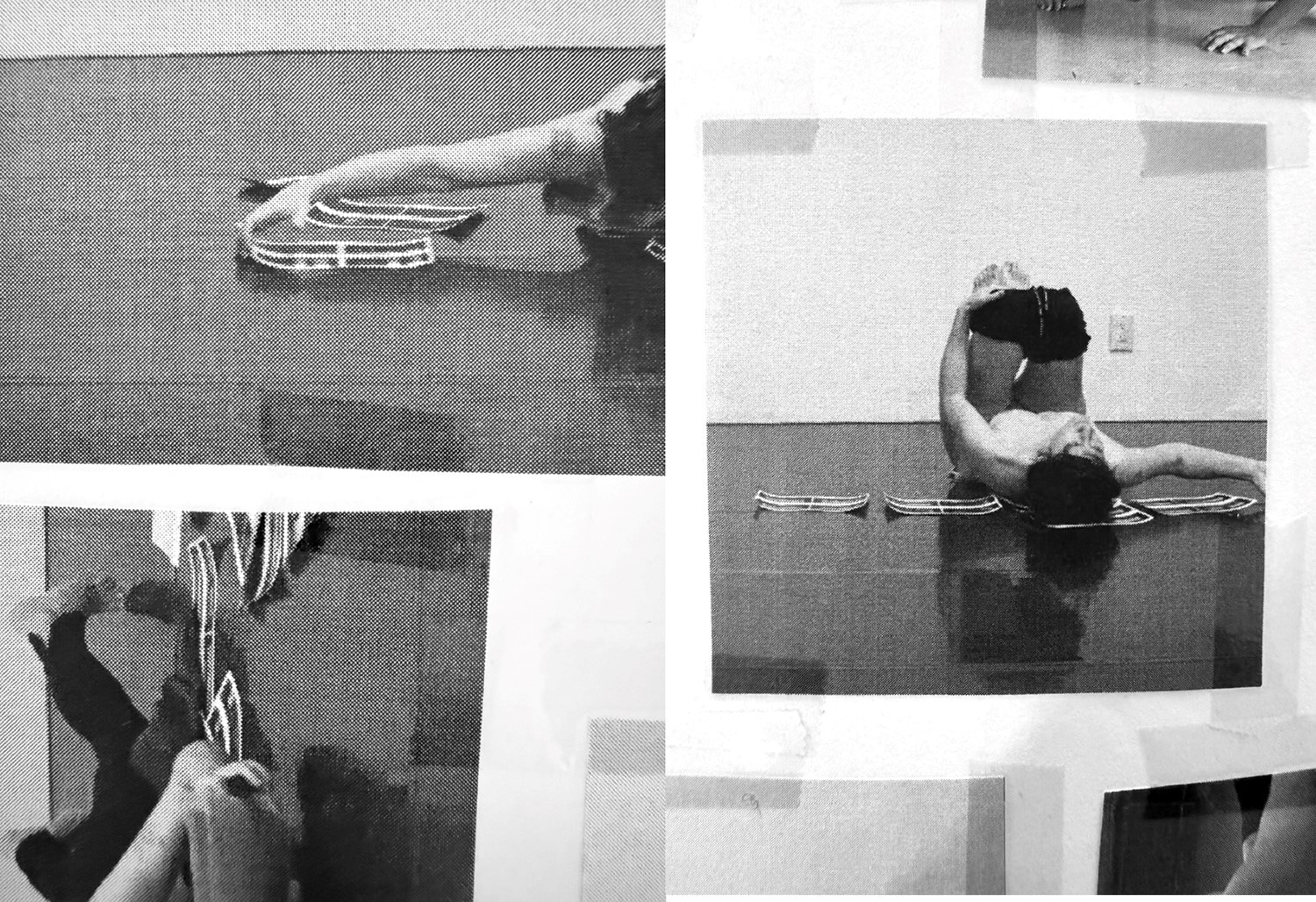
A selection of film stills from the ballet’s first act form the basis of Schorr’s new book, titled Writing a Letter: Akerman Ballet, Act I – a work that Schorr describes as telling “another story, based on the ones that Chantal Akerman had told me, about power and desire and compulsion and essentially free speech in the male-dominated field … ” The book is a poignant instance of one artist entering into dialogue with another’s work, as well as a testament to the power of sharing, and caring for, queer histories. Here, filmmaker Matt Wolf – whose 2025 documentary on Paul Reubens, Pee-Wee as Himself, resulted in a similarly all-encompassing engagement with a fellow artist’s work – met with Schorr to learn more about her first foray into ballet and her plans for the project’s future.
Matt Wolf: In this work, you’ve put your body on the line by learning a new medium, ballet, and using it to adapt this extraordinary film. The thread across your large body of work is desire, its power relations, and the presentation of gender and sexuality, all of which are also present in Je Tu Il Elle. When did you first see the film?
Collier Schorr: I think I saw it in Amy Taubin’s class at SVA [School of Visual Arts]. If I didn’t, I saw it at the Quad. I went to school in 1981, so a long time ago. Akerman’s work was one of the only delivery options for my gender and my sexuality. That’s one of the reasons it stood out. But I didn’t carry it with me: it came up again when I started thinking about the practices of women artists who appear in their work.
MW: In the book, there’s a correspondence between you and the feminist performance scholar Peggy Phelan, where you mention you once sat next to Akerman at a screening of her film News from Home …
CS: I didn’t sit next to her, but I went up and sat next to her for a minute before the film. It’s such an important thing that I did. I just wish I’d sat longer and really talked to her. But she was so intimidating, so steely and slightly sad, so I didn’t want to linger. But I subsequently lingered for six years in her body.
MW: Is this project an effort to start the communication you couldn’t have in real life?
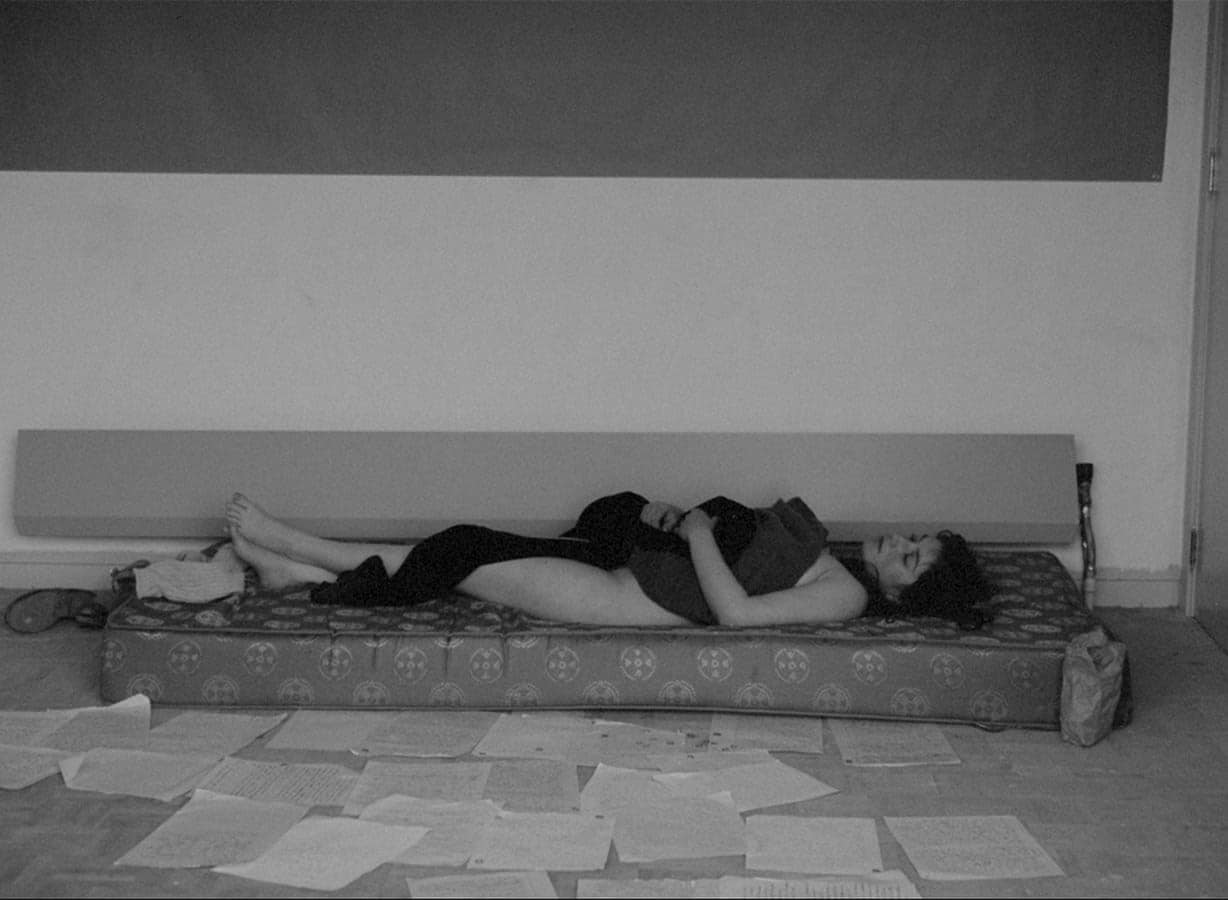
CS: I think so. I was also interested in the photographs of Yvonne Rainer’s performances and the idea that someone took them who wasn’t Yvonne. I didn’t want to take someone’s picture, I wanted to take a picture of my work, and the only way to do that was to make a performance. I thought it was going to be a work with a bunch of different kinds of people, not solely focused on dance. Then, when I saw clips of the film – I haven’t allowed myself to watch it; it’s too much for me – there was so much precise movement stemming from 70s New York dance and performance that I decided to move through the film in all these precise movements depicting a nervous breakdown and an obsession with love.

MW: Why is it too much for you to watch the movie in full?
CS: It feels like an ex for me because I embedded myself in all the very internal stuff in it. There’s a lot of obsession with oneself – the object of affection is rarely the subject of pain. Sometimes when I see pictures of Chantal, I think it’s me. Anyway, because I was psychically trying to adapt her movements, which could be sex or writing a letter, the amazing thing was to give the dancers pictures of Chantal doing something and say, “OK, we’re doing this” …
MW: Does that method of adaptation also come from a place of devotion or even love – if it’s an ex?
CS: Yes, I would never adapt a happy work. I felt very comfortable in the drama, as did the dancers I was dancing with. To dance this piece is to inhabit a physical space that’s sometimes violent and sometimes mournful. I was thinking about how it would be called a performance, but really it’s an experience that I had that people then get to see, because there was no audience while making it.
MW: Was it Akerman who sparked your impulse to train in ballet?
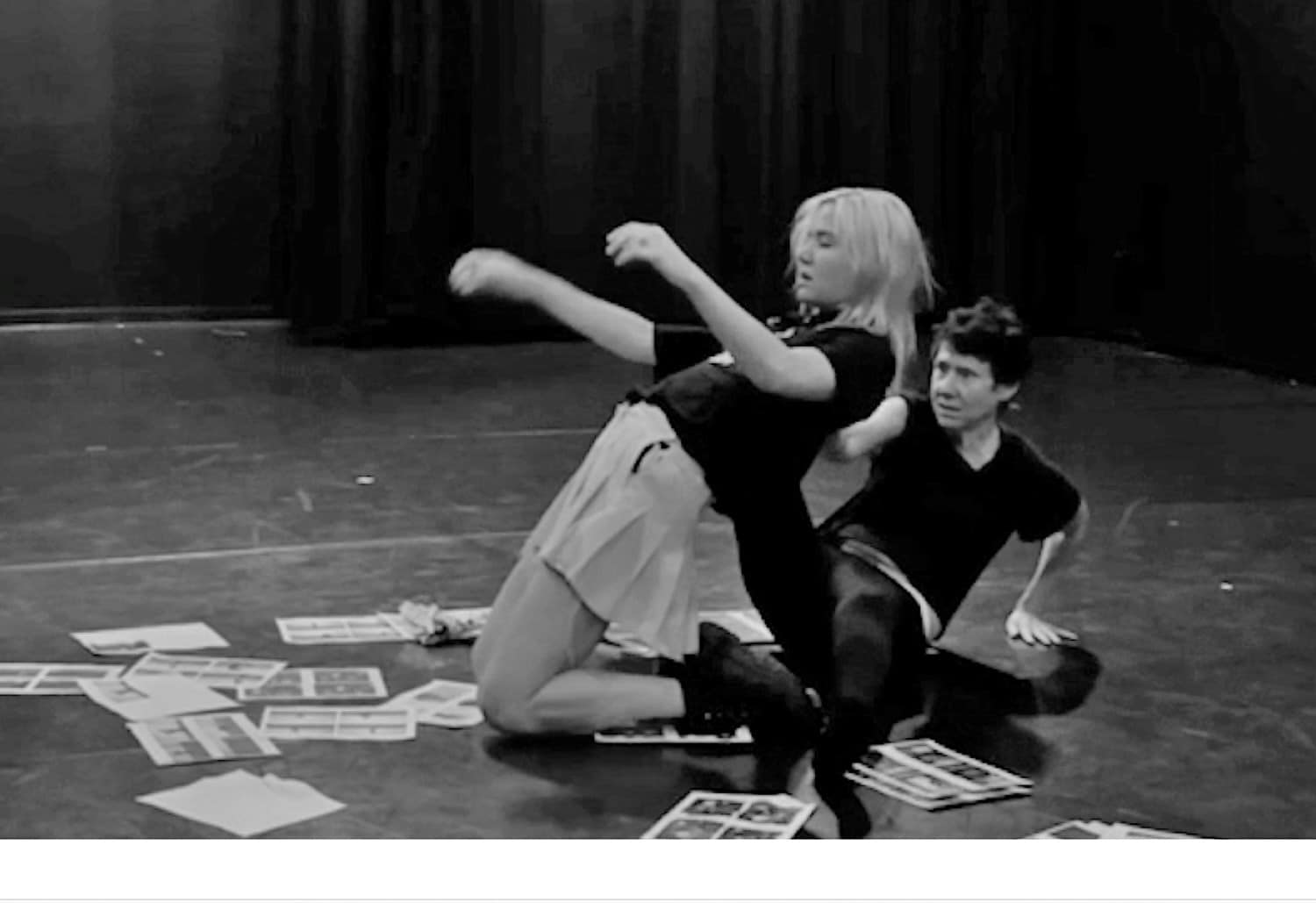
CS: Yes. I use the word “ballet” because it’s such a product of the patriarchy, and ballet’s such a fraught, male-dominated medium. I thought, “I’m going to take ‘Akerman’ and I’m going to put ‘Ballet’ next to it, and that will tell everyone it’s a full-length narrative piece, and a ‘fuck you’, on some level, to dance.” Also, it’s made with the dancers – I’m the director but everything is co-choreographed because it’s all improv, even if we repeat things.
MW: Have you been the subject of your own image-making before?
CS: No, except for a fashion editorial for Fantastic Man, which was sort of the first time I saw myself. Before that, part of this obsession with artists who had been in their work – Ana Mendieta, Adrian Piper, Akerman, Cindy Sherman – was that I felt there was a kind of woman that was allowed to be the subject, and I didn’t fit that bill. For whatever reason, I thought at 55 it was my time. I always tell this joke: Yvonne Rainer became a lesbian at 55 and I became a dancer at 55, and we both had a lot of catching up to do.
MW: In the text with Phelan, you talk about the awkwardness you feel. You’re blurring the boundaries between you and Akerman – did you feel she felt awkward as a subject in Je Tu Il Elle?
CS: She was awkward. The permission I got was that she wrote this piece and she knew she had to be in it because an actress couldn’t be so clumsy. I thought, “I can be the primary character because I’m awkward and I don’t know how to dance, and I’ve decided to make it a dance because I don’t know how to act.” Once I gave myself permission to do it, it was just an extension of directing. I got so tired of telling people what to do that it was easier and more interesting to use my hands and move someone. Dance is the most amazing medium because there’s an agreement between two bodies that you’re allowed to touch in different ways to communicate. In training, I had to learn both how to touch someone, and how to be touched.
MW: There’s a tendency to romanticise the early work of artists like Akerman. It’s easy to imagine this 24-year-old, who’s just spent a formative period living in New York, intuitively making this seminal film. Were you galvanised by her seeming naivity?
CS: Probably but no one knew I was doing this. I didn’t do it with the gallery or an institution. I did it with the dancers and an iPhone, for the most part, piece by piece, working our way through a script I’d made from film stills. So the stakes were very low and I wasn’t sure how far I’d go. I didn’t realise I would dance the whole thing.
MW: Now the book is out and it’s no longer private, would you consider performing it publicly?
CS: I think we will but the greater impetus of the project was to publish the full script of all the dances so that other companies can perform the whole work. There’s three acts in total – the book’s just a part of Act I. The joy for me about ballet is that it has a long history of being performed by different companies with different agendas. That was sort of my gift to Chantal: the possibility of further performances of this work.
MW: Is this the end of your ballet journey or the beginning?
CS: I don’t know. I’m thinking about how to stage it and, in that case, I think we’ll go back and work on some things. I love my life as a dancer, I love pulling stills out of the dances, and I completely changed from doing it.
Writing a Letter: Akerman Ballet, Act 1 by Collier Schorr is out now, published by The Song Cave.
in HTML format, including tags, to make it appealing and easy to read for Japanese-speaking readers aged 20 to 40 interested in fashion. Organize the content with appropriate headings and subheadings (h1, h2, h3, h4, h5, h6), translating all text, including headings, into Japanese. Retain any existing
tags from
Lead ImageWriting a Letter: Akerman Ballet, Act I by Collier SchorrPhotography by Collier Schorr
In 1974, Chantal Akerman made her feature film debut with Je Tu Il Elle, an enigmatic triptych starring the 24-year-old Belgian filmmaker as a listless woman in search of meaning and human connection. It is a stark examination of routine and the breaking of it, and features an uninterrupted lesbian sex scene entirely radical in its intimacy, vulnerability and rejection of eroticism. Among the film’s many admirers is Collier Schorr, who over the course of six years has adapted it into a ballet that draws on its themes of transparency, sexuality, shame and love. The American artist and fashion photographer learned to dance for the purpose, acting as both director and part of the dance troupe as she and her team committed the dances to videotape.
A selection of film stills from the ballet’s first act form the basis of Schorr’s new book, titled Writing a Letter: Akerman Ballet, Act I – a work that Schorr describes as telling “another story, based on the ones that Chantal Akerman had told me, about power and desire and compulsion and essentially free speech in the male-dominated field … ” The book is a poignant instance of one artist entering into dialogue with another’s work, as well as a testament to the power of sharing, and caring for, queer histories. Here, filmmaker Matt Wolf – whose 2025 documentary on Paul Reubens, Pee-Wee as Himself, resulted in a similarly all-encompassing engagement with a fellow artist’s work – met with Schorr to learn more about her first foray into ballet and her plans for the project’s future.
Matt Wolf: In this work, you’ve put your body on the line by learning a new medium, ballet, and using it to adapt this extraordinary film. The thread across your large body of work is desire, its power relations, and the presentation of gender and sexuality, all of which are also present in Je Tu Il Elle. When did you first see the film?
Collier Schorr: I think I saw it in Amy Taubin’s class at SVA [School of Visual Arts]. If I didn’t, I saw it at the Quad. I went to school in 1981, so a long time ago. Akerman’s work was one of the only delivery options for my gender and my sexuality. That’s one of the reasons it stood out. But I didn’t carry it with me: it came up again when I started thinking about the practices of women artists who appear in their work.
MW: In the book, there’s a correspondence between you and the feminist performance scholar Peggy Phelan, where you mention you once sat next to Akerman at a screening of her film News from Home …
CS: I didn’t sit next to her, but I went up and sat next to her for a minute before the film. It’s such an important thing that I did. I just wish I’d sat longer and really talked to her. But she was so intimidating, so steely and slightly sad, so I didn’t want to linger. But I subsequently lingered for six years in her body.
MW: Is this project an effort to start the communication you couldn’t have in real life?
CS: I think so. I was also interested in the photographs of Yvonne Rainer’s performances and the idea that someone took them who wasn’t Yvonne. I didn’t want to take someone’s picture, I wanted to take a picture of my work, and the only way to do that was to make a performance. I thought it was going to be a work with a bunch of different kinds of people, not solely focused on dance. Then, when I saw clips of the film – I haven’t allowed myself to watch it; it’s too much for me – there was so much precise movement stemming from 70s New York dance and performance that I decided to move through the film in all these precise movements depicting a nervous breakdown and an obsession with love.
MW: Why is it too much for you to watch the movie in full?
CS: It feels like an ex for me because I embedded myself in all the very internal stuff in it. There’s a lot of obsession with oneself – the object of affection is rarely the subject of pain. Sometimes when I see pictures of Chantal, I think it’s me. Anyway, because I was psychically trying to adapt her movements, which could be sex or writing a letter, the amazing thing was to give the dancers pictures of Chantal doing something and say, “OK, we’re doing this” …
MW: Does that method of adaptation also come from a place of devotion or even love – if it’s an ex?
CS: Yes, I would never adapt a happy work. I felt very comfortable in the drama, as did the dancers I was dancing with. To dance this piece is to inhabit a physical space that’s sometimes violent and sometimes mournful. I was thinking about how it would be called a performance, but really it’s an experience that I had that people then get to see, because there was no audience while making it.
MW: Was it Akerman who sparked your impulse to train in ballet?
CS: Yes. I use the word “ballet” because it’s such a product of the patriarchy, and ballet’s such a fraught, male-dominated medium. I thought, “I’m going to take ‘Akerman’ and I’m going to put ‘Ballet’ next to it, and that will tell everyone it’s a full-length narrative piece, and a ‘fuck you’, on some level, to dance.” Also, it’s made with the dancers – I’m the director but everything is co-choreographed because it’s all improv, even if we repeat things.
MW: Have you been the subject of your own image-making before?
CS: No, except for a fashion editorial for Fantastic Man, which was sort of the first time I saw myself. Before that, part of this obsession with artists who had been in their work – Ana Mendieta, Adrian Piper, Akerman, Cindy Sherman – was that I felt there was a kind of woman that was allowed to be the subject, and I didn’t fit that bill. For whatever reason, I thought at 55 it was my time. I always tell this joke: Yvonne Rainer became a lesbian at 55 and I became a dancer at 55, and we both had a lot of catching up to do.
MW: In the text with Phelan, you talk about the awkwardness you feel. You’re blurring the boundaries between you and Akerman – did you feel she felt awkward as a subject in Je Tu Il Elle?
CS: She was awkward. The permission I got was that she wrote this piece and she knew she had to be in it because an actress couldn’t be so clumsy. I thought, “I can be the primary character because I’m awkward and I don’t know how to dance, and I’ve decided to make it a dance because I don’t know how to act.” Once I gave myself permission to do it, it was just an extension of directing. I got so tired of telling people what to do that it was easier and more interesting to use my hands and move someone. Dance is the most amazing medium because there’s an agreement between two bodies that you’re allowed to touch in different ways to communicate. In training, I had to learn both how to touch someone, and how to be touched.
MW: There’s a tendency to romanticise the early work of artists like Akerman. It’s easy to imagine this 24-year-old, who’s just spent a formative period living in New York, intuitively making this seminal film. Were you galvanised by her seeming naivity?
CS: Probably but no one knew I was doing this. I didn’t do it with the gallery or an institution. I did it with the dancers and an iPhone, for the most part, piece by piece, working our way through a script I’d made from film stills. So the stakes were very low and I wasn’t sure how far I’d go. I didn’t realise I would dance the whole thing.
MW: Now the book is out and it’s no longer private, would you consider performing it publicly?
CS: I think we will but the greater impetus of the project was to publish the full script of all the dances so that other companies can perform the whole work. There’s three acts in total – the book’s just a part of Act I. The joy for me about ballet is that it has a long history of being performed by different companies with different agendas. That was sort of my gift to Chantal: the possibility of further performances of this work.
MW: Is this the end of your ballet journey or the beginning?
CS: I don’t know. I’m thinking about how to stage it and, in that case, I think we’ll go back and work on some things. I love my life as a dancer, I love pulling stills out of the dances, and I completely changed from doing it.
Writing a Letter: Akerman Ballet, Act 1 by Collier Schorr is out now, published by The Song Cave.
and integrate them seamlessly into the new content without adding new tags. Ensure the new content is fashion-related, written entirely in Japanese, and approximately 1500 words. Conclude with a “結論” section and a well-formatted “よくある質問” section. Avoid including an introduction or a note explaining the process.