Rewrite
Lead ImageAnOther World: Marguerite HumeauPhotography by Will Bruce
On an inconspicuous backstreet in Bermondsey is a retired industrial granary. It’s unremarkable enough from the outside – weathered greying brickwork, arching steel-framed crittal windows, monolithic in scale. It looks just like a 19th-century dockland warehouse along the Thames should. Today it serves a new function, transformed into residential apartments, studios and workspaces by an architect who acquired it in the Seventies. Here, up several flights of stairs, is artist and sculptor Marguerite Humeau’s home and studio, her world.
Humeau is wearing her slippers when I arrive. I offer to take my shoes off – “mais, ce n’est pas nécessaire,” she says with a thick French accent, waving me through. Humeau, who grew up in the countryside in the Loire Valley, moved to London to study a now-discontinued MA course in Design Interactions at the Royal Academy of Art. “It was very speculative,” she tells me, a methodology that remains fundamental in how she approaches her work today.
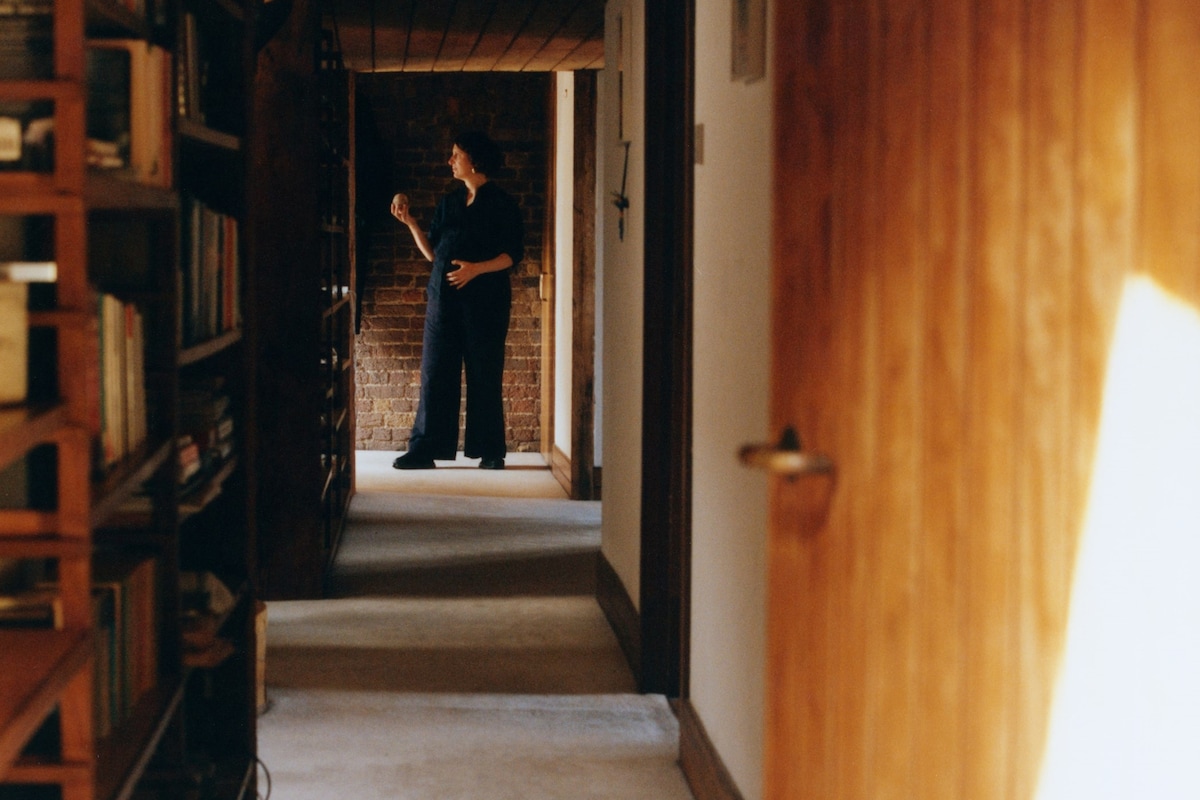
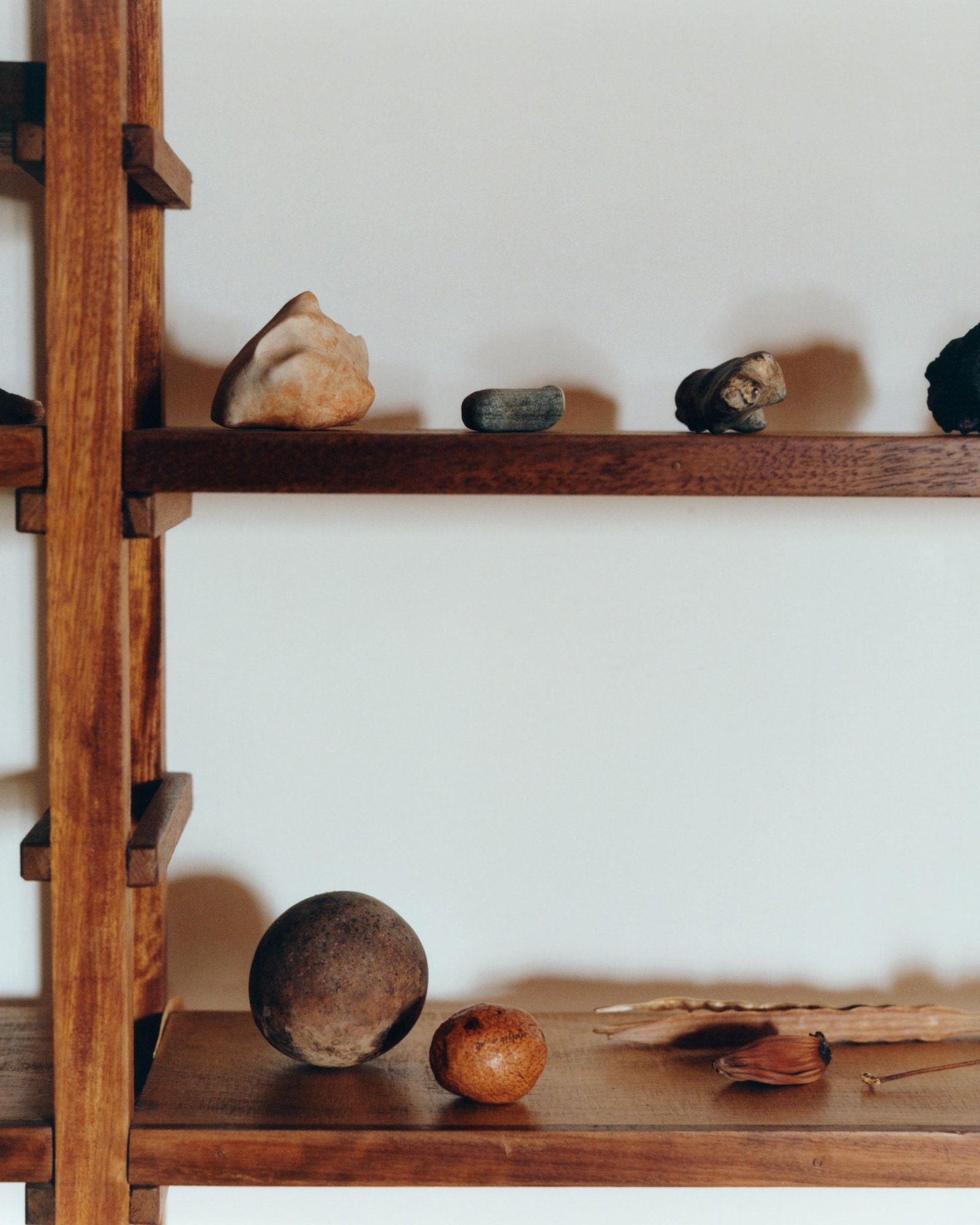
Heavily pregnant, Humeau leads me down a long corridor with low ceilings and exposed timber beams, lined by shelves of bones and stones, rocks, fossils, fragments of shells, driftwood and debris, seeds. “These seedpods are so perfectly designed to spread life, they have ultimate functionality.” Is that a spine? Yes. She found it in a geopark. She’s not sure what kind of animal it belonged to. Humeau gathered these pieces of time, markers of life and history while travelling over the years. It’s something she likes to do with her partner (he’s a quantum physicist – a totally logical match for an artist whose work imagines alternatives and quantum superpositions). Gathering, Humeau tells me, is a huge part of her creative process. Gathering research, gathering collaborators, gathering histories, prehistories, references, talking to experts – among them clairvoyants, foragers, geomancers, anthropologists, historians – over several years until an idea evolves into a vast web of a project. “I want to create worlds and for that I need lots of different perspectives,” she says. “I want it to be a sum of all of its parts.”

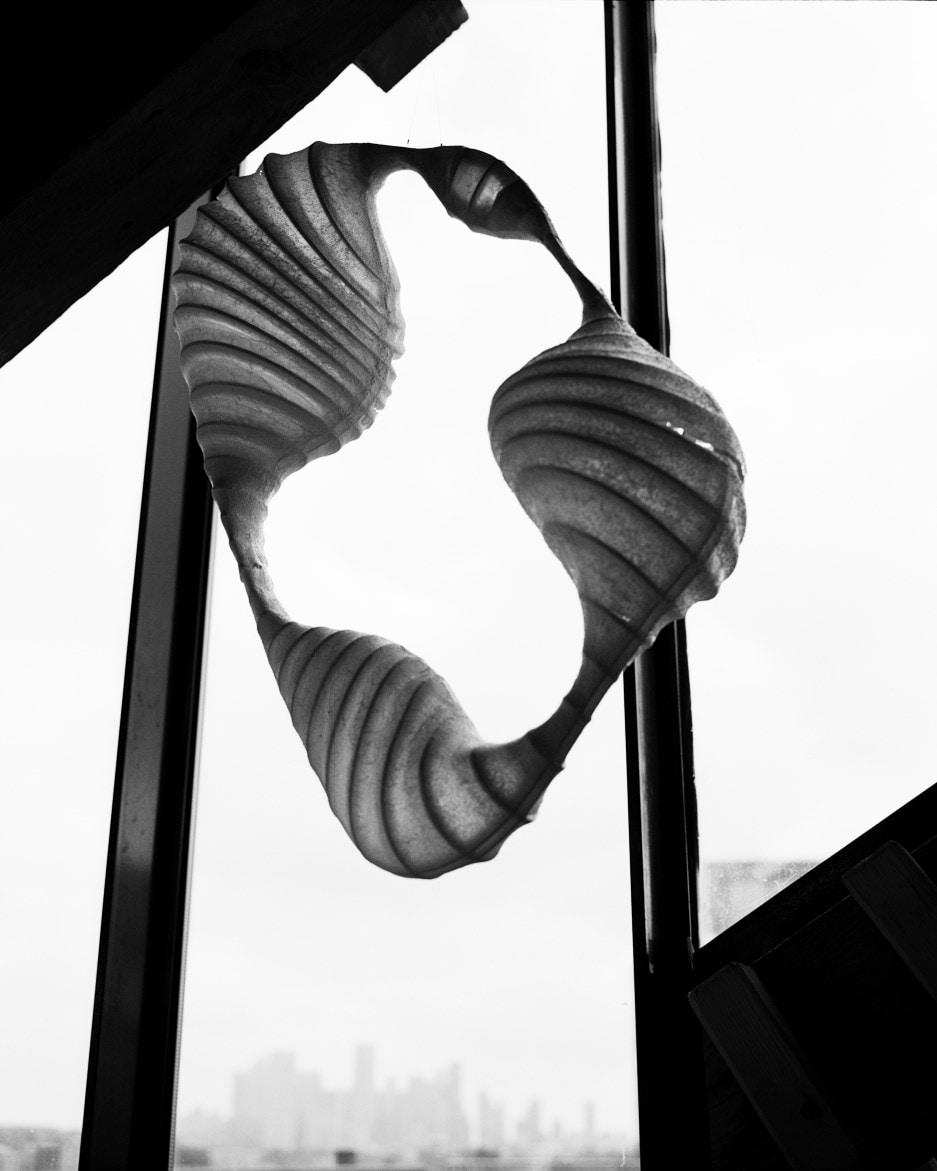
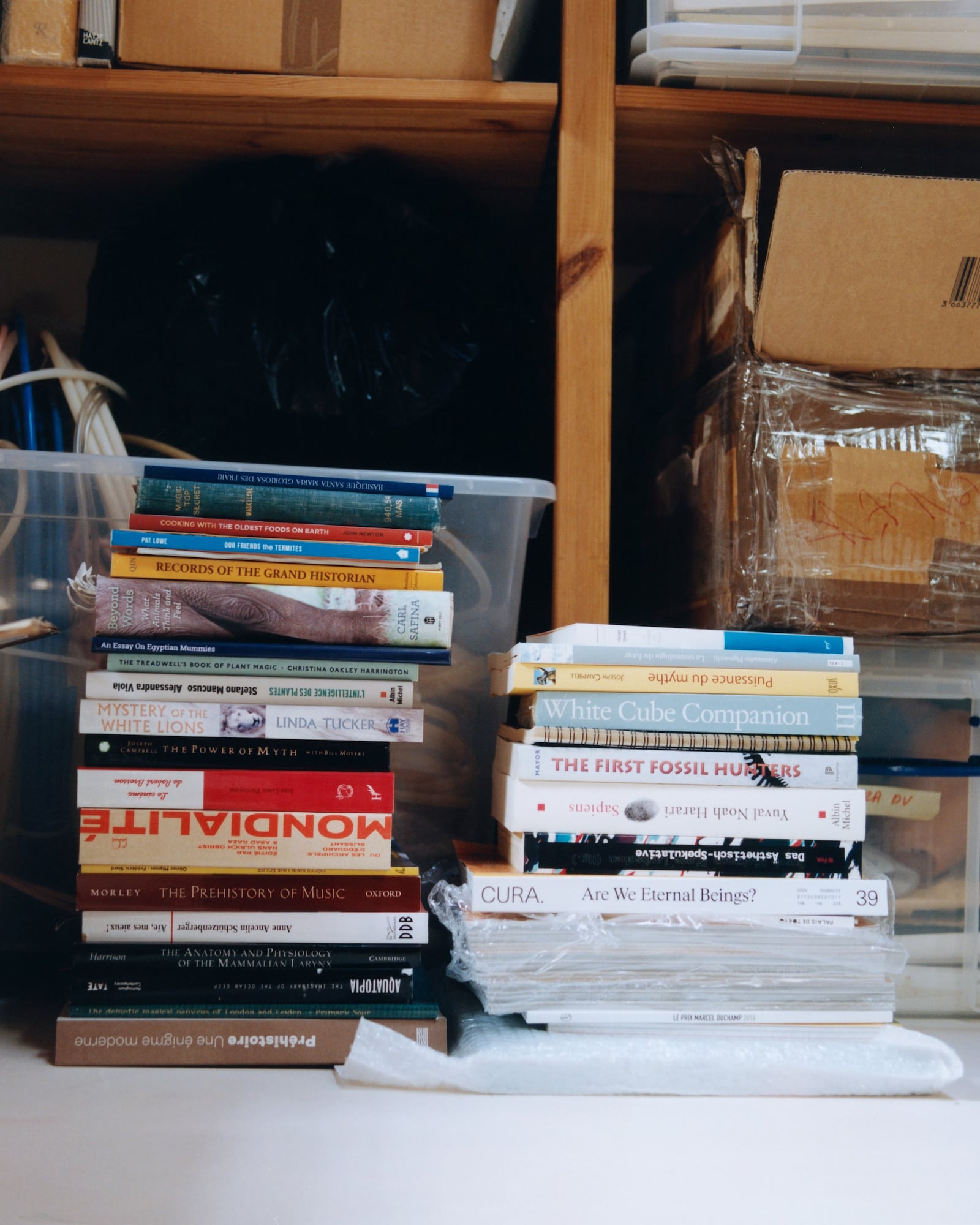
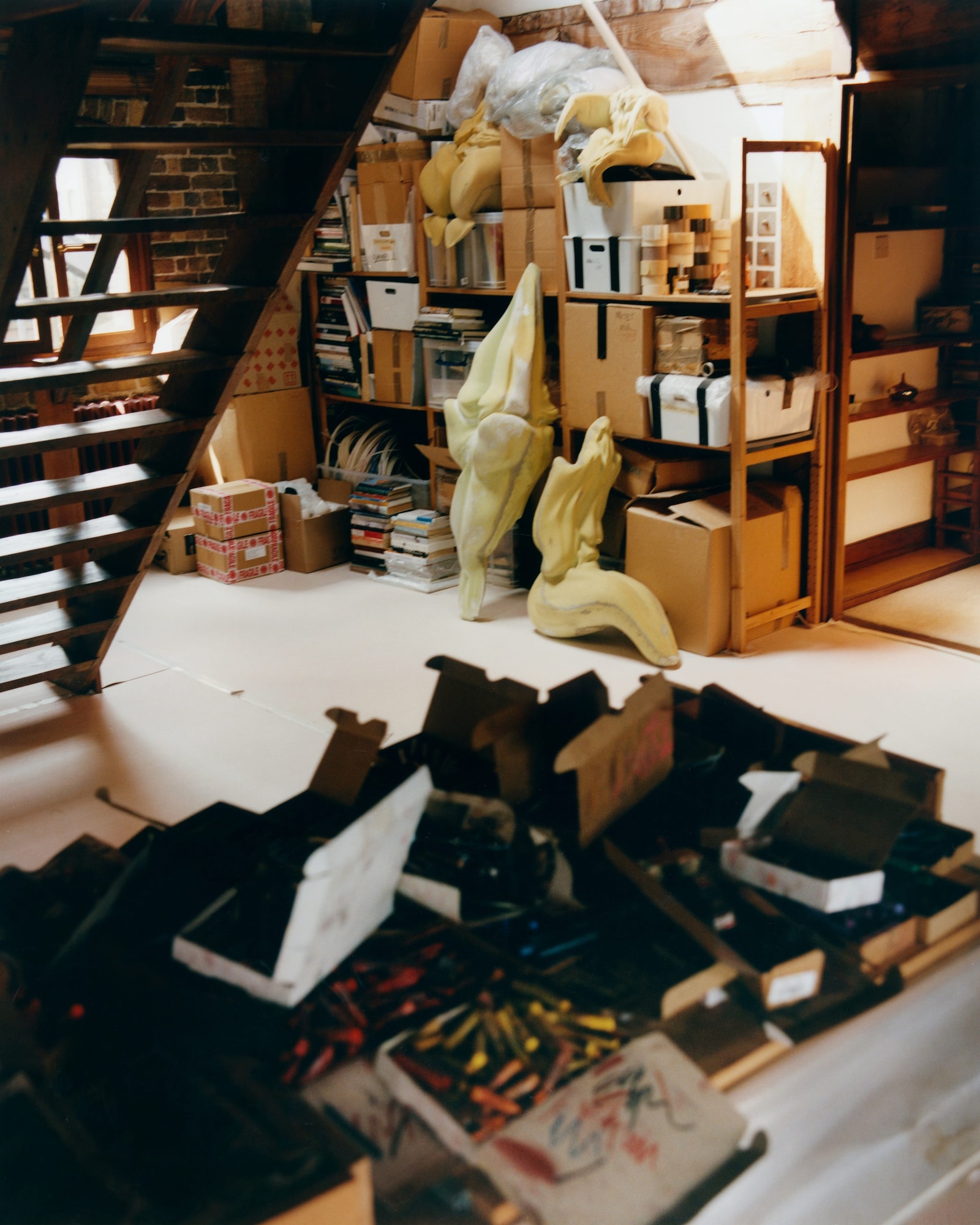
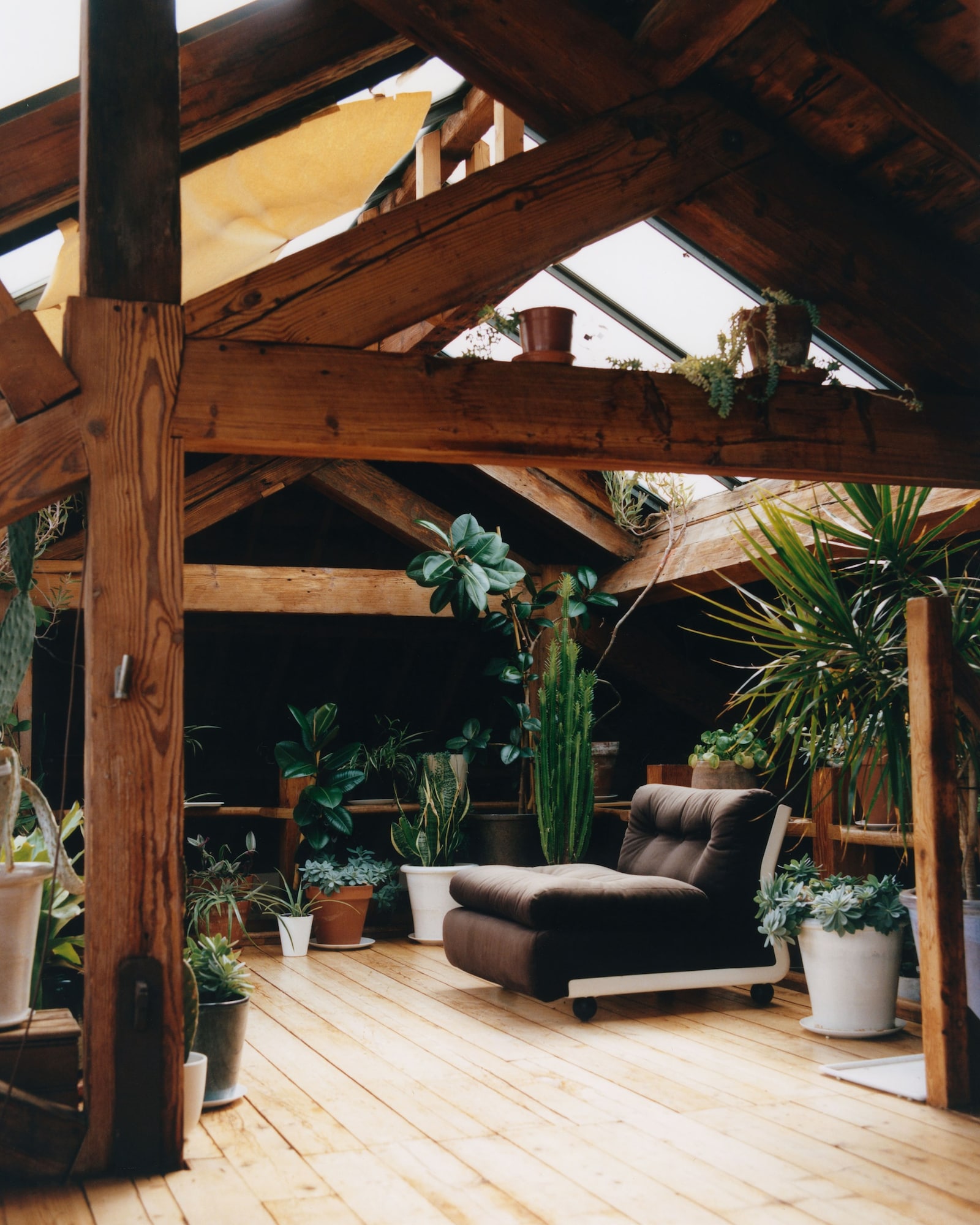
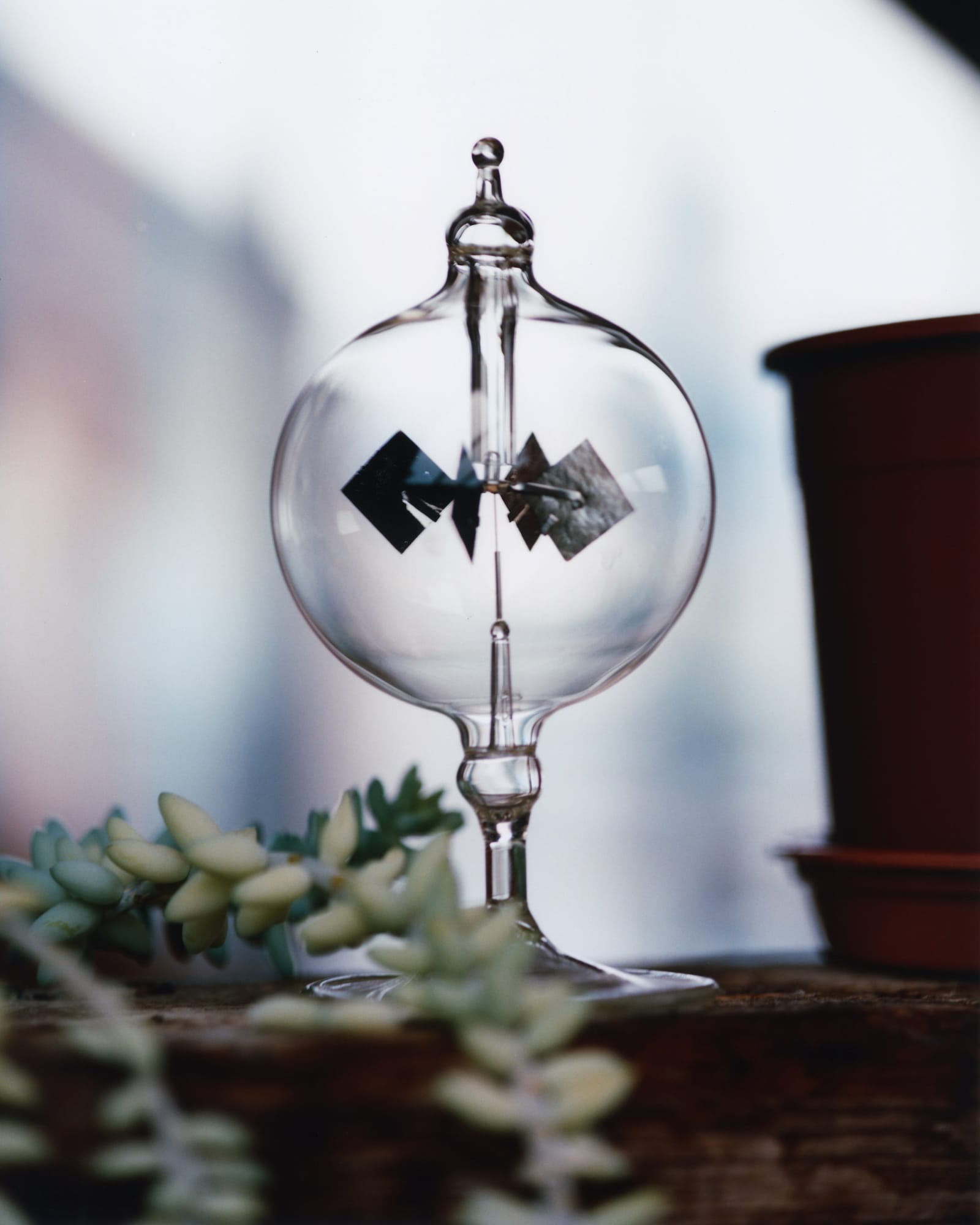
We continue down the corridor, past a set of stairs made from wood and steel which curl round in a Fibonacci spiral, past a bookshelf with hundreds of books – A New Earth by Eckhart Tolle; Utopia for Realists by Rutger Bregman; Plato’s Ghost by Jeremy Gray; Prophetic Culture, Federico Campagna. Humeau’s workspace is open. Its walls are brick and bare. The ceiling opens up into the eaves of the roof, rafters and timber beams exposed. A legion of vivacious houseplants commandeer a wooden mezzanine. Hundreds of coloured oil pastels sit on top of a metal chest of drawers. Shelves and storage units line the room’s perimeter, filled with sketchbooks, notebooks, boxes of dried plant matter, equipment, papers and files. Sinuous and alien foam model sculptures are propped up here and there. It’s an organised chaos, not messy nor particularly tidy but a manifestation of the inner workings of her frenetic mind. Glass doors open out onto a Thames-side balcony with a view of what feels like the whole of London. “I feel very lucky to be able to watch the river flow every day,” she says. “A part of me believes that if you want to be free in your mind you should watch a river flowing, it makes your brain flow better in a way. The river is always moving.”
Humeau is among four artists shortlisted for the 2026 Turner Prize, nominated for her ambitious landscape of installations, Torches. It’s a project about imagining what came before, what comes after and what could exist in parallel to the present. And, like much of her work, it speculates about possible futures. Across five chapters, she looks at life, death, transcendence, spirituality, origin. Sculptures of Venus, elephants, female forms look at prehistory from a matriarchal point of view. “History and prehistory are so often told through the lens of male archaeologists and anthropologists,” she says. “Lots of stories and bodies of knowledge have never had a written form. They’ve been transmitted between generations through word of mouth, among them stories told from women to women and I’m sure a lot of them will have gone extinct.”
In the corner of her studio is a grand piano. Do you play? I ask. “I work a lot with sound but I’m a terrible musician.” Humeau worked with musician Bendik Giske to create compositions to accompany Torches. “I wanted a soundscape that sounded a little like an orchestra trying to tune, but because it’s a new life form they’re still finding their way to coexist.” She recorded and amplified microorganisms, the rhythms they emit as they evolve together. “It sounds almost drum-like. It makes me think of a group of early humans playing drums, communicating via movement, sound and music.”
Her materials can be equally peculiar, often natural or organic: beeswax, yeast, maize, microorganisms – “I want my works to feel like they’re alive, and at the same time like they could disappear” – and, more interested in states of transition than the static, her works decay and age. She once painted the walls of Tate Britain with the venom of the Black Mamba snake – “It was yellow and amazing. You were drawn to it but it’s deadly, though not in that dose,” she tells me.
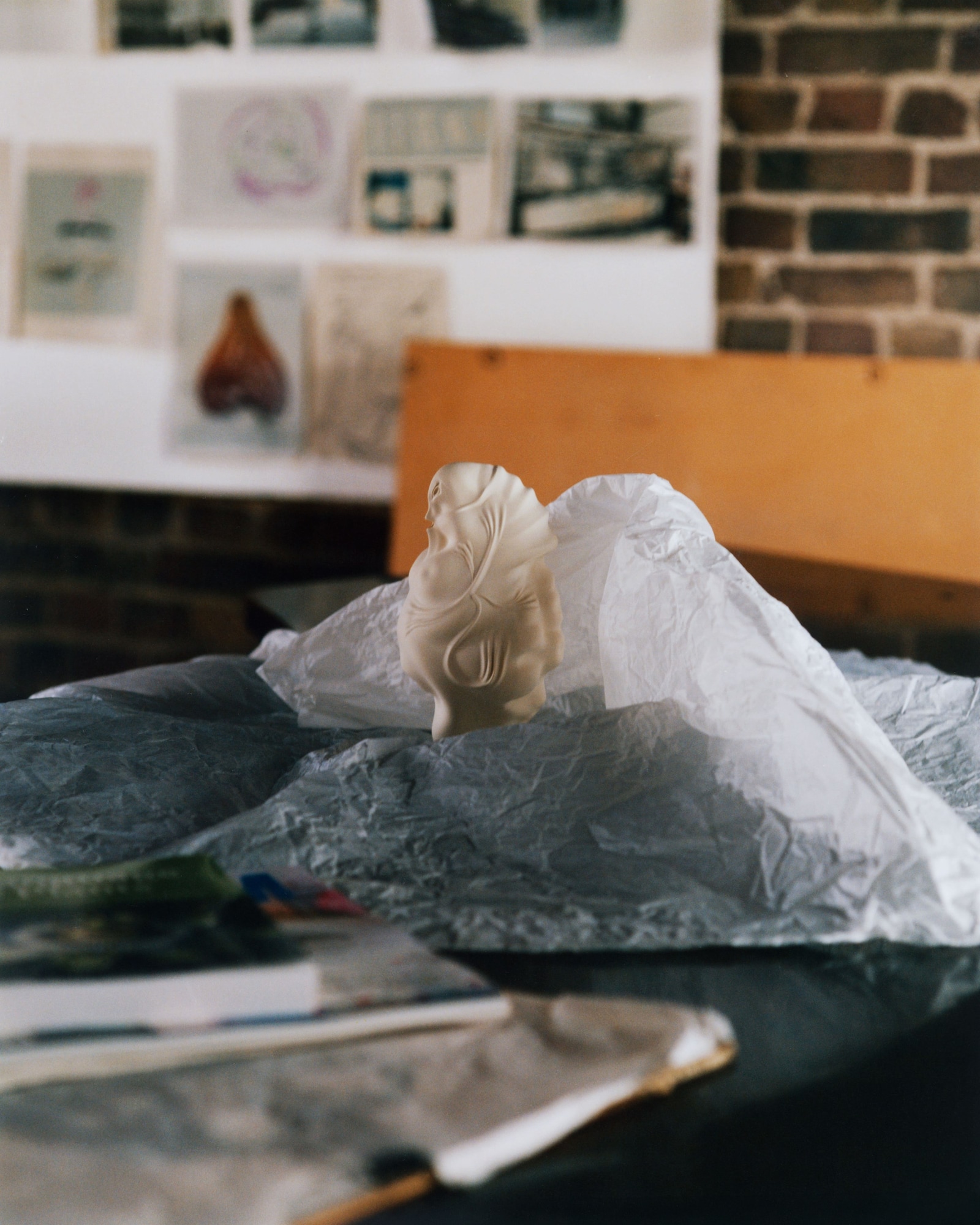
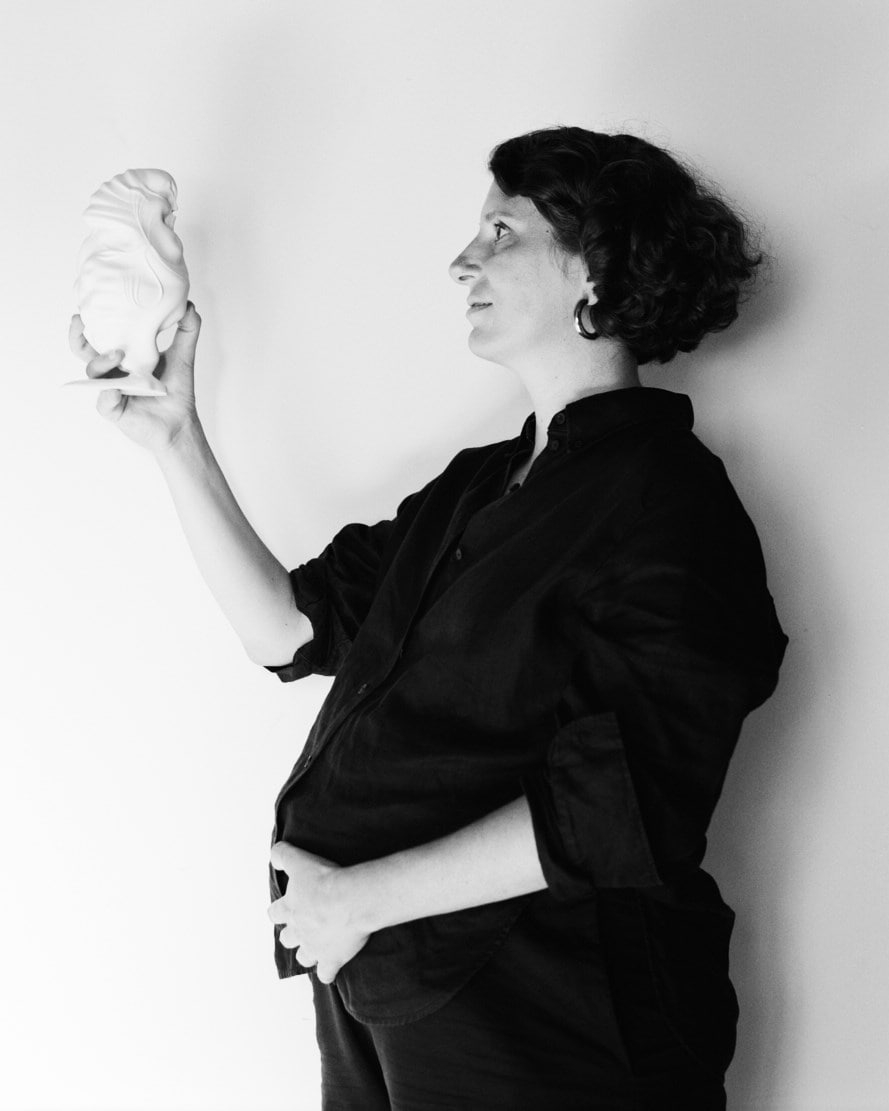
We continue around the room. “These are some 3D-printed flowers I made for the Venice Biennale in 2022,” they don’t look like flowers in a traditional sense, there’s something quite feminine about them, like reproductive organs. “This is the same idea but it’s a teapot,” she says, taking off its unglazed porcelain lid, “for brewing my elixirs.” Humeau often collaborates with local foragers to create a unique elixir that feels symbolic of a project to consume before experiencing it. “My installation in the San Luis Valley in Colorado [Orisons] was on unusable land previously farmed for potatoes,” she says, showing me jars and bottles of ingredients – berries, flowers, liquids, potions, all, she assures me, are safe for consumption. “I was thinking about extraction, and our relationship with land, particularly how we consume the products of the land without ever seeing the land they come from. The elixir is about consuming the essence of the land you’re looking at.”
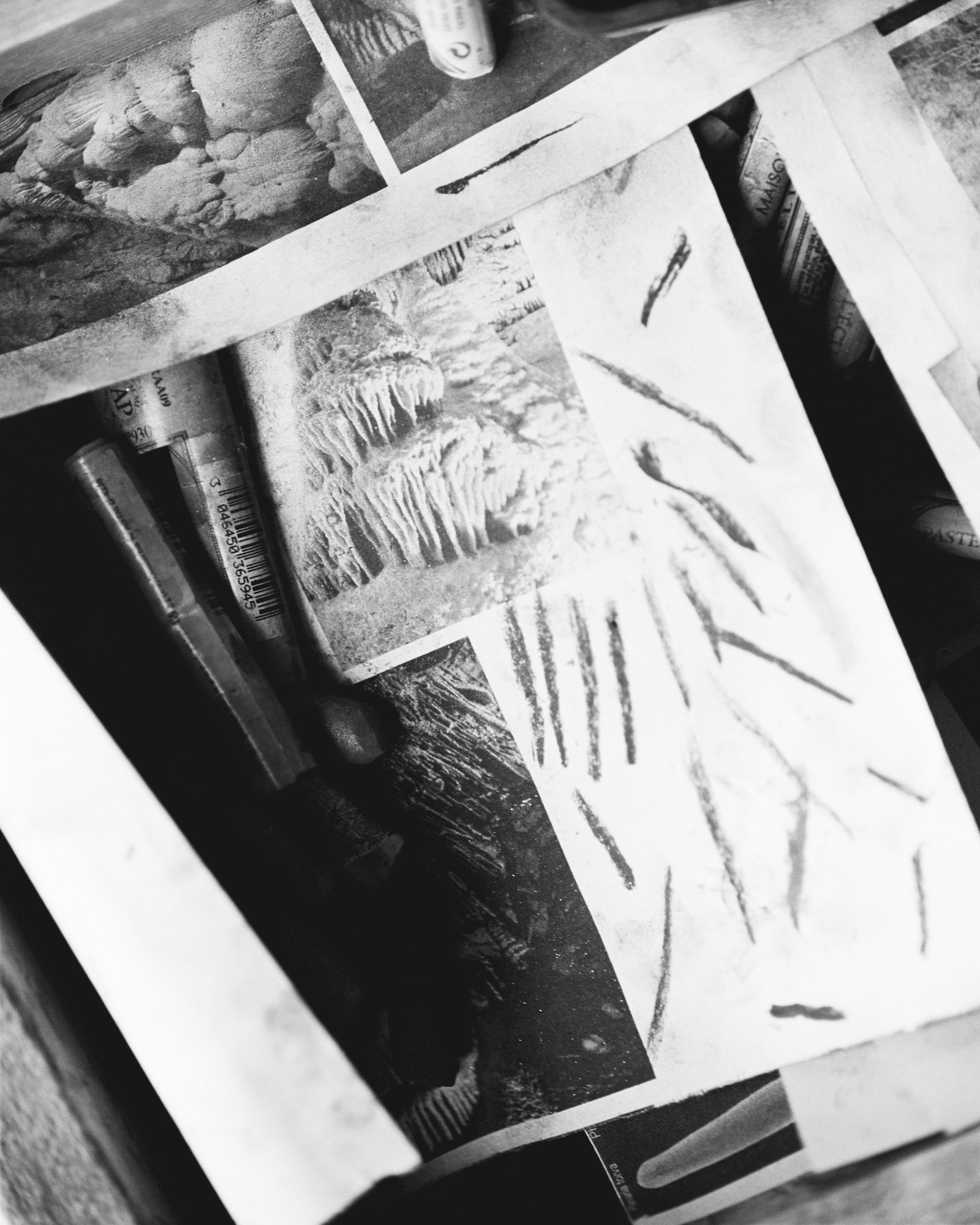
Pinned to a board so large it covers most of one wall are photographs of spruce forests and CAD sketches of curious tree-like shapes – research for The Garden of Resuscitation, which opened in August at Kistefos, a sculpture park in a forest in Norway. “It was a place of extraction that I wanted to transform into a place of reverence,” she says of the site, which was once a paper mill. “In a way, these sites of extraction are the ruins of our times, like Stone Henge.” She shows me a cartoonised sketch of the forest’s anatomy from above. It looks like a cell with a central nucleus – her sculpture, trees like endoplasmic organelle orbiting it in circular rings in the lumen, walkways like golgi, benches like floating mitochondria. The sculpture itself is made up of models in three-dimensional-printed steel of the parasitic and symbiotic species affiliated with a spruce tree, engineered in metal but grown through software intended to mimic biological development. And the elixir is made from ingredients planted in the forest by Humeau and her foragers, intensifying the forest’s ecosystem. “The work is the whole forest.”
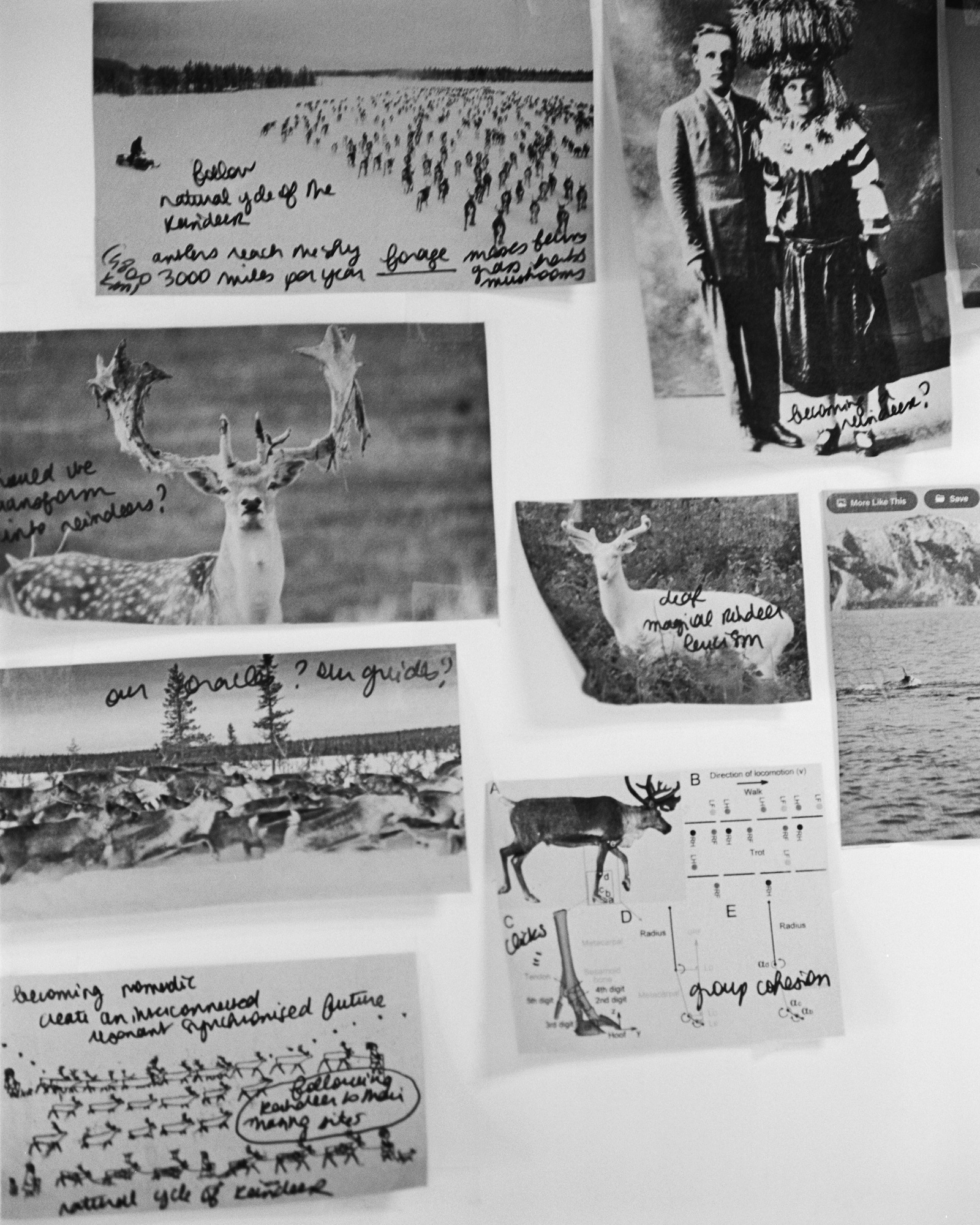
Up in the righthand corner of the board is another island of thought: images of reindeers, bells, foxglove flowers, poetry and scribbles on the Doctrine of Signatures. This is research for a sculpture she’s working on commissioned by the city of Helsinki. “I’m interested in origin,” she says, “and through building new communities, new liveable spaces, schools and organisations within that, like the emergence of new human communities and local cultures.” The sculpture – a large cast aluminium sculpture featuring hundreds of bells – will be permanently erected in the Keski-Palisa district in Helsinki after premiering at the Biennial next June.
Before she starts a new project, Humeau will spend time digesting the last, allowing time to gather. “I want to push the boundaries with each project, I never want to feel like I’m on a conveyor belt and I want each project to feel new, looking at a new topic and working with a new material in a new context. […] I’m not interested in making objects for people to look at. I’m interested in creating unstable changing situations or environments or ecosystems or worlds that you step in and feel you’re a part of.”
To deal in the organic but to live, work and seek inspiration somewhere so urban feels almost counterintuitive. Why London? “London is exceptional. I think you can feel quite at home here coming from anywhere,” she says. Humeau thinks of humankind as a mega-organism – each one of us, a different cell that is part of a large body. “When you look on a digital map, and zoom out, each city looks like a fungal colony, a cluster of mould, a coagulate of cells almost replicating, growing and thriving with life. For me, a city is organic.”
in HTML format, including tags, to make it appealing and easy to read for Japanese-speaking readers aged 20 to 40 interested in fashion. Organize the content with appropriate headings and subheadings (h1, h2, h3, h4, h5, h6), translating all text, including headings, into Japanese. Retain any existing
tags from
Lead ImageAnOther World: Marguerite HumeauPhotography by Will Bruce
On an inconspicuous backstreet in Bermondsey is a retired industrial granary. It’s unremarkable enough from the outside – weathered greying brickwork, arching steel-framed crittal windows, monolithic in scale. It looks just like a 19th-century dockland warehouse along the Thames should. Today it serves a new function, transformed into residential apartments, studios and workspaces by an architect who acquired it in the Seventies. Here, up several flights of stairs, is artist and sculptor Marguerite Humeau’s home and studio, her world.
Humeau is wearing her slippers when I arrive. I offer to take my shoes off – “mais, ce n’est pas nécessaire,” she says with a thick French accent, waving me through. Humeau, who grew up in the countryside in the Loire Valley, moved to London to study a now-discontinued MA course in Design Interactions at the Royal Academy of Art. “It was very speculative,” she tells me, a methodology that remains fundamental in how she approaches her work today.
Heavily pregnant, Humeau leads me down a long corridor with low ceilings and exposed timber beams, lined by shelves of bones and stones, rocks, fossils, fragments of shells, driftwood and debris, seeds. “These seedpods are so perfectly designed to spread life, they have ultimate functionality.” Is that a spine? Yes. She found it in a geopark. She’s not sure what kind of animal it belonged to. Humeau gathered these pieces of time, markers of life and history while travelling over the years. It’s something she likes to do with her partner (he’s a quantum physicist – a totally logical match for an artist whose work imagines alternatives and quantum superpositions). Gathering, Humeau tells me, is a huge part of her creative process. Gathering research, gathering collaborators, gathering histories, prehistories, references, talking to experts – among them clairvoyants, foragers, geomancers, anthropologists, historians – over several years until an idea evolves into a vast web of a project. “I want to create worlds and for that I need lots of different perspectives,” she says. “I want it to be a sum of all of its parts.”
We continue down the corridor, past a set of stairs made from wood and steel which curl round in a Fibonacci spiral, past a bookshelf with hundreds of books – A New Earth by Eckhart Tolle; Utopia for Realists by Rutger Bregman; Plato’s Ghost by Jeremy Gray; Prophetic Culture, Federico Campagna. Humeau’s workspace is open. Its walls are brick and bare. The ceiling opens up into the eaves of the roof, rafters and timber beams exposed. A legion of vivacious houseplants commandeer a wooden mezzanine. Hundreds of coloured oil pastels sit on top of a metal chest of drawers. Shelves and storage units line the room’s perimeter, filled with sketchbooks, notebooks, boxes of dried plant matter, equipment, papers and files. Sinuous and alien foam model sculptures are propped up here and there. It’s an organised chaos, not messy nor particularly tidy but a manifestation of the inner workings of her frenetic mind. Glass doors open out onto a Thames-side balcony with a view of what feels like the whole of London. “I feel very lucky to be able to watch the river flow every day,” she says. “A part of me believes that if you want to be free in your mind you should watch a river flowing, it makes your brain flow better in a way. The river is always moving.”
Humeau is among four artists shortlisted for the 2026 Turner Prize, nominated for her ambitious landscape of installations, Torches. It’s a project about imagining what came before, what comes after and what could exist in parallel to the present. And, like much of her work, it speculates about possible futures. Across five chapters, she looks at life, death, transcendence, spirituality, origin. Sculptures of Venus, elephants, female forms look at prehistory from a matriarchal point of view. “History and prehistory are so often told through the lens of male archaeologists and anthropologists,” she says. “Lots of stories and bodies of knowledge have never had a written form. They’ve been transmitted between generations through word of mouth, among them stories told from women to women and I’m sure a lot of them will have gone extinct.”
In the corner of her studio is a grand piano. Do you play? I ask. “I work a lot with sound but I’m a terrible musician.” Humeau worked with musician Bendik Giske to create compositions to accompany Torches. “I wanted a soundscape that sounded a little like an orchestra trying to tune, but because it’s a new life form they’re still finding their way to coexist.” She recorded and amplified microorganisms, the rhythms they emit as they evolve together. “It sounds almost drum-like. It makes me think of a group of early humans playing drums, communicating via movement, sound and music.”
Her materials can be equally peculiar, often natural or organic: beeswax, yeast, maize, microorganisms – “I want my works to feel like they’re alive, and at the same time like they could disappear” – and, more interested in states of transition than the static, her works decay and age. She once painted the walls of Tate Britain with the venom of the Black Mamba snake – “It was yellow and amazing. You were drawn to it but it’s deadly, though not in that dose,” she tells me.
We continue around the room. “These are some 3D-printed flowers I made for the Venice Biennale in 2022,” they don’t look like flowers in a traditional sense, there’s something quite feminine about them, like reproductive organs. “This is the same idea but it’s a teapot,” she says, taking off its unglazed porcelain lid, “for brewing my elixirs.” Humeau often collaborates with local foragers to create a unique elixir that feels symbolic of a project to consume before experiencing it. “My installation in the San Luis Valley in Colorado [Orisons] was on unusable land previously farmed for potatoes,” she says, showing me jars and bottles of ingredients – berries, flowers, liquids, potions, all, she assures me, are safe for consumption. “I was thinking about extraction, and our relationship with land, particularly how we consume the products of the land without ever seeing the land they come from. The elixir is about consuming the essence of the land you’re looking at.”
Pinned to a board so large it covers most of one wall are photographs of spruce forests and CAD sketches of curious tree-like shapes – research for The Garden of Resuscitation, which opened in August at Kistefos, a sculpture park in a forest in Norway. “It was a place of extraction that I wanted to transform into a place of reverence,” she says of the site, which was once a paper mill. “In a way, these sites of extraction are the ruins of our times, like Stone Henge.” She shows me a cartoonised sketch of the forest’s anatomy from above. It looks like a cell with a central nucleus – her sculpture, trees like endoplasmic organelle orbiting it in circular rings in the lumen, walkways like golgi, benches like floating mitochondria. The sculpture itself is made up of models in three-dimensional-printed steel of the parasitic and symbiotic species affiliated with a spruce tree, engineered in metal but grown through software intended to mimic biological development. And the elixir is made from ingredients planted in the forest by Humeau and her foragers, intensifying the forest’s ecosystem. “The work is the whole forest.”
Up in the righthand corner of the board is another island of thought: images of reindeers, bells, foxglove flowers, poetry and scribbles on the Doctrine of Signatures. This is research for a sculpture she’s working on commissioned by the city of Helsinki. “I’m interested in origin,” she says, “and through building new communities, new liveable spaces, schools and organisations within that, like the emergence of new human communities and local cultures.” The sculpture – a large cast aluminium sculpture featuring hundreds of bells – will be permanently erected in the Keski-Palisa district in Helsinki after premiering at the Biennial next June.
Before she starts a new project, Humeau will spend time digesting the last, allowing time to gather. “I want to push the boundaries with each project, I never want to feel like I’m on a conveyor belt and I want each project to feel new, looking at a new topic and working with a new material in a new context. […] I’m not interested in making objects for people to look at. I’m interested in creating unstable changing situations or environments or ecosystems or worlds that you step in and feel you’re a part of.”
To deal in the organic but to live, work and seek inspiration somewhere so urban feels almost counterintuitive. Why London? “London is exceptional. I think you can feel quite at home here coming from anywhere,” she says. Humeau thinks of humankind as a mega-organism – each one of us, a different cell that is part of a large body. “When you look on a digital map, and zoom out, each city looks like a fungal colony, a cluster of mould, a coagulate of cells almost replicating, growing and thriving with life. For me, a city is organic.”
and integrate them seamlessly into the new content without adding new tags. Ensure the new content is fashion-related, written entirely in Japanese, and approximately 1500 words. Conclude with a “結論” section and a well-formatted “よくある質問” section. Avoid including an introduction or a note explaining the process.