Rewrite
Marilyn Minter
Gallery / 22 images
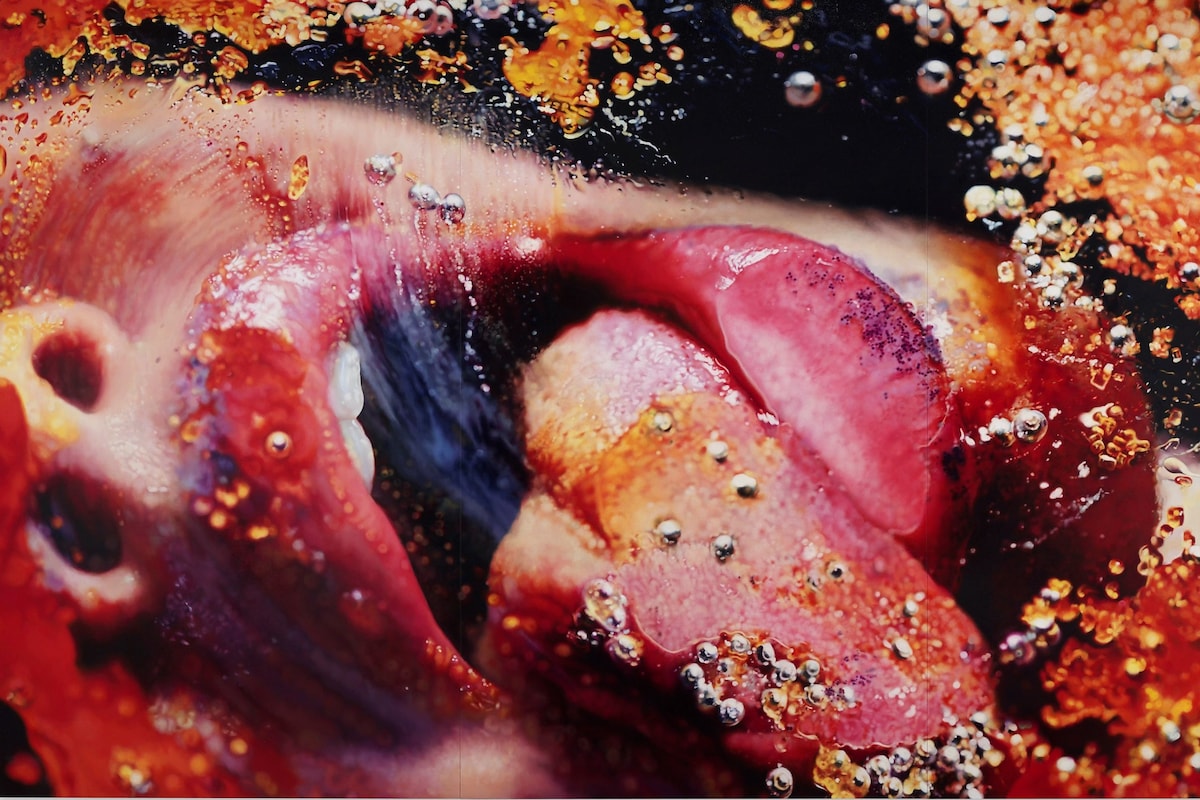
There’s a particular kind of artist who has been through the fire so many times they’ve stopped flinching. Marilyn Minter, whose lush, unapologetically carnal paintings, photographs, and videos have spent decades offending and seducing the art world in equal measure, is one of them.
In the late 1980s and into the 90s, works like Porn Grid (a series of enamel-on-metal paintings based on X-rated images lifted from pornographic magazines) earned her the condemnation of critics who accused her of complicity in the very imagery she was trying to subvert. Minter has since spoken openly about how deeply that period damaged her standing in the art world, and how she kept working anyway.
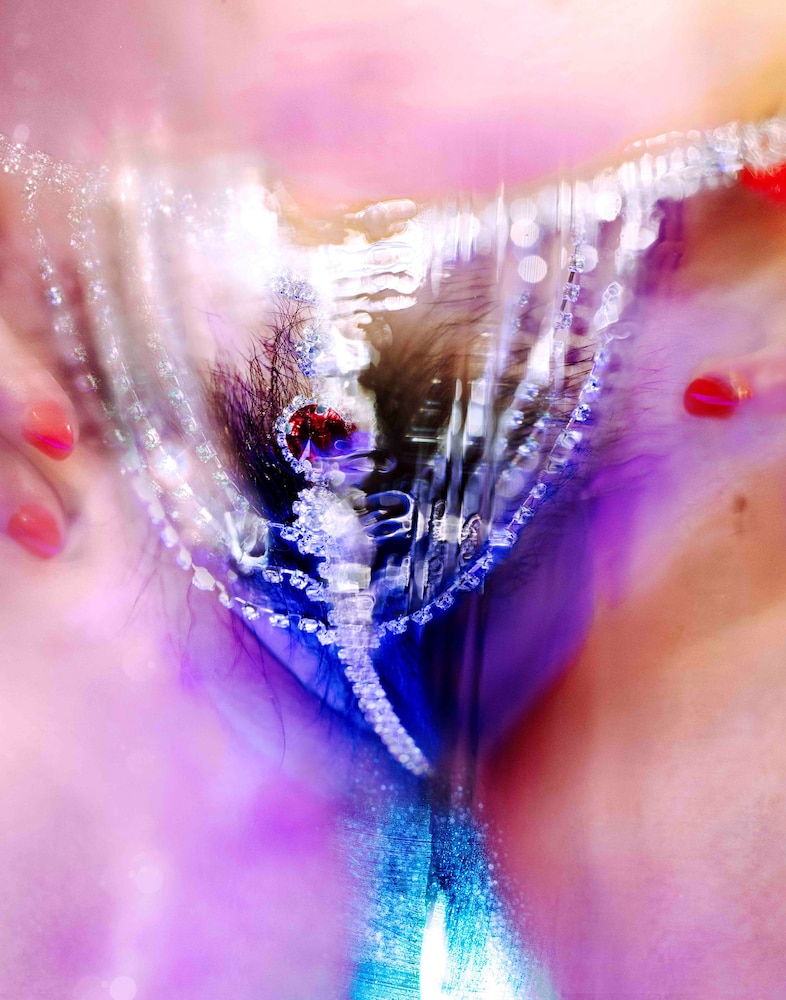
Later came Plush (2014), a series of archival inkjet prints in which Minter isolates female pubic areas in extreme close-up, turning them into lush fields of texture. Commissioned by Playboy and ultimately rejected, the images were too feral, too insistently frank for a magazine that had spent decades selling a highly controlled male fantasy of the female form (Richard Prince’s press published it in a limited edition of 500 in 2014. It sold out in a week).
Her Elder Sex series (2022) extended Minter’s long-standing interest in work that falls outside approved fantasies. Originally commissioned by New York Times Magazine and later expanded into a full body of work exhibited at LGDR gallery in 2023, it depicts couples over the age of 70, stripped to lingerie or briefs, hugging, kissing, caressing, one woman in pearls and red nail polish, wielding a sex toy, shot through textured or frozen glass.
The wrinkles are there. The flesh is there. The desire is unmistakably there. As always, the point is not novelty but visibility: Minter turns her gaze toward intimacy, pleasure, and glamour where polite society would prefer not to look. And her work, now held in the collections of MoMA, the Guggenheim, and the Whitney, among many others, has not softened over more than 50 years.
Below, we speak with the acclaimed artist, taking a look at her life and work through her own words.

When we speak by phone, Minter is in New York, her husband heading out to yoga, two rescue dogs somewhere underfoot. She is warm, funny, and absolutely unsparing. We’re talking because this summer she will be honoured at Anderson Ranch Arts Center, one of America’s most singular arts institutions. And, in an era of vanishing public arts funding, something of a miracle.
Founded in 1966 by ceramic artist Paul Soldner on a former sheep ranch just outside Aspen in Snowmass Village, Colorado, the idea remains simple: that artists thrive and grow when left alone together, away from the market, away from the city, away from the noise.
Minter first encountered the Ranch in 2014, when she introduced Catherine Opie as a featured artist and spent the day looking at Opie’s ceramics, a quieter, less celebrated corner of her practice and exactly the kind of work the Ranch makes space for. For Minter, who spent decades having her work policed, a place like this is more than a retreat: it is a space outside the market, the gatekeepers and the machinery of the art world. “There’s nothing like it anywhere I’ve ever been,” she says. “It’s a unique little universe of ideas and creativity and freedom.”
And in an era of vanishing public arts funding, it is a universe that depends more than ever on people showing up to protect it. “We’ve got this horrible fascist losing his mind, who is not going to support any art he doesn’t understand or agree with,” she says. The Trump administration’s fiscal 2026 budget proposal called for eliminating the National Endowment for the Arts and the National Endowment for the Humanities, even as Congress has pushed to preserve some level of federal support. In other words, the threat is real, even if the outcome is not fully settled.
But Minter, the 28th recipient of the Ranch’s International Artist Award, has seen this before. She recalls the culture-war attacks of the late 1980s and 1990s, when figures such as conservative senator Jesse Helms targeted federally supported art they deemed obscene, revoking NEA grants, pushing to have Robert Mapplethorpe’s The Perfect Moment retrospective shut down, and condemning Andres Serrano’s Piss Christ on the Senate floor. “He dried up the National Endowment for the Arts,” she says flatly. “It repeats.”
What has kept her intact throughout it all is work. Fine art, she adds, has always been about breaking rules, and it can only be suppressed so far. “I’ll never get along with people who want art to be about landscapes,” she says. “It’s always going to be like that.”
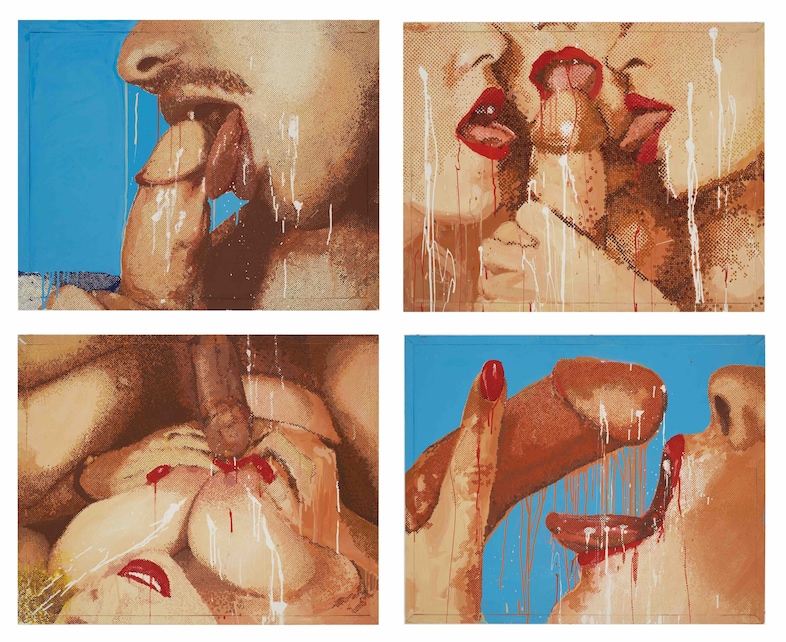
What does it mean to survive as an artist across decades of cultural whiplash, embraced, then vilified, then claimed as foundational? Minter knows that particular climate intimately. When Porn Grid debuted in 1989, she was condemned by the anti-porn feminist movement, which was then dominated by writer Andrea Dworkin and legal scholar Catharine MacKinnon, who argued that all sexually explicit imagery was inherently harmful to women regardless of who made it or why, and considered Minter nothing more than a patriarchal collaborator. She was dropped by galleries and shut out of institutions as a result. In 1994, curator Marcia Tucker organised Bad Girls at the New Museum, a landmark show of transgressive feminist work, and decided Minter’s work was too explicit even for that.
“I don’t think you have any choice. You just make your work from loving it, or you get broken.” She pauses. “I know artists who have been broken by culture. I won’t name names. But they were the poster child for rebellion, and it destroyed them.”
At 77, Minter is still making new work, still provoking, still showing up. If the art world once treated her as too much, the culture now treats her as indispensable. That long arc of vilification and canonisation is also the subject of Pretty Dirty: The Life and Times of Marilyn Minter, the documentary that traces her rise, exile, and return to prominence over five decades.
Minter returns, again and again, to a conviction that feels almost theological in its certainty: “All art comes from pain. I’ve never seen an exception. People come from a challenging lot, and they make art. Those are the ones that become good artists.”
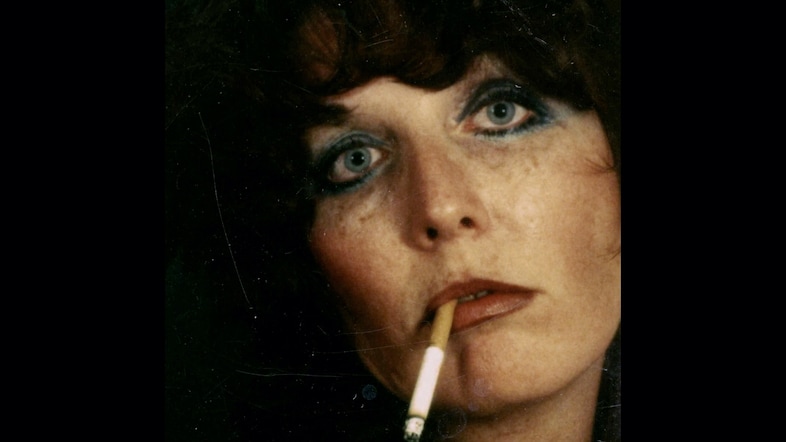
Her own career makes the point: in 1969, as an undergraduate at the University of Florida in Gainesville, she brought proof sheets of her photographs to a critique she wasn’t enrolled in, led by a visiting Diane Arbus. The raw, unsettling black-and-white studies of her ageing mother – a Southern belle smoking and dyeing her eyebrows in bed, braless in her nightgown, liver spots on her arms, something ghostly in her eyes, staging herself against domestic decay – were the only work Arbus liked that day.
Minter left the negatives unprinted for twenty-five years, but those photographs, which she titled Coral Ridge Towers after the Florida apartment complex where her mother lived, can now be read as the psychic and visual source code for much of what followed.
And if her career offers a lesson, it is not a soft one: Institutions are fickle. Critical language changes. Moral certainty ages badly. But artists who build a real visual language will always outlast those who try to discipline it.
Anderson Ranch Arts Center’s 2026 summer program includes 150 workshops open to all levels. Ranch Week runs July 13–18. Minter’s public conversation with Lisa Phillips, director of the New Museum, takes place on July 14, and the Ranch Gala honouring her is July 15. Public events are free. Register here.
Pretty Dirty: The Life and Times of Marilyn Minter, the documentary tracing her five decades of art practice, featuring Jane Fonda, Monica Lewinsky, and Lizzo, screens concurrently.
in HTML format, including tags, to make it appealing and easy to read for Japanese-speaking readers aged 20 to 40 interested in fashion. Organize the content with appropriate headings and subheadings (h1, h2, h3, h4, h5, h6), translating all text, including headings, into Japanese. Retain any existing
tags from
Marilyn Minter
Gallery / 22 images
There’s a particular kind of artist who has been through the fire so many times they’ve stopped flinching. Marilyn Minter, whose lush, unapologetically carnal paintings, photographs, and videos have spent decades offending and seducing the art world in equal measure, is one of them.
In the late 1980s and into the 90s, works like Porn Grid (a series of enamel-on-metal paintings based on X-rated images lifted from pornographic magazines) earned her the condemnation of critics who accused her of complicity in the very imagery she was trying to subvert. Minter has since spoken openly about how deeply that period damaged her standing in the art world, and how she kept working anyway.
Later came Plush (2014), a series of archival inkjet prints in which Minter isolates female pubic areas in extreme close-up, turning them into lush fields of texture. Commissioned by Playboy and ultimately rejected, the images were too feral, too insistently frank for a magazine that had spent decades selling a highly controlled male fantasy of the female form (Richard Prince’s press published it in a limited edition of 500 in 2014. It sold out in a week).
Her Elder Sex series (2022) extended Minter’s long-standing interest in work that falls outside approved fantasies. Originally commissioned by New York Times Magazine and later expanded into a full body of work exhibited at LGDR gallery in 2023, it depicts couples over the age of 70, stripped to lingerie or briefs, hugging, kissing, caressing, one woman in pearls and red nail polish, wielding a sex toy, shot through textured or frozen glass.
The wrinkles are there. The flesh is there. The desire is unmistakably there. As always, the point is not novelty but visibility: Minter turns her gaze toward intimacy, pleasure, and glamour where polite society would prefer not to look. And her work, now held in the collections of MoMA, the Guggenheim, and the Whitney, among many others, has not softened over more than 50 years.
Below, we speak with the acclaimed artist, taking a look at her life and work through her own words.
When we speak by phone, Minter is in New York, her husband heading out to yoga, two rescue dogs somewhere underfoot. She is warm, funny, and absolutely unsparing. We’re talking because this summer she will be honoured at Anderson Ranch Arts Center, one of America’s most singular arts institutions. And, in an era of vanishing public arts funding, something of a miracle.
Founded in 1966 by ceramic artist Paul Soldner on a former sheep ranch just outside Aspen in Snowmass Village, Colorado, the idea remains simple: that artists thrive and grow when left alone together, away from the market, away from the city, away from the noise.
Minter first encountered the Ranch in 2014, when she introduced Catherine Opie as a featured artist and spent the day looking at Opie’s ceramics, a quieter, less celebrated corner of her practice and exactly the kind of work the Ranch makes space for. For Minter, who spent decades having her work policed, a place like this is more than a retreat: it is a space outside the market, the gatekeepers and the machinery of the art world. “There’s nothing like it anywhere I’ve ever been,” she says. “It’s a unique little universe of ideas and creativity and freedom.”
And in an era of vanishing public arts funding, it is a universe that depends more than ever on people showing up to protect it. “We’ve got this horrible fascist losing his mind, who is not going to support any art he doesn’t understand or agree with,” she says. The Trump administration’s fiscal 2026 budget proposal called for eliminating the National Endowment for the Arts and the National Endowment for the Humanities, even as Congress has pushed to preserve some level of federal support. In other words, the threat is real, even if the outcome is not fully settled.
But Minter, the 28th recipient of the Ranch’s International Artist Award, has seen this before. She recalls the culture-war attacks of the late 1980s and 1990s, when figures such as conservative senator Jesse Helms targeted federally supported art they deemed obscene, revoking NEA grants, pushing to have Robert Mapplethorpe’s The Perfect Moment retrospective shut down, and condemning Andres Serrano’s Piss Christ on the Senate floor. “He dried up the National Endowment for the Arts,” she says flatly. “It repeats.”
What has kept her intact throughout it all is work. Fine art, she adds, has always been about breaking rules, and it can only be suppressed so far. “I’ll never get along with people who want art to be about landscapes,” she says. “It’s always going to be like that.”
What does it mean to survive as an artist across decades of cultural whiplash, embraced, then vilified, then claimed as foundational? Minter knows that particular climate intimately. When Porn Grid debuted in 1989, she was condemned by the anti-porn feminist movement, which was then dominated by writer Andrea Dworkin and legal scholar Catharine MacKinnon, who argued that all sexually explicit imagery was inherently harmful to women regardless of who made it or why, and considered Minter nothing more than a patriarchal collaborator. She was dropped by galleries and shut out of institutions as a result. In 1994, curator Marcia Tucker organised Bad Girls at the New Museum, a landmark show of transgressive feminist work, and decided Minter’s work was too explicit even for that.
“I don’t think you have any choice. You just make your work from loving it, or you get broken.” She pauses. “I know artists who have been broken by culture. I won’t name names. But they were the poster child for rebellion, and it destroyed them.”
At 77, Minter is still making new work, still provoking, still showing up. If the art world once treated her as too much, the culture now treats her as indispensable. That long arc of vilification and canonisation is also the subject of Pretty Dirty: The Life and Times of Marilyn Minter, the documentary that traces her rise, exile, and return to prominence over five decades.
Minter returns, again and again, to a conviction that feels almost theological in its certainty: “All art comes from pain. I’ve never seen an exception. People come from a challenging lot, and they make art. Those are the ones that become good artists.”
Her own career makes the point: in 1969, as an undergraduate at the University of Florida in Gainesville, she brought proof sheets of her photographs to a critique she wasn’t enrolled in, led by a visiting Diane Arbus. The raw, unsettling black-and-white studies of her ageing mother – a Southern belle smoking and dyeing her eyebrows in bed, braless in her nightgown, liver spots on her arms, something ghostly in her eyes, staging herself against domestic decay – were the only work Arbus liked that day.
Minter left the negatives unprinted for twenty-five years, but those photographs, which she titled Coral Ridge Towers after the Florida apartment complex where her mother lived, can now be read as the psychic and visual source code for much of what followed.
And if her career offers a lesson, it is not a soft one: Institutions are fickle. Critical language changes. Moral certainty ages badly. But artists who build a real visual language will always outlast those who try to discipline it.
Anderson Ranch Arts Center’s 2026 summer program includes 150 workshops open to all levels. Ranch Week runs July 13–18. Minter’s public conversation with Lisa Phillips, director of the New Museum, takes place on July 14, and the Ranch Gala honouring her is July 15. Public events are free. Register here.
Pretty Dirty: The Life and Times of Marilyn Minter, the documentary tracing her five decades of art practice, featuring Jane Fonda, Monica Lewinsky, and Lizzo, screens concurrently.
and integrate them seamlessly into the new content without adding new tags. Ensure the new content is fashion-related, written entirely in Japanese, and approximately 1500 words. Conclude with a “結論” section and a well-formatted “よくある質問” section. Avoid including an introduction or a note explaining the process.