
Rewrite
Rapper Jeshi has traded politically-charged storytelling for Essex house euphoria. He talks clubland, massive boobs, and why dance music doesn’t need to be so serious.

Last time I saw Jeshi, he cycled past me in Victoria Park as I was breaking up with someone I’ll call “my Scottish ting.” “Ooh, it’s Jeshi,” I said, pointing out the rapper. That didn’t go down too well. This time round, I’m chatting to the East Londoner under better circumstances — I’ve joined him on set as he shoots the video for “champagne”, the first single off his yet-to-be-titled project. Project? Would that be the right word? “Oh man,” says Jeshi, choosing his words carefully. He lands on calling it a “new chapter in what [he’s] been doing.” It might be called clubland. The rapper hasn’t decided for sure, though he has gone to the trouble of sorting merch of sorts, pulling up a picture of a t-shirt emblazoned with the word in rhinestones.
You don’t need to see the 00s splendour of the t-shirt to get that Jeshi’s latest venture is somewhat of an unexpected one. Though there are hints of the rapper’s electronic inclination on his sophomore album, 2025’s Airbag Woke Me Up, it’s worlds away from his politically-charged, story-driven debut, Universal Credit. He’s “put the parameters on” compared to his older stuff – which Jeshi dubs “wide-spanning” and “[sounding] like everything” – and created a sonic ode to all corners of electronic “from the perspective of someone who’s actually in it.” While a track like “girls and boys” favours sparser production, sounding a little Hot Chip-esque, over on “at the wheel”, which Jeshi produced with Big Ever, it’s a classic house sample at the core. Elsewhere, on “linea rossa”, it’s a darker spin on garage — that particular track reminds me of the Conducta remix of CASISDEAD’s “Steptronic”.
“There couldn’t have been a song [on my first album] talking about being on the table like a slag and feeling sexy like a slag,” laughs Jeshi. Inspiration-wise, it’s an odd yet deeply resonant little smörgåsbord: namely, it’s Essex house and the listeners of Essex house. “You know those pictures where it’s, like, lads about to go on a night out, then it’s just got some text across it,” he explains, holding up his arm to evoke that pose. Boil it down even further, and it could be said that Jeshi’s made music that functions as a kind of spiritual ode to the memes of @lordoldgen. Personally, I’m sold. I’m one listen of “champagne” away from calling someone a sket and donning some Alexander McQueen’s.
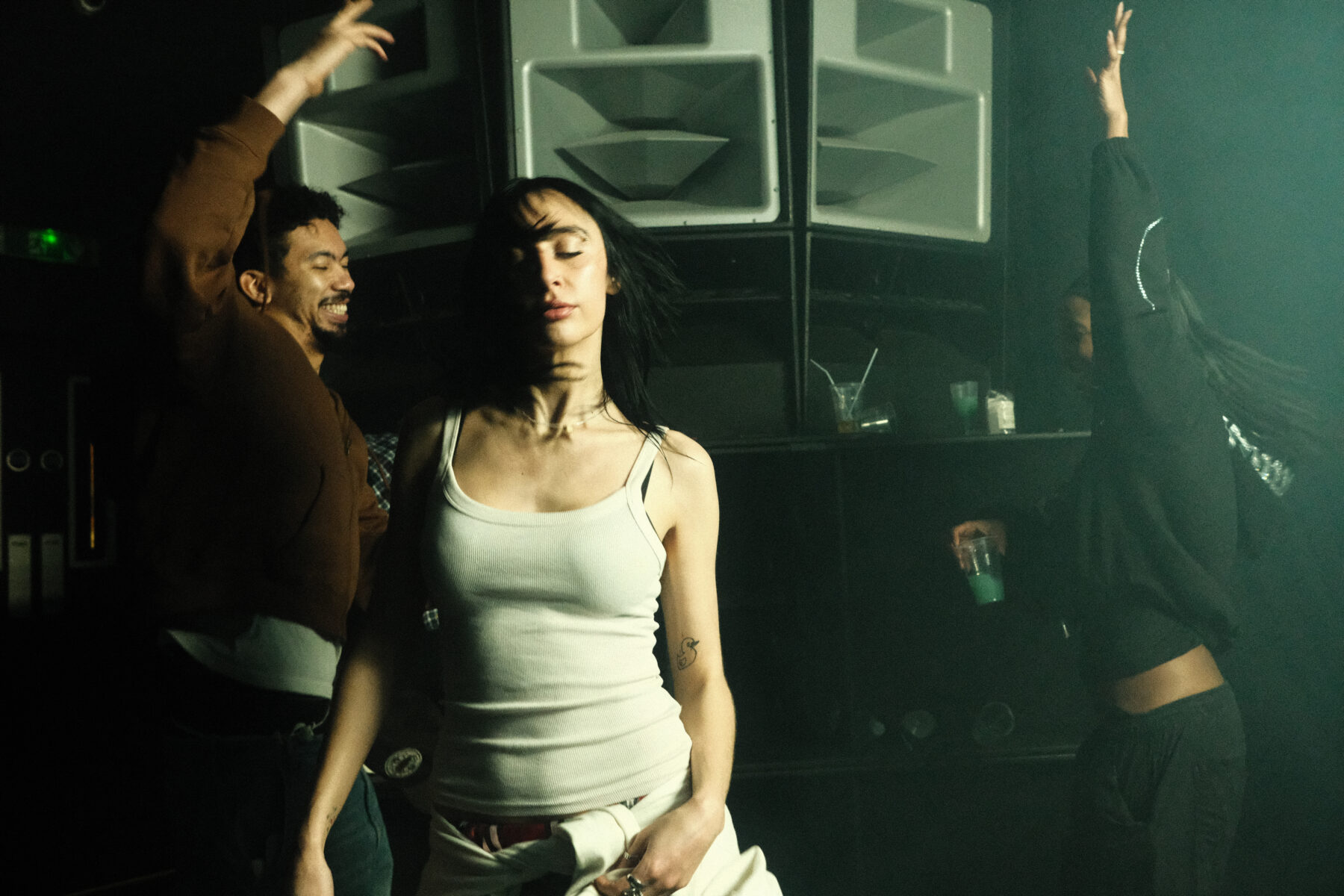
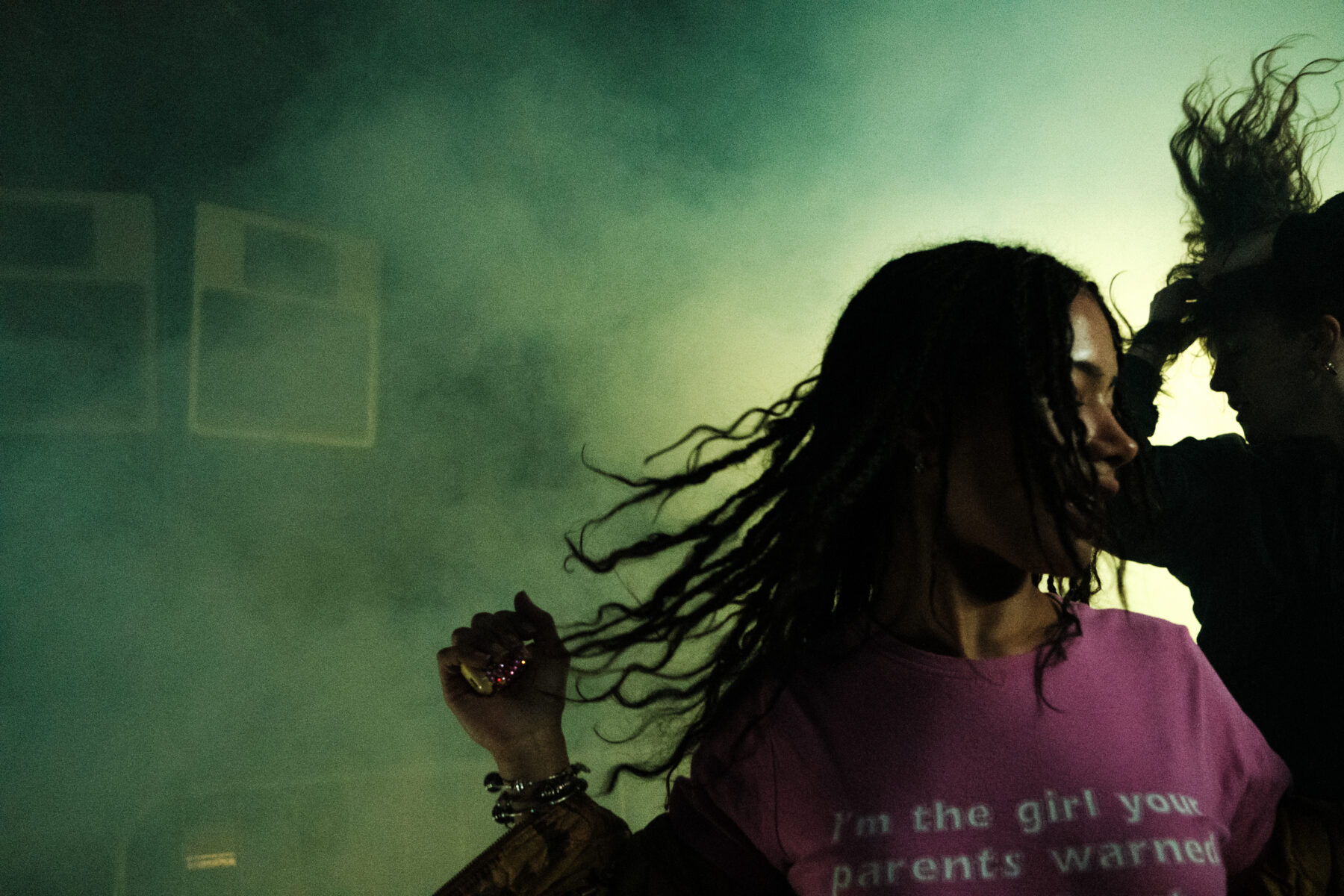
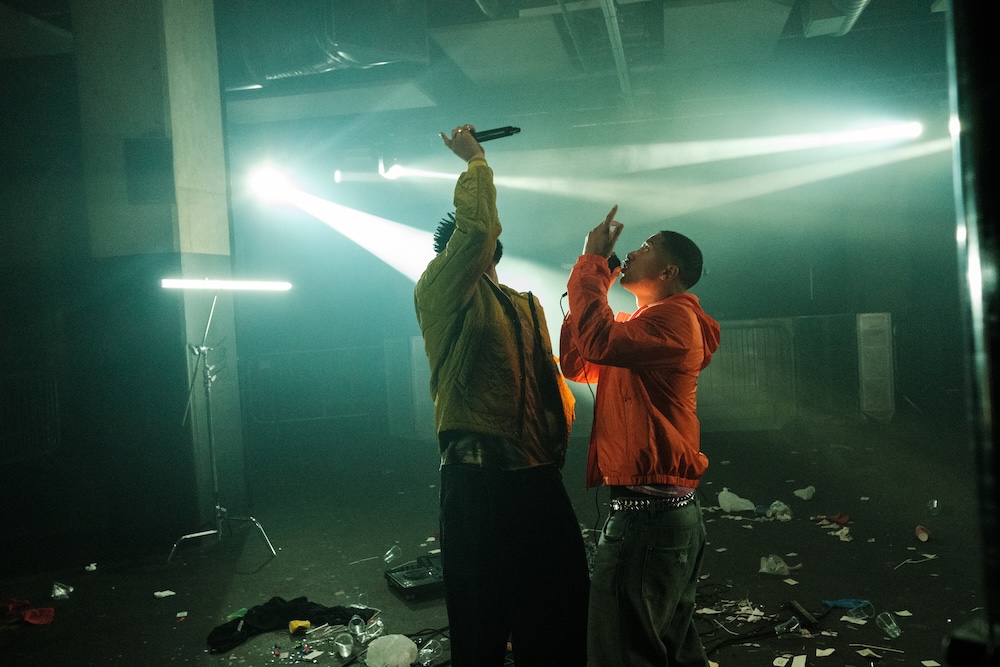
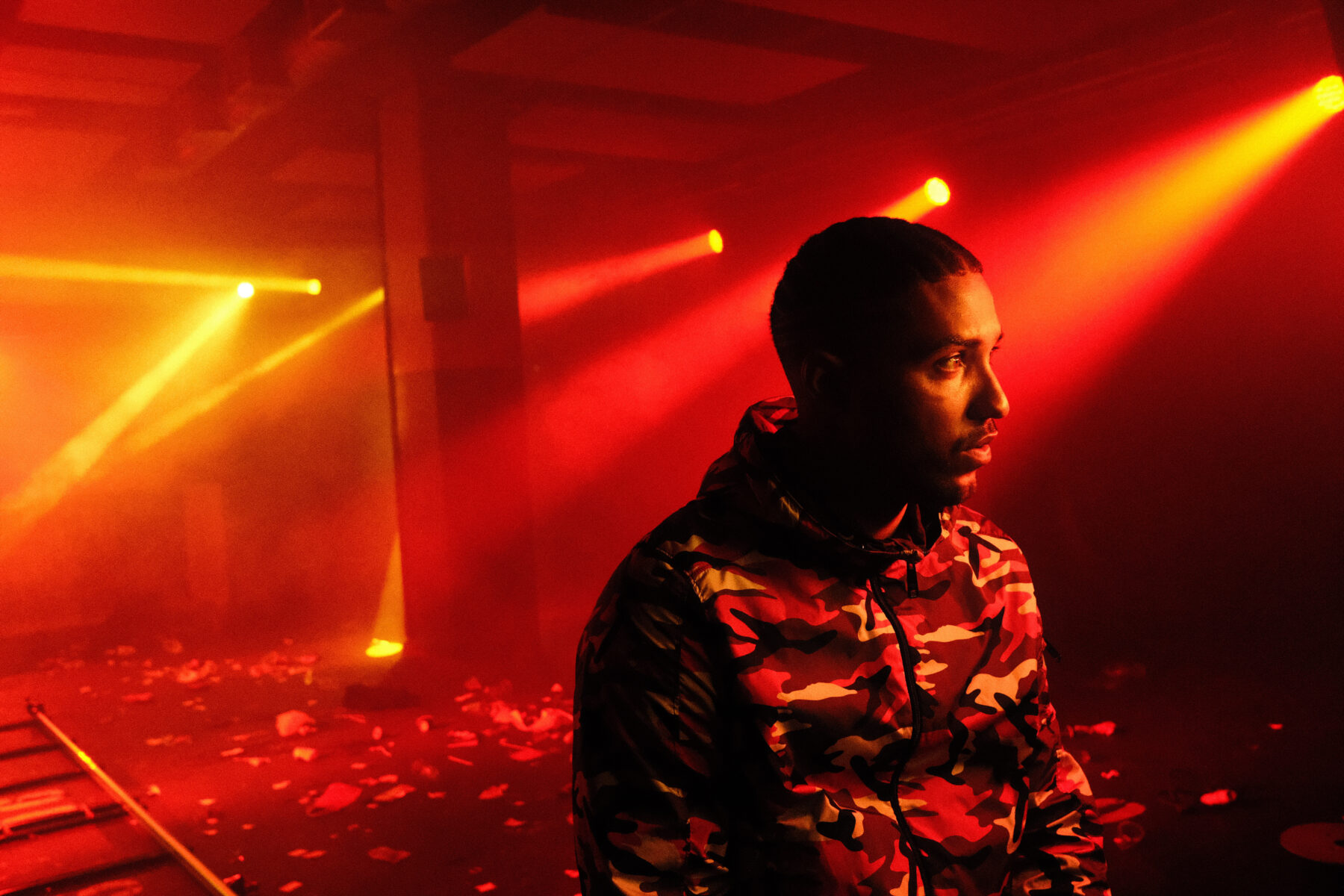
By the way, the set in question is a club in Tottenham. It’s 10am so there aren’t any real punters here, but Jeshi has enlisted a slew of his mates for what’ll be, in essence, a midday rave — marginally less gurning, etc. “Originally I wanted the video for ‘champagne’ to be me being suffocated by loads of huge boobs,” the rapper behind “Protein” explains, using his hands to mimic a pair of massive knockers. Fortunately or unfortunately (it depends on how much you like tits), that vision has since been honed by director Pedro Takahashi. “I guess this is a new era for [Jeshi],” says Pedro. “He’s going more electronic, and that world is club-based, so we’re leaning into that aesthetic.” They’re shooting three, as Jeshi puts it, “vignettes” today. “One is the rave, one is a comedown, and the third is the start of a night out,” the director explains. “It’s all based on that sort of feeling — a London night out that everyone’s been to.”
Below, in honour of the release of “champagne” out now via Select Discs, I speak to Jeshi about creating “ridiculous” electronic music, Kent turf wars, and slags.
Tell me a little bit about the new project.
So, the project. Oh man. I’m not actually gonna describe it as a project. Essentially, it’s just a new chapter in what I’ve been doing. I haven’t put out music in quite a while and I’ve always been fascinated by electronic music. It’s always been something I’ve listened to a lot and I’ve DJed for fun. I think the issue I’ve always had is I could never play the music I was making with the music I was DJing. It felt like an obvious thing to bridge those two worlds together. I hate when some rappers make electronic music because it seems disingenuous. You can tell they don’t actually like that music, and it feels like a cash grab — it feels dirty. I wanted it to be very authentic. Whenever you get rappers and dance music and it’s a crossover, it’s always like the rapper is the accessory to the dance music. I wanted to do it in a way where it’s me first, driven by my vision of what I want it to be. I think that creates something new. That was the inspiration behind what I’m doing now. I don’t really know what it’s gonna turn into. We’ll learn in real time together.
Is clubland the title?
clubland is just this overarching thing I had when I was making the music. Sometimes with dance music it feels so snooty. It’s chin-stroking and serious. But when I started going to clubs, they were really shitty clubs. I remember going to Oceana in Watford when I was really young. I think there’s beauty in places like that ’cause that’s where people start going out. You know, real dance music isn’t like real clubbing. Like, Four Tet’s not there. But I wanted to make it from the perspective of someone who’s actually in it. I like dance music. I like all music, but I don’t think it needs to be so serious
So it’s been an easy segue to dance music? I think you can hear hints of that on Airbag Woke Me Up?
It was really easy. I mean, I’ve done stuff with Ross from Friends before. Stuff with Vegyn. It’s just music I like. When I’ve been making stuff before, it’s been really wide-spanning. It sounded like everything. It was quite fun to just put the parameters on and explore that space exclusively.
Is it a different process writing the lyrics when it’s dance music?
I think it’s just allowed for a lot more silliness in a certain way. Like, on my first album, there couldn’t have been a song talking about being on the table like a slag and feeling sexy like a slag. The intention behind it is still very much the same and there are tracks where the lyrics are more serious, but the lyrics are just as important. For things to be really good lyrically, they don’t always have to be so serious and story-driven. As long as you’re saying something, which we are, it feels good.

What’s the setting you envisage this project getting played in?
I think, you know, dance music’s just moving in a bit of a different place. You make really good rap music, but the space for it in festivals is so limited these days. Like, I love James Blake. I remember being at a festival and seeing James Blake at 3am, but I didn’t want to. I just wanted to have fun and dance. I feel like I was at a point where I wanted to make stuff which would allow me to be on stage at 3am. The shows will feel really different. It’s gonna be less of a show – like, play this song, play this song – and more like a DJ set. Which means I can have more fun.
Why lead with “champagne” as the first single?
I just think it’s just so over the top and obnoxious and ridiculous. That it’s a good way to knock on someone’s door. From when we first made it, I just loved it and it felt really exciting. Intuition, I guess. It just felt good. I wish I had a more complex answer. Like, I was going into data and trying to figure out what’s gonna work the best. It might be a terrible decision, you know?
Tell me about the videos you’re shooting today. Would you call them visualisers?
I wouldn’t say so, ’cause I hate that word. I think it cheapens it. I would say they’re vignettes? Yeah, I’ll call them vignettes. Or I’ll call them short music videos. It’s the same production value as a music video. The problem is I’ve spent so much on music videos but you post a one minute clip on Instagram and people only ever watch that one minute clip. Why not just make the one minute clip the best bit? I’ll make music videos again, but for now it makes sense. Maybe I’ll start a GoFundMe. I should do a GoFundMe to get more champagne as part of the rollout.
I know you’re fairly involved in the visuals. Did you always know it was going to be this rave setting?
It’s a collaborative thing. Me and Pedro had lots of conversations. I had ideas about what I wanted to feel like. You want it to feel in that world, but still something new. It’s trying to find that balance. Originally I wanted the video for “champagne” to be me being suffocated by loads of huge boobs, but we’re not doing that.

How would that work?
I wanted to do it in the back of a limo and have loads of girls with fake boobs, but then they progressively get bigger and bigger and bigger, and I’m in one of those rooms where the walls get smaller.
Is that a thing?
You know, the thing is, like, people in a room and all the walls come in.
As in that happens in films?
I don’t know. It’s just a thing.
Is it? You can go and visit one of those rooms?
Maybe.
And what about the other two tracks that you’re shooting the vignettes for. “at the wheel” and “girls and boys”.
Is vignettes right?
I did film studies — vignettes is right.
Look at me. I recorded “at the wheel” and “girls and boys” at home. All three are produced by Big Ever. The first few songs on the project I did at home with tracks he sent me. Me and Fred made “champagne” just before going out, while getting drunk, which was fun. “at the wheel” is a little bit more serious, but it’s still within the dance remit. Then “girls and boys” is quite ridiculous again.
The sample on “girls and boys” is interesting. It’s quite classic house.
I don’t know what the sample’s saying. I’ve tried to decipher it. It was on the track when he sent it. We went through this whole thing of getting someone else to do the sample, but sometimes you get so attached to the way something sounds.
Have you ever listened to an Essex house playlist?
That’s the inspo for the whole album. You know those pictures where it’s, like, lads about to go on a night out, then it’s just got some text across it. Normally something very misogynistic. That’s not what we’re doing but there’s something funny about it.
I love Essex house.
I love Essex. The first club I ever went to was in Essex.
I’m from Tunbridge Wells — you should check out the Tunbridge Wells club scene.
Really?
No.
I know someone from Tunbridge Wells. Someone told me that Tunbridge Wells has beef with Tonbridge?
Yeah, people call Tonbridge “scumbridge.” You’ve talked about the monetary challenges of putting out music, the infrastructure issues. There was a gap between your first two albums — this one’s come around faster. What changed?
I talk too much. I don’t even remember saying all the shit. I read it and I’m like, I don’t even think that. I mean, music doesn’t need to be expensive to make, but if you’re working with a label and they’re down to spend money, of course you’re gonna spend the money. Why not spend the money? I’m a little bit more restrained now, which is good. And sometimes the things that don’t feel so glossy connect with people more. When there’s loads of money behind it that can be off-putting. It makes things seem disingenuous, even if it’s not. But no, it wasn’t an intentional thing. It’s just like, the music was there and things lined up in a good way.
You’ve deleted all your Instagram posts. New era of Jeshi?
I wanted to make a separation between what I was doing before. As I said before, I hate when people do dance and it feels like it doesn’t have conviction. When it feels like they’re trying to grab money or put themselves in a new space. But I see this being the world I’m operating in now. You don’t wanna hold on to old things because like, who cares?
So, it’s a big pivot to dance?
Not necessarily dance, but I look at electronic in a wider space. Right now the stuff is more dancey, but I also look at the music I love — you know, Massive Attack and music that’s adjacent to the dance stuff. I look at it all in like one world. I feel like where it’ll go is a sweet spot between those things. You know, if you look at Sbtrkt and Mount Kimbie.
Maybe you go full trip-hop. Get Vegyn back on?
Maybe I just go full Essex house. That might be the next move. We’ll see.
That would be a really big rebrand.
Yeah, I’d change my look. Wear polos.
Skinny jeans. Alexander McQueens. It’s a shame because I think if you went to Essex now they’d actually be wearing baggy jeans. It’s not the same.
They’ve lost themselves. I can’t wait for my Essex hate piece to come out.
Words: Amber Rawlings
BTS Photography: Zand Maroof
Director: Pedro Takahashi
Producer: Abby Rothwell
Production Company: Friend London
Executive Producer: Gina Crighton
Label: Partisan Records
DOP: Max Conran
Stylist: Ellie Rimmer
Editor: Pedro Takahashi
Colourist: Connor Coolbear
in HTML format, including tags, to make it appealing and easy to read for Japanese-speaking readers aged 20 to 40 interested in fashion. Organize the content with appropriate headings and subheadings (h1, h2, h3, h4, h5, h6), translating all text, including headings, into Japanese. Retain any existing
tags from
Rapper Jeshi has traded politically-charged storytelling for Essex house euphoria. He talks clubland, massive boobs, and why dance music doesn’t need to be so serious.
Last time I saw Jeshi, he cycled past me in Victoria Park as I was breaking up with someone I’ll call “my Scottish ting.” “Ooh, it’s Jeshi,” I said, pointing out the rapper. That didn’t go down too well. This time round, I’m chatting to the East Londoner under better circumstances — I’ve joined him on set as he shoots the video for “champagne”, the first single off his yet-to-be-titled project. Project? Would that be the right word? “Oh man,” says Jeshi, choosing his words carefully. He lands on calling it a “new chapter in what [he’s] been doing.” It might be called clubland. The rapper hasn’t decided for sure, though he has gone to the trouble of sorting merch of sorts, pulling up a picture of a t-shirt emblazoned with the word in rhinestones.
You don’t need to see the 00s splendour of the t-shirt to get that Jeshi’s latest venture is somewhat of an unexpected one. Though there are hints of the rapper’s electronic inclination on his sophomore album, 2025’s Airbag Woke Me Up, it’s worlds away from his politically-charged, story-driven debut, Universal Credit. He’s “put the parameters on” compared to his older stuff – which Jeshi dubs “wide-spanning” and “[sounding] like everything” – and created a sonic ode to all corners of electronic “from the perspective of someone who’s actually in it.” While a track like “girls and boys” favours sparser production, sounding a little Hot Chip-esque, over on “at the wheel”, which Jeshi produced with Big Ever, it’s a classic house sample at the core. Elsewhere, on “linea rossa”, it’s a darker spin on garage — that particular track reminds me of the Conducta remix of CASISDEAD’s “Steptronic”.
“There couldn’t have been a song [on my first album] talking about being on the table like a slag and feeling sexy like a slag,” laughs Jeshi. Inspiration-wise, it’s an odd yet deeply resonant little smörgåsbord: namely, it’s Essex house and the listeners of Essex house. “You know those pictures where it’s, like, lads about to go on a night out, then it’s just got some text across it,” he explains, holding up his arm to evoke that pose. Boil it down even further, and it could be said that Jeshi’s made music that functions as a kind of spiritual ode to the memes of @lordoldgen. Personally, I’m sold. I’m one listen of “champagne” away from calling someone a sket and donning some Alexander McQueen’s.
By the way, the set in question is a club in Tottenham. It’s 10am so there aren’t any real punters here, but Jeshi has enlisted a slew of his mates for what’ll be, in essence, a midday rave — marginally less gurning, etc. “Originally I wanted the video for ‘champagne’ to be me being suffocated by loads of huge boobs,” the rapper behind “Protein” explains, using his hands to mimic a pair of massive knockers. Fortunately or unfortunately (it depends on how much you like tits), that vision has since been honed by director Pedro Takahashi. “I guess this is a new era for [Jeshi],” says Pedro. “He’s going more electronic, and that world is club-based, so we’re leaning into that aesthetic.” They’re shooting three, as Jeshi puts it, “vignettes” today. “One is the rave, one is a comedown, and the third is the start of a night out,” the director explains. “It’s all based on that sort of feeling — a London night out that everyone’s been to.”
Below, in honour of the release of “champagne” out now via Select Discs, I speak to Jeshi about creating “ridiculous” electronic music, Kent turf wars, and slags.
Tell me a little bit about the new project.
So, the project. Oh man. I’m not actually gonna describe it as a project. Essentially, it’s just a new chapter in what I’ve been doing. I haven’t put out music in quite a while and I’ve always been fascinated by electronic music. It’s always been something I’ve listened to a lot and I’ve DJed for fun. I think the issue I’ve always had is I could never play the music I was making with the music I was DJing. It felt like an obvious thing to bridge those two worlds together. I hate when some rappers make electronic music because it seems disingenuous. You can tell they don’t actually like that music, and it feels like a cash grab — it feels dirty. I wanted it to be very authentic. Whenever you get rappers and dance music and it’s a crossover, it’s always like the rapper is the accessory to the dance music. I wanted to do it in a way where it’s me first, driven by my vision of what I want it to be. I think that creates something new. That was the inspiration behind what I’m doing now. I don’t really know what it’s gonna turn into. We’ll learn in real time together.
Is clubland the title?
clubland is just this overarching thing I had when I was making the music. Sometimes with dance music it feels so snooty. It’s chin-stroking and serious. But when I started going to clubs, they were really shitty clubs. I remember going to Oceana in Watford when I was really young. I think there’s beauty in places like that ’cause that’s where people start going out. You know, real dance music isn’t like real clubbing. Like, Four Tet’s not there. But I wanted to make it from the perspective of someone who’s actually in it. I like dance music. I like all music, but I don’t think it needs to be so serious
So it’s been an easy segue to dance music? I think you can hear hints of that on Airbag Woke Me Up?
It was really easy. I mean, I’ve done stuff with Ross from Friends before. Stuff with Vegyn. It’s just music I like. When I’ve been making stuff before, it’s been really wide-spanning. It sounded like everything. It was quite fun to just put the parameters on and explore that space exclusively.
Is it a different process writing the lyrics when it’s dance music?
I think it’s just allowed for a lot more silliness in a certain way. Like, on my first album, there couldn’t have been a song talking about being on the table like a slag and feeling sexy like a slag. The intention behind it is still very much the same and there are tracks where the lyrics are more serious, but the lyrics are just as important. For things to be really good lyrically, they don’t always have to be so serious and story-driven. As long as you’re saying something, which we are, it feels good.
What’s the setting you envisage this project getting played in?
I think, you know, dance music’s just moving in a bit of a different place. You make really good rap music, but the space for it in festivals is so limited these days. Like, I love James Blake. I remember being at a festival and seeing James Blake at 3am, but I didn’t want to. I just wanted to have fun and dance. I feel like I was at a point where I wanted to make stuff which would allow me to be on stage at 3am. The shows will feel really different. It’s gonna be less of a show – like, play this song, play this song – and more like a DJ set. Which means I can have more fun.
Why lead with “champagne” as the first single?
I just think it’s just so over the top and obnoxious and ridiculous. That it’s a good way to knock on someone’s door. From when we first made it, I just loved it and it felt really exciting. Intuition, I guess. It just felt good. I wish I had a more complex answer. Like, I was going into data and trying to figure out what’s gonna work the best. It might be a terrible decision, you know?
Tell me about the videos you’re shooting today. Would you call them visualisers?
I wouldn’t say so, ’cause I hate that word. I think it cheapens it. I would say they’re vignettes? Yeah, I’ll call them vignettes. Or I’ll call them short music videos. It’s the same production value as a music video. The problem is I’ve spent so much on music videos but you post a one minute clip on Instagram and people only ever watch that one minute clip. Why not just make the one minute clip the best bit? I’ll make music videos again, but for now it makes sense. Maybe I’ll start a GoFundMe. I should do a GoFundMe to get more champagne as part of the rollout.
I know you’re fairly involved in the visuals. Did you always know it was going to be this rave setting?
It’s a collaborative thing. Me and Pedro had lots of conversations. I had ideas about what I wanted to feel like. You want it to feel in that world, but still something new. It’s trying to find that balance. Originally I wanted the video for “champagne” to be me being suffocated by loads of huge boobs, but we’re not doing that.
How would that work?
I wanted to do it in the back of a limo and have loads of girls with fake boobs, but then they progressively get bigger and bigger and bigger, and I’m in one of those rooms where the walls get smaller.
Is that a thing?
You know, the thing is, like, people in a room and all the walls come in.
As in that happens in films?
I don’t know. It’s just a thing.
Is it? You can go and visit one of those rooms?
Maybe.
And what about the other two tracks that you’re shooting the vignettes for. “at the wheel” and “girls and boys”.
Is vignettes right?
I did film studies — vignettes is right.
Look at me. I recorded “at the wheel” and “girls and boys” at home. All three are produced by Big Ever. The first few songs on the project I did at home with tracks he sent me. Me and Fred made “champagne” just before going out, while getting drunk, which was fun. “at the wheel” is a little bit more serious, but it’s still within the dance remit. Then “girls and boys” is quite ridiculous again.
The sample on “girls and boys” is interesting. It’s quite classic house.
I don’t know what the sample’s saying. I’ve tried to decipher it. It was on the track when he sent it. We went through this whole thing of getting someone else to do the sample, but sometimes you get so attached to the way something sounds.
Have you ever listened to an Essex house playlist?
That’s the inspo for the whole album. You know those pictures where it’s, like, lads about to go on a night out, then it’s just got some text across it. Normally something very misogynistic. That’s not what we’re doing but there’s something funny about it.
I love Essex house.
I love Essex. The first club I ever went to was in Essex.
I’m from Tunbridge Wells — you should check out the Tunbridge Wells club scene.
Really?
No.
I know someone from Tunbridge Wells. Someone told me that Tunbridge Wells has beef with Tonbridge?
Yeah, people call Tonbridge “scumbridge.” You’ve talked about the monetary challenges of putting out music, the infrastructure issues. There was a gap between your first two albums — this one’s come around faster. What changed?
I talk too much. I don’t even remember saying all the shit. I read it and I’m like, I don’t even think that. I mean, music doesn’t need to be expensive to make, but if you’re working with a label and they’re down to spend money, of course you’re gonna spend the money. Why not spend the money? I’m a little bit more restrained now, which is good. And sometimes the things that don’t feel so glossy connect with people more. When there’s loads of money behind it that can be off-putting. It makes things seem disingenuous, even if it’s not. But no, it wasn’t an intentional thing. It’s just like, the music was there and things lined up in a good way.
You’ve deleted all your Instagram posts. New era of Jeshi?
I wanted to make a separation between what I was doing before. As I said before, I hate when people do dance and it feels like it doesn’t have conviction. When it feels like they’re trying to grab money or put themselves in a new space. But I see this being the world I’m operating in now. You don’t wanna hold on to old things because like, who cares?
So, it’s a big pivot to dance?
Not necessarily dance, but I look at electronic in a wider space. Right now the stuff is more dancey, but I also look at the music I love — you know, Massive Attack and music that’s adjacent to the dance stuff. I look at it all in like one world. I feel like where it’ll go is a sweet spot between those things. You know, if you look at Sbtrkt and Mount Kimbie.
Maybe you go full trip-hop. Get Vegyn back on?
Maybe I just go full Essex house. That might be the next move. We’ll see.
That would be a really big rebrand.
Yeah, I’d change my look. Wear polos.
Skinny jeans. Alexander McQueens. It’s a shame because I think if you went to Essex now they’d actually be wearing baggy jeans. It’s not the same.
They’ve lost themselves. I can’t wait for my Essex hate piece to come out.
Words: Amber Rawlings
BTS Photography: Zand Maroof
Director: Pedro Takahashi
Producer: Abby Rothwell
Production Company: Friend London
Executive Producer: Gina Crighton
Label: Partisan Records
DOP: Max Conran
Stylist: Ellie Rimmer
Editor: Pedro Takahashi
Colourist: Connor Coolbear
and integrate them seamlessly into the new content without adding new tags. Ensure the new content is fashion-related, written entirely in Japanese, and approximately 1500 words. Conclude with a “結論” section and a well-formatted “よくある質問” section. Avoid including an introduction or a note explaining the process.