Rewrite
VCUarts Qatar, Aghrab Idrāk: Thresholds of Perception
Gallery / 10 images
There’s no “genius artist” in the latest show from VCUArts Qatar, says the institution’s dean, Amir Berbić. He’s quick to clarify: “I don’t mean this negatively. I mean that there’s no single artist represented in our exhibition. It’s made up of collectives, of groups, of labs.”
This is the first thing that makes Aghrab Idrāk: Thresholds of Perception, the school’s collateral event at this year’s Venice Biennale, unusual. The second unusual factor? Holding an exhibition at the Biennale in the first place. After all, VCUarts Qatar (an offshoot of Virginia Commonwealth University School of the Arts) is an academic institution whose focus typically lies in cross-disciplinary research – projects that seek to break new ground when it comes to culture, heritage, sustainability, and emerging technologies, but don’t necessarily translate into work thats fits into a traditional exhibition format. The presence of an institution like this at the Venice Biennale, where it’s taken over a whole palazzo, is rare.
“We are a very unique school in so many different ways,” says Berbić. “But we feel that we have a lot to offer in the global discussion around contemporary art and design. Even though, of course, we are situated in a very specific context – and we take that responsibility very seriously – we also know, and want to show, that we are participating in global conversations.” As such, Aghrab Idrāk: Thresholds of Perception showcases projects from VCUarts Qatar’s Institute for Creative Research (ICR), including shapeshifting musical installations, zine collectives, and interactive robotics that speak directly to our present conditions.

At the ICR, work and study takes shape via self-formed, faculty-led, and “highly collaborative” research labs. “We’re a very small community,” explains Dr Diane Derr, associate dean for research and development at VCUarts Qatar, which was the first partner university to be established in Education City, a literal city built on the outskirts of Doha to invest in education and innovation. This means they can work one-on-one with faculty or students, to help them define the infrastructure for a new lab and “matchmake” with other likeminded artists or designers. “It’s really about celebrating a diversity of perspectives,” she adds, “and creating a non-hierarchical structure, which lends itself to a new educational paradigm” – a way of learning and generating new knowledge that goes beyond the increasingly-outdated format of the classical university system.
“It’s really about celebrating a diversity of perspectives, and creating a non-hierarchical structure, which lends itself to a new educational paradigm” – Dr Diane Derr
So VCUarts Qatar is a school that resists traditional methods of education, a US-founded institution based in the Gulf that aims to honour the region’s “deep traditions” while shaping the course of global culture, and it offers an arts education that refuses to limit itself to what we typically call ‘art’. Are there any unique tensions that come with its hybrid, boundary-pushing approach? “Where are they not?” jokes Derr, and Berbić agrees that the challenges are almost constant. “We continually have to work through them, through constant dialog and constant evolution,” he suggests. “I don’t think I’m wrong in saying that even some of our faculty who form labs together, yet come from very different disciplinary backgrounds, have had to learn how to work together.”
“They didn’t even know how to speak the same disciplinary language,” adds Derr. “They have a very different vocabulary about certain things.” These tensions can also generate new ideas and workarounds, though. Take, for example, the clash between more design-led approaches and methods lifted from fine art, which Derr defines as “problem solving” versus “problem seeking”. “Problem solving is a very traditional approach in design,” she adds, “but problem seeking is something that really lends itself to asking critical questions around our social and cultural conditions.” Right now, it feels like we could use a healthy dose of both.
Below, we’ve gathered some of the most boundary-breaking and innovative projects from Aghrab Idrāk: Thresholds of Perception. The show is co-curated by Dr. Hesperia Iliadou, director of the Museums & Exhibitions Study Society in Venice, and Chase Westfall, head of gallery at VCUarts Qatar.
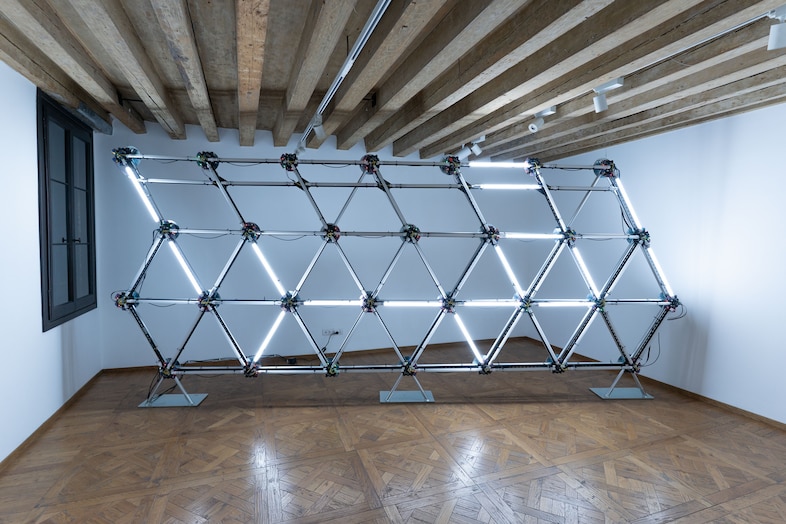
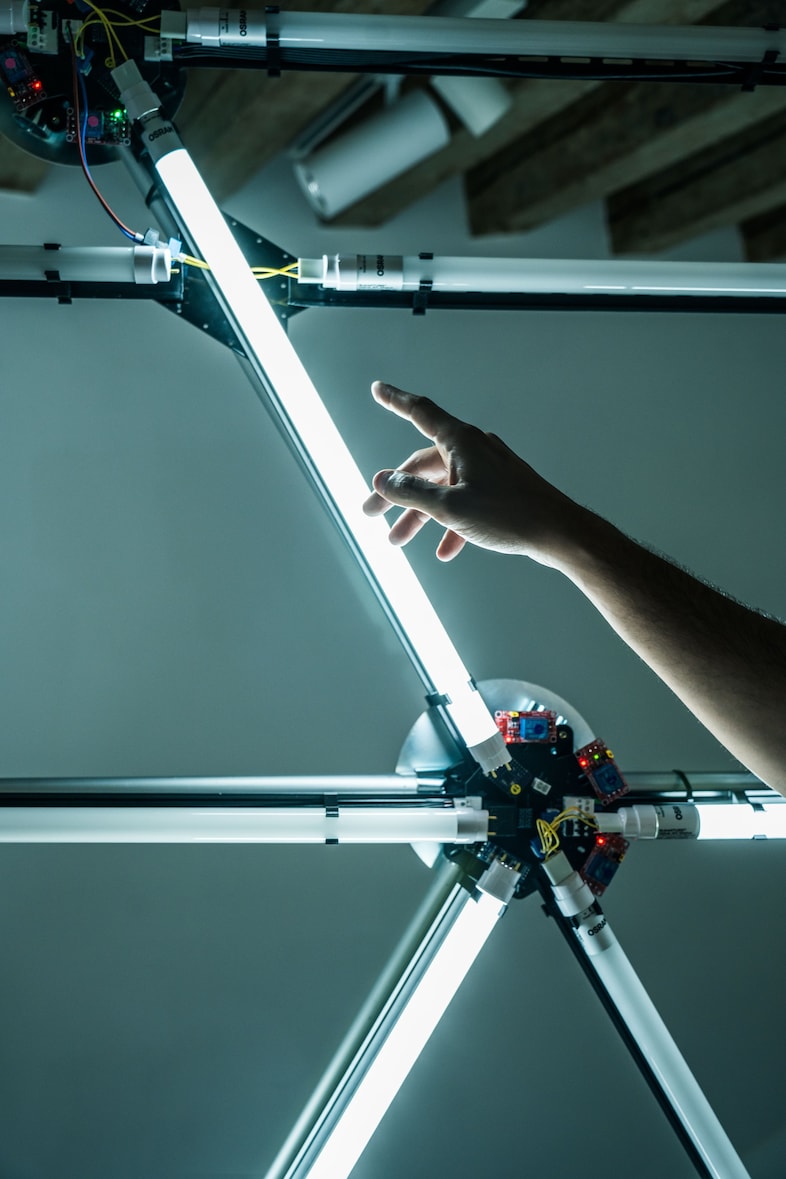
As an “anti-hierarchical and extra-disciplinary research and development entity” xLab speaks pretty clearly to the ICR’s broader aims. Serving both a critical and creative purpose, it hones in on the history of mechanical reduction in typography – the simplification of Arabic scripts to fit digital displays, for example, and the bias toward Latin script that comes with any kind of standardisation. In Venice, the lab presents a kinetic light sculpture, proposing how Arabic language could live and evolve into the future, on its own terms.
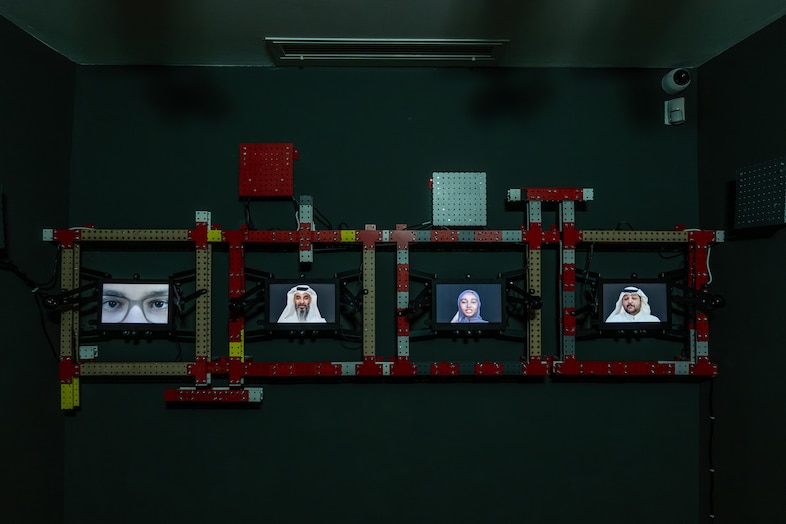
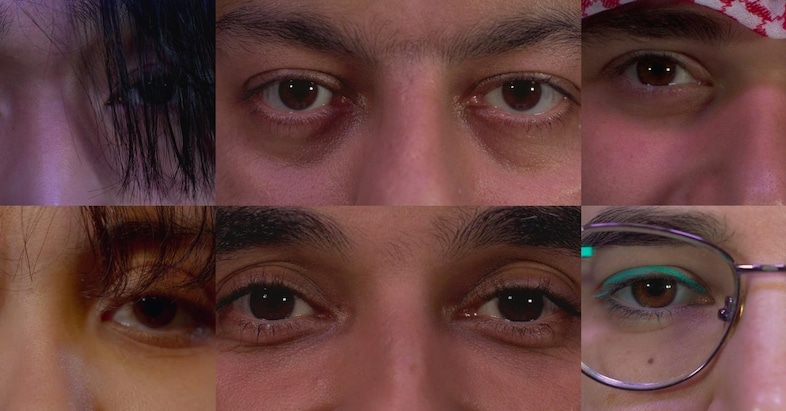
Doha Film Institute’s Geekdom is Qatar’s largest pop culture event, bringing together cosplayers, gamers, anime lovers, and a broader community of fans and creatives. And United Geekdom consists of plans for a permanent home for the event, by Anthro-Tech Atelier. The video portrait series Whisper from United Geekdom, presented in Venice, makes a strong case for the importance of the event itself, amplifying the voices of people from the region who’ve found a home among its off-kilter communities. From an anthropological angle (the lab serves as a crossroads between the social sciences and design) it also sets about deconstructing the stereotypes that surround the broad array of subcultures that Geekdom represents.
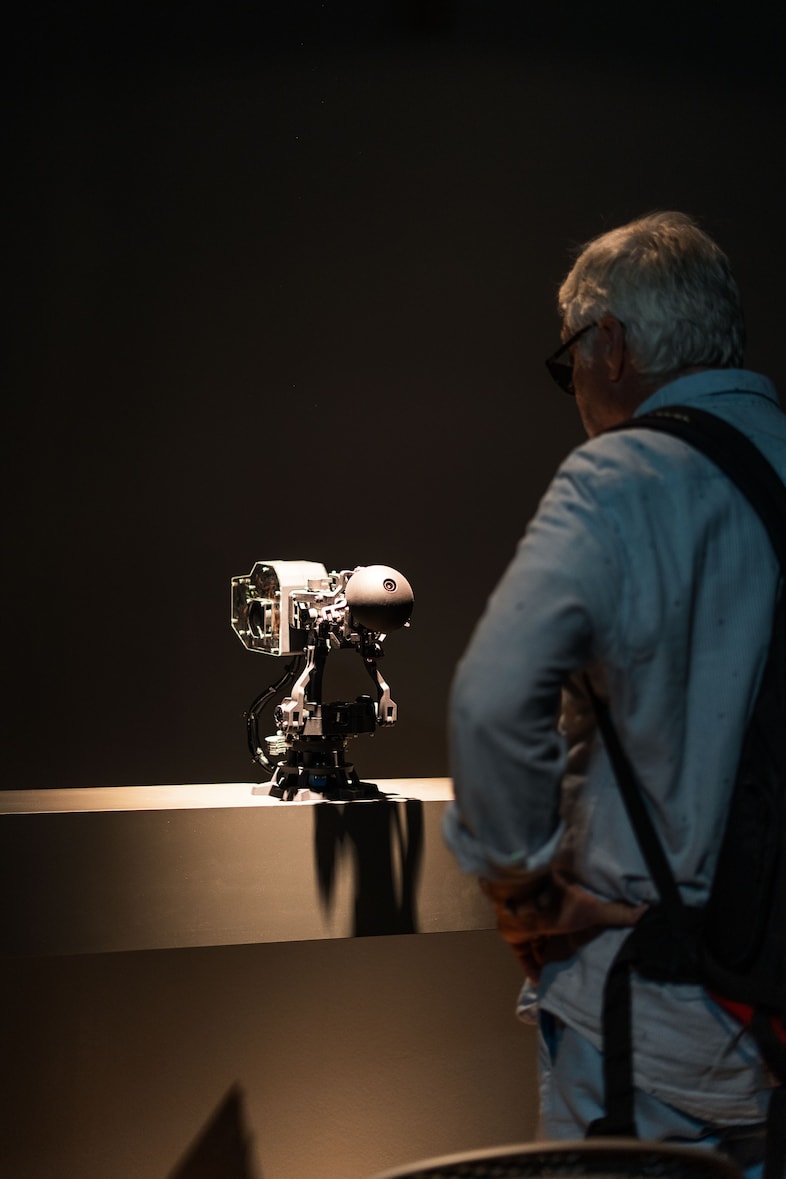
An eerie robot sits at the heart of A Monocular Monologue, consisting of little more than a mechanical eye (camera) on a mechanism that enables it to turn and face the viewer, wherever they’re standing. Its movements are slightly janky and the mechanics are deliberately exposed, but that only serves as a reminder of how little we actually need, as humans, to believe that something is thinking, feeling, and acting of its own accord (see: AI “psychosis” and our ongoing obsession with defining the moment that AI tools gained consciousness). Mesh Labs’ uncanny installation is also accompanied by an AI-generated monologue – hence the name – that explores the philosophical implications of the technology itself.
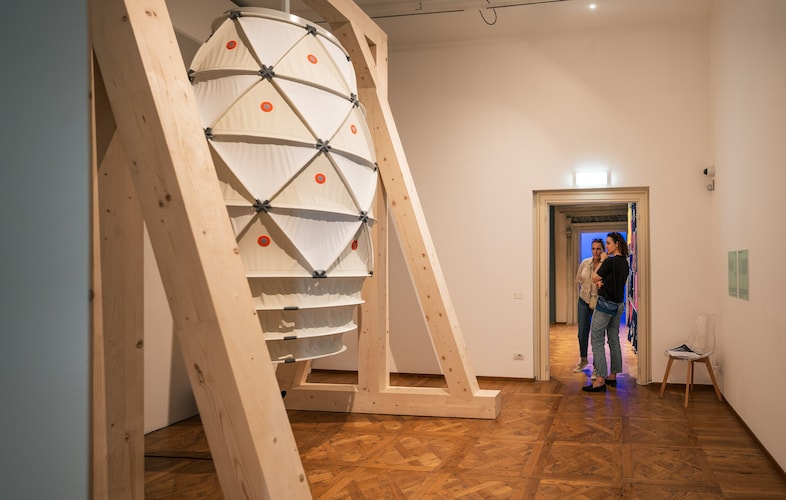
It’s no secret that artists can be allergic to talking about money, and part of Boost Lab’s aim is to bridge the gap between carefully-designed objects, creative artefacts, and their commercial applications. This takes the shape, in Aghrab Idrāk (which loosely translates to “strange knowledge”), of Chrysalis, a massive air-cleaning sculpture that uses innovative textiles and a kinetic structure to take in dirty air, purify it, and put it back into the atmosphere. Functionally, the sculpture conducts a similar process to that of a tree, while its concertinaed ‘body’ appears to breathe like an animal, letting out a deep sigh when it reaches the bottom of its cycle. As a result, suggests Westfall, it not only serves a useful purpose, but also engenders a kind of “strange knowledge” about our place in a broader ecosystem of other living beings and machines.
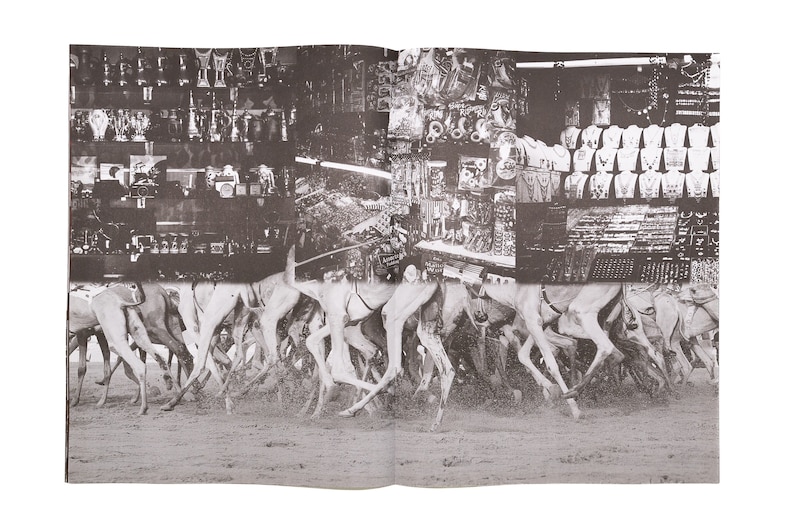
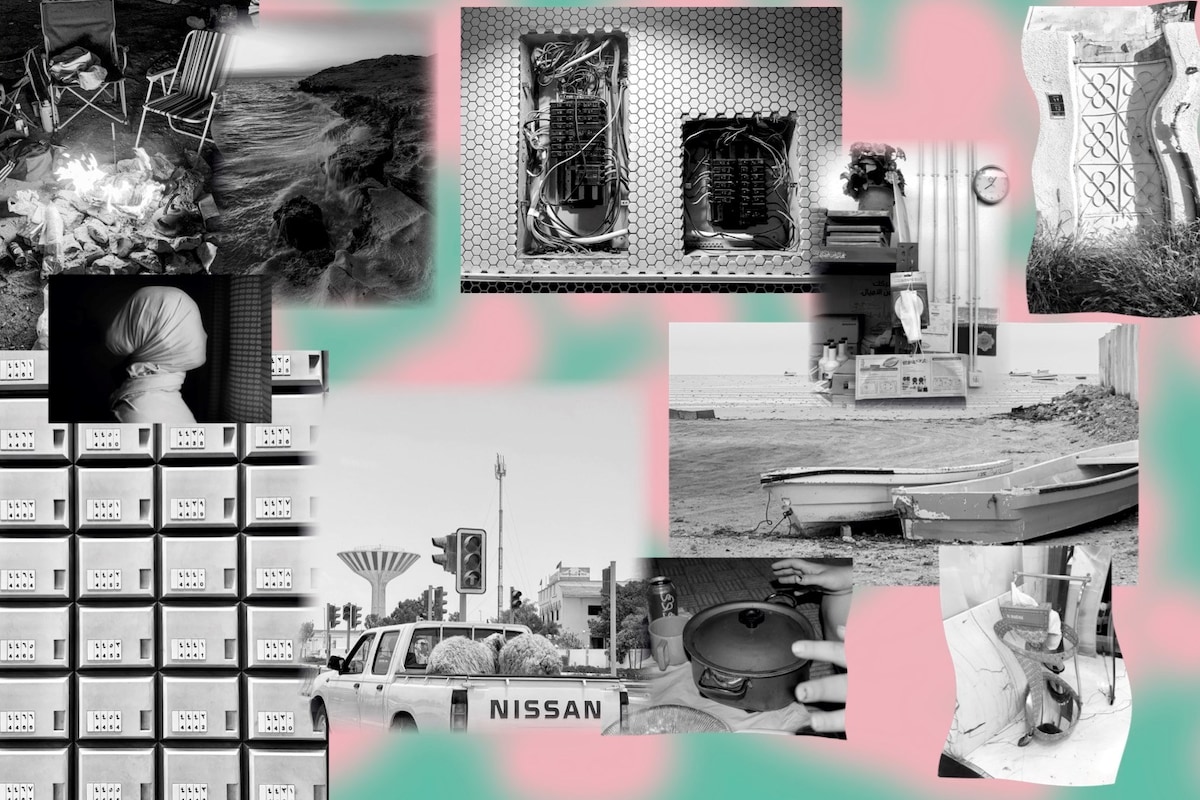
Water With Water (otherwise known as W/W/W) is an experimental publishing project and visual research lab based in Doha and built, for the most part, out of VCUarts educators and alumni. It’s project The Gulf Between Us is a DIY, hand-collaged zine series that brings together images from artists and photographers in Qatar and the broader Gulf region, based on open calls. Photos from local fish markets sit alongside street portraits and snapshots of nightlife. The result, as noted by Iliadou, is a multifaceted depiction, straight from the artists themselves, of “what their place means to them”.
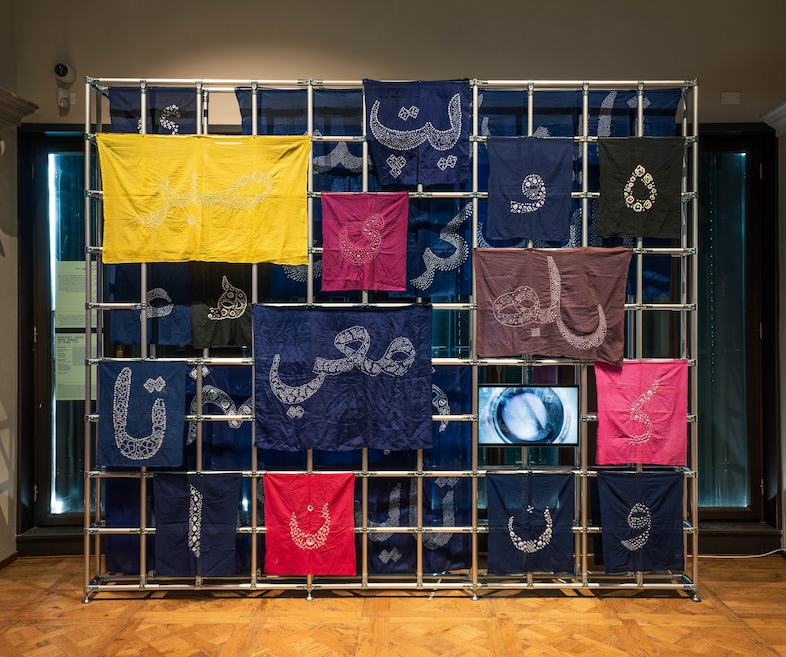
TypeAraby is a lab dedicated to preserving and evolving Arabic typography and type design, based out of VCUarts’ graphic design department. It aims to “cultivate a contemporary vision” for the Arabic type while staying true to its calligraphic roots, and as such its past work includes everything from animated tapestries to Palestinian embroidery. Bandhani Arabi: From Thread to Word takes TypeAraby’s efforts to India, rendering text using Bandhani tie dye techniques in collaboration with Indian muslim women in Bhuj, India, and further expanding ideas about who ‘gets to’ exhibit work at an exhibition like the Venice Biennale.
Aghrab Idrāk: Thresholds of Perception is on show at Palazzo Cavanis, Venice, until November 22.
in HTML format, including tags, to make it appealing and easy to read for Japanese-speaking readers aged 20 to 40 interested in fashion. Organize the content with appropriate headings and subheadings (h1, h2, h3, h4, h5, h6), translating all text, including headings, into Japanese. Retain any existing
tags from
VCUarts Qatar, Aghrab Idrāk: Thresholds of Perception
Gallery / 10 images
There’s no “genius artist” in the latest show from VCUArts Qatar, says the institution’s dean, Amir Berbić. He’s quick to clarify: “I don’t mean this negatively. I mean that there’s no single artist represented in our exhibition. It’s made up of collectives, of groups, of labs.”
This is the first thing that makes Aghrab Idrāk: Thresholds of Perception, the school’s collateral event at this year’s Venice Biennale, unusual. The second unusual factor? Holding an exhibition at the Biennale in the first place. After all, VCUarts Qatar (an offshoot of Virginia Commonwealth University School of the Arts) is an academic institution whose focus typically lies in cross-disciplinary research – projects that seek to break new ground when it comes to culture, heritage, sustainability, and emerging technologies, but don’t necessarily translate into work thats fits into a traditional exhibition format. The presence of an institution like this at the Venice Biennale, where it’s taken over a whole palazzo, is rare.
“We are a very unique school in so many different ways,” says Berbić. “But we feel that we have a lot to offer in the global discussion around contemporary art and design. Even though, of course, we are situated in a very specific context – and we take that responsibility very seriously – we also know, and want to show, that we are participating in global conversations.” As such, Aghrab Idrāk: Thresholds of Perception showcases projects from VCUarts Qatar’s Institute for Creative Research (ICR), including shapeshifting musical installations, zine collectives, and interactive robotics that speak directly to our present conditions.
At the ICR, work and study takes shape via self-formed, faculty-led, and “highly collaborative” research labs. “We’re a very small community,” explains Dr Diane Derr, associate dean for research and development at VCUarts Qatar, which was the first partner university to be established in Education City, a literal city built on the outskirts of Doha to invest in education and innovation. This means they can work one-on-one with faculty or students, to help them define the infrastructure for a new lab and “matchmake” with other likeminded artists or designers. “It’s really about celebrating a diversity of perspectives,” she adds, “and creating a non-hierarchical structure, which lends itself to a new educational paradigm” – a way of learning and generating new knowledge that goes beyond the increasingly-outdated format of the classical university system.
“It’s really about celebrating a diversity of perspectives, and creating a non-hierarchical structure, which lends itself to a new educational paradigm” – Dr Diane Derr
So VCUarts Qatar is a school that resists traditional methods of education, a US-founded institution based in the Gulf that aims to honour the region’s “deep traditions” while shaping the course of global culture, and it offers an arts education that refuses to limit itself to what we typically call ‘art’. Are there any unique tensions that come with its hybrid, boundary-pushing approach? “Where are they not?” jokes Derr, and Berbić agrees that the challenges are almost constant. “We continually have to work through them, through constant dialog and constant evolution,” he suggests. “I don’t think I’m wrong in saying that even some of our faculty who form labs together, yet come from very different disciplinary backgrounds, have had to learn how to work together.”
“They didn’t even know how to speak the same disciplinary language,” adds Derr. “They have a very different vocabulary about certain things.” These tensions can also generate new ideas and workarounds, though. Take, for example, the clash between more design-led approaches and methods lifted from fine art, which Derr defines as “problem solving” versus “problem seeking”. “Problem solving is a very traditional approach in design,” she adds, “but problem seeking is something that really lends itself to asking critical questions around our social and cultural conditions.” Right now, it feels like we could use a healthy dose of both.
Below, we’ve gathered some of the most boundary-breaking and innovative projects from Aghrab Idrāk: Thresholds of Perception. The show is co-curated by Dr. Hesperia Iliadou, director of the Museums & Exhibitions Study Society in Venice, and Chase Westfall, head of gallery at VCUarts Qatar.
As an “anti-hierarchical and extra-disciplinary research and development entity” xLab speaks pretty clearly to the ICR’s broader aims. Serving both a critical and creative purpose, it hones in on the history of mechanical reduction in typography – the simplification of Arabic scripts to fit digital displays, for example, and the bias toward Latin script that comes with any kind of standardisation. In Venice, the lab presents a kinetic light sculpture, proposing how Arabic language could live and evolve into the future, on its own terms.
Doha Film Institute’s Geekdom is Qatar’s largest pop culture event, bringing together cosplayers, gamers, anime lovers, and a broader community of fans and creatives. And United Geekdom consists of plans for a permanent home for the event, by Anthro-Tech Atelier. The video portrait series Whisper from United Geekdom, presented in Venice, makes a strong case for the importance of the event itself, amplifying the voices of people from the region who’ve found a home among its off-kilter communities. From an anthropological angle (the lab serves as a crossroads between the social sciences and design) it also sets about deconstructing the stereotypes that surround the broad array of subcultures that Geekdom represents.
An eerie robot sits at the heart of A Monocular Monologue, consisting of little more than a mechanical eye (camera) on a mechanism that enables it to turn and face the viewer, wherever they’re standing. Its movements are slightly janky and the mechanics are deliberately exposed, but that only serves as a reminder of how little we actually need, as humans, to believe that something is thinking, feeling, and acting of its own accord (see: AI “psychosis” and our ongoing obsession with defining the moment that AI tools gained consciousness). Mesh Labs’ uncanny installation is also accompanied by an AI-generated monologue – hence the name – that explores the philosophical implications of the technology itself.
It’s no secret that artists can be allergic to talking about money, and part of Boost Lab’s aim is to bridge the gap between carefully-designed objects, creative artefacts, and their commercial applications. This takes the shape, in Aghrab Idrāk (which loosely translates to “strange knowledge”), of Chrysalis, a massive air-cleaning sculpture that uses innovative textiles and a kinetic structure to take in dirty air, purify it, and put it back into the atmosphere. Functionally, the sculpture conducts a similar process to that of a tree, while its concertinaed ‘body’ appears to breathe like an animal, letting out a deep sigh when it reaches the bottom of its cycle. As a result, suggests Westfall, it not only serves a useful purpose, but also engenders a kind of “strange knowledge” about our place in a broader ecosystem of other living beings and machines.
Water With Water (otherwise known as W/W/W) is an experimental publishing project and visual research lab based in Doha and built, for the most part, out of VCUarts educators and alumni. It’s project The Gulf Between Us is a DIY, hand-collaged zine series that brings together images from artists and photographers in Qatar and the broader Gulf region, based on open calls. Photos from local fish markets sit alongside street portraits and snapshots of nightlife. The result, as noted by Iliadou, is a multifaceted depiction, straight from the artists themselves, of “what their place means to them”.
TypeAraby is a lab dedicated to preserving and evolving Arabic typography and type design, based out of VCUarts’ graphic design department. It aims to “cultivate a contemporary vision” for the Arabic type while staying true to its calligraphic roots, and as such its past work includes everything from animated tapestries to Palestinian embroidery. Bandhani Arabi: From Thread to Word takes TypeAraby’s efforts to India, rendering text using Bandhani tie dye techniques in collaboration with Indian muslim women in Bhuj, India, and further expanding ideas about who ‘gets to’ exhibit work at an exhibition like the Venice Biennale.
Aghrab Idrāk: Thresholds of Perception is on show at Palazzo Cavanis, Venice, until November 22.
and integrate them seamlessly into the new content without adding new tags. Ensure the new content is fashion-related, written entirely in Japanese, and approximately 1500 words. Conclude with a “結論” section and a well-formatted “よくある質問” section. Avoid including an introduction or a note explaining the process.