Rewrite
Presented in conjunction with Kyotographie photography festival, Kawada Kikuji x Iwane Ai at Japan House London features the work of two photographers whose images contemplate memory, loss and preservation in the shadow of tragic national catastrophe
Since Japan House London opened in South Kensington in 2018, it has hosted exhibitions on nearly everything from the Tokyo Olympics to restaurant-window food replicas and artist Naoki Urasawa’s manga. This June, however, the venue unveils its first-ever photography exhibition that spans nearly 75 years of material.
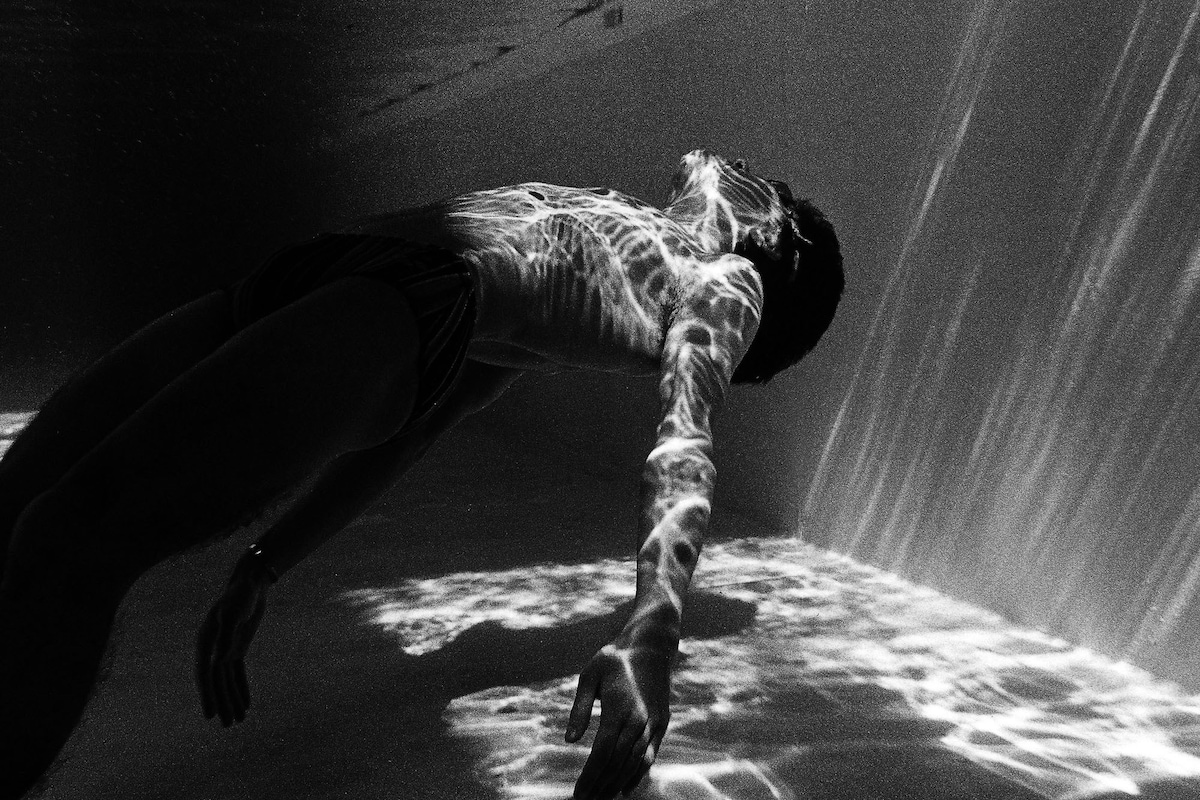
Presented in conjunction with Kyotographie photography festival, Kawada Kikuji x Iwane Ai pairs two photographers separated by more than half a century, but unexpectedly intertwined via their expressions of memory, loss and preservation. Nonagenerian Kikuji, a recipient of the lifetime achievement award from the Photographic Society of Japan in 2011, is described by director of programming Simon Wright as “the grandaddy of photography” in Japan. Iwane AI, meanwhile, has risen to prominence following the publication of her award-winning debut monograph KIPUKA in 2019.
Though distinct in their practice, the pairing is intuitive. National catastrophes like the atomic bombings of Hiroshima and Nagasaki and the 2011 Fukushima Daiichi nuclear disaster cast a shadow across each photographer’s work. But the exhibition goes deeper. “The thread is about overcoming loss and coming to terms with grief,” says Wright, with Kawada’s societal meditations “mapping his world on a grander scale”, as Iwane’s reflections draw from personal loss and the displacements of small communities.
The result is an exhibition that meditates broadly on how memory is captured and carried forward following upheaval – and with this perspective, its impression lingers.

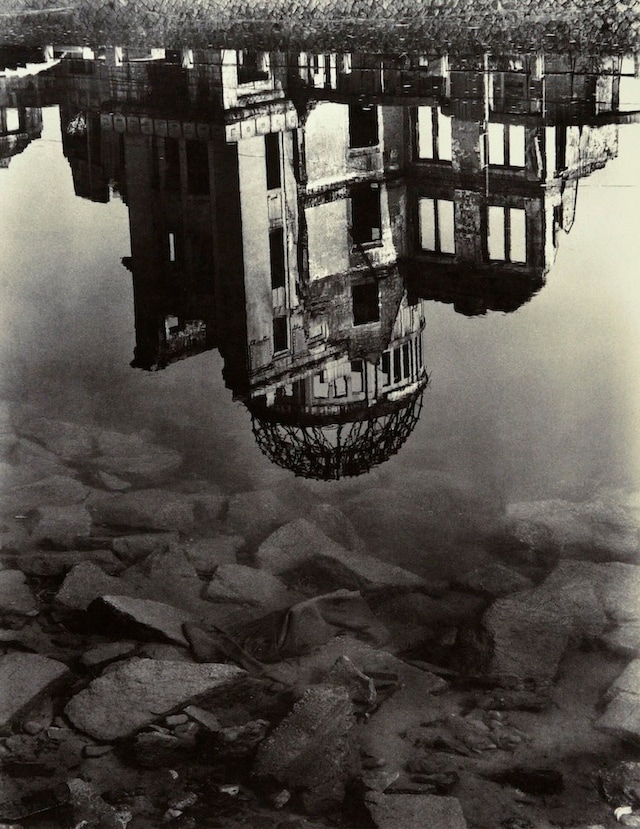
Kikuji Kawada was born in 1933 and was just 12 years old when World War Two concluded with the atomic destruction of two major cities in Japan at the hands of US forces. As an adult, Kawada began to photograph the destruction in Hiroshima as part of a project that would become, arguably, Japan’s most important photobook: 1965’s Chizu (The Map).
“It was about 13 years since the atomic bomb was dropped,” Kawada tells AnOther of the project’s genesis, “but rumour had it that radioactivity still lingered in the city. It was a ‘sacred ruin’ of unprecedented violence. But I wanted to shift from the objective perspective of documentary photography towards a more personal vision.”
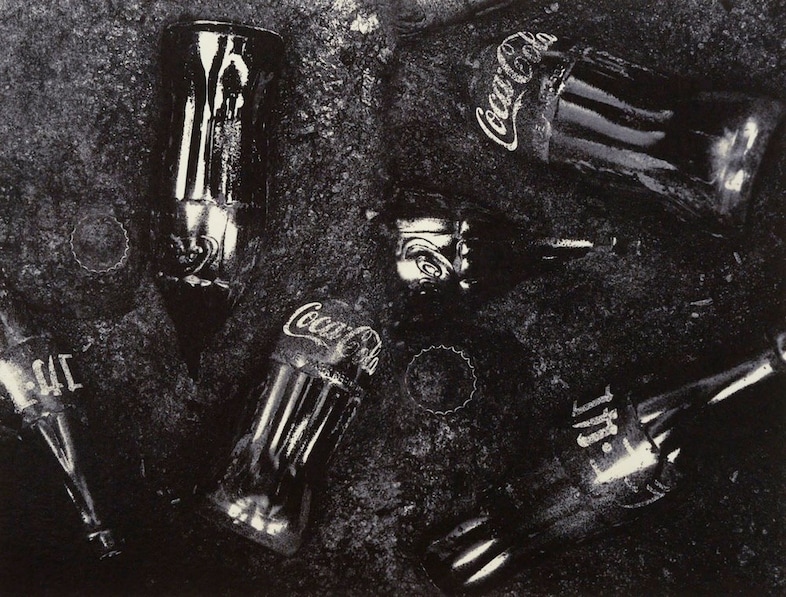
The results have lost none of their power. The ravaged interiors of the ruined Industrial Promotion Hall (now the Hiroshima Peace Memorial or “Atomic Bomb Dome”) are depicted alongside relics of US culture, such as Coca-Cola bottles and Lucky Strike cigarette packets, that lay embedded in the same rubble. These aren’t merely societal statements that point to the impact of a foreign power, but also insights into Kawada’s artistic vision and philosophy: “Within these highly representational photographs, there conversely lay a power to present illusions,” Kawada continues. “I found abstract images in the ‘stains’ covering the entirety of the dimly lit ceiling inside the Atomic Bomb Dome.”
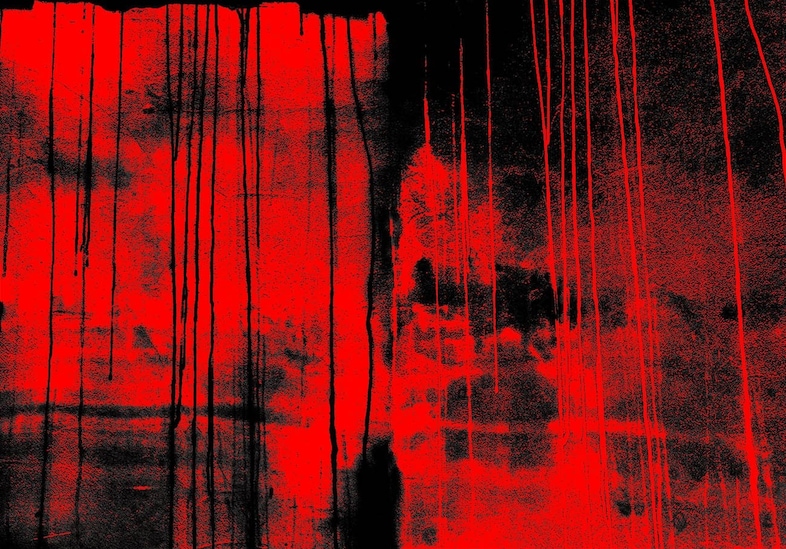
Later Kawada works on display offer further insight into the photographer’s evolving worldviews, with the urban snapshots of Los Caprichos (1968-1981) offering distinct, and often haunting daily observations. 11th September, 2006, from The Last Cosmology series, meanwhile, offers a fresh glance towards America in association with disaster – “it refers to the evening of the terrorist attacks in New York, which I watched on the news on TV in Tokyo,” Kawada says. “Strangely enough, the sky took on an unusual hue [that day].”
The deeper dualities of meaning present in the title for Zeno and KiKi – a depiction of two crows observed in the night sky – further underline Kawada’s enduring rumination on the nuances of disaster. “Zeno is the ancient Greek inventor of paradoxes; the word KiKi means ‘crisis’ in Japanese,” he says. “The name was inspired by my admiration for Surrealist paintings from long ago. I sense violence and catastrophe in such a crisis-ridden space and time, and this, too, seems to be connected to Chizu (The Map).”
As Kawada’s wider The Last Cosmology series points to a broader and celestial scale of self-reflection, Iwane Ai’s work, which also reacts to seismic events and upheavals, is more intimate. Long-running series KIPUKA, for one, exposes the ceremonial commemoration of half-forgotten Japanese immigrants in Hawaii – and is anchored by captivating panoramas of the Fukushima Ondo bon dance, a taiko drum-fuelled folk tradition to honour the dead that followed immigrant communities from Fukushima to the American Pacific island in the late 19th century.


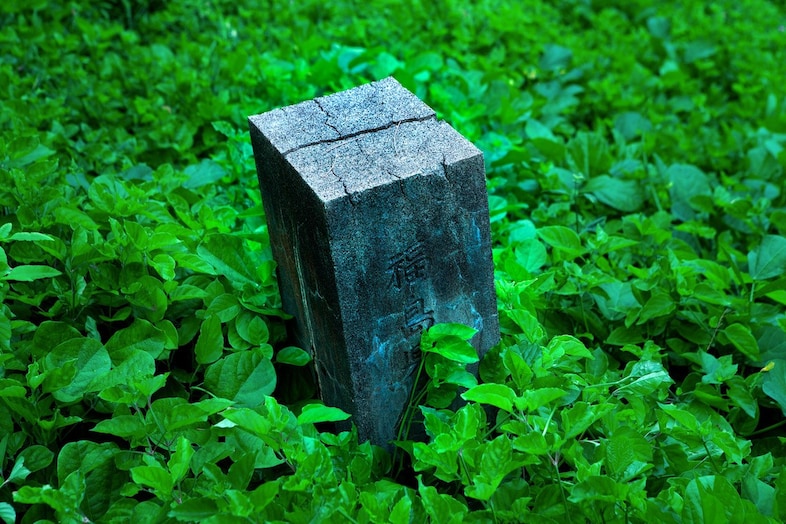
“KIPUKA started after I went to Hawaii for the first time in 2006, and discovered the abandoned graveyards of the first generation of immigrants,” says Iwane, gesturing towards an image of a cracked stone column half-consumed by verdant vegetation. “Between 1868 and 1924, 220,000 people migrated to Hawaii from Japan to work in sugarcane plantations and pineapple fields, but it’s kind of an untold history.”
In the process of documenting these scenes of commemoration and celebration, Iwane discovered long panoramic photos depicting immigrant funerals in the homes of their ancestors in Hawaii. “They were taken so that [the displaced families] could record how many people had shown up at the moment of death, and send those images home,” she explains. After acquiring a deteriorating Kodak Cirkut rotating camera in Maui, Iwane then utilised the same panoramic format to capture the clapping hands of the bon dance under fire-red lights, and graveyards encroached by the pyroclastic flows of Hawaiian volcanoes. The collection’s title is taken from the Hawaiian word referring to an isolated area of land that survives a lava flow following volcanic eruption – a term also used to define a place “of new life”, or “where life, or culture, endures”.
Iwane’s work took on a greater poignancy following the Fukushima Daiichi nuclear power plant disaster (caused by the Tо̄hoku earthquake and tsunami) of 2011 – after which she continued with the panoramic format as she traced the origins of the Fukushima Ondo song to the evacuated town of Futaba in Fukushima. Presented in parallel to images captured in Hawaii, themes of destruction and desolation become increasingly prevalent.
Selections from 2020’s A New River series, which captures deserted cherry blossoms in bloom at the height of the Covid-19 pandemic, were also shot in the same Tо̄hoku region. “Usually, there are 3,000 people here every day during cherry season,” says Iwane. “But this was all taken away.” The night-time stills showcase blooming vegetation distorted by glimmering light and ogre-like oni demons. The latter’s presence was inspired by taiko drummer and Futaba evacuee Hisakatsu Yokoyama, who wrote a musical piece inspired by the rhythmic footsteps [of evacuees] following the 2011 power plant meltdown. Much like the radiation released from that event, he considers oni not as purely evil – but as merely a force coexisting with nature.
Time spent among the lonely, irradiated cherry blossoms held a deep personal significance for Iwane. “My sister took her own life 19 years ago during the cherry season,” she says. Reflecting on her memories of that grief and its gradual dissipation from her day-to-day life, she created a slide projection that layers the new images she captured of the cherry blossoms over family photos of her sibling. “As you bring in another image, the image of my sister [is obscured] but doesn’t completely fade away,” says Iwane. “This is how I think of her now.”
Motifs that point to such tragedies and contemplations endure across all corners of this thought-provoking exhibition, and likewise continue to underscore the practices of each displaying photographer.
At 93 years old, Kawada continues to “stand in this wilderness of imagination” as he perseveres with his craft every single day – documenting his observations on Instagram in foreboding images that speak both to the past and the future. “Louis Jacques Mandé Daguerre, [the inventor of the daguerrotype,] described photography as ‘a mirror with a memory’,” says Kawada. “A mirror reveals to us what we can’t see … and I am always in search of encounters with the invisible.”
For Iwane, such contemplations of memory and exposure are no less evident. “The Japanese immigrant people in Hawaii are always very careful to take their family story to the next generation, passing through their history and their struggle,” she concludes of her displaying works. “From working with them, I realised something: as far back as you can think of your past, and understand how it’s connected to you, you should also think this far, and as much, to the future.”
Kyotographie: Kawada Kikuji x Iwane Ai runs until 18 October 2026 at Japan House London.
in HTML format, including tags, to make it appealing and easy to read for Japanese-speaking readers aged 20 to 40 interested in fashion. Organize the content with appropriate headings and subheadings (h1, h2, h3, h4, h5, h6), translating all text, including headings, into Japanese. Retain any existing
tags from
Presented in conjunction with Kyotographie photography festival, Kawada Kikuji x Iwane Ai at Japan House London features the work of two photographers whose images contemplate memory, loss and preservation in the shadow of tragic national catastrophe
Since Japan House London opened in South Kensington in 2018, it has hosted exhibitions on nearly everything from the Tokyo Olympics to restaurant-window food replicas and artist Naoki Urasawa’s manga. This June, however, the venue unveils its first-ever photography exhibition that spans nearly 75 years of material.
Presented in conjunction with Kyotographie photography festival, Kawada Kikuji x Iwane Ai pairs two photographers separated by more than half a century, but unexpectedly intertwined via their expressions of memory, loss and preservation. Nonagenerian Kikuji, a recipient of the lifetime achievement award from the Photographic Society of Japan in 2011, is described by director of programming Simon Wright as “the grandaddy of photography” in Japan. Iwane AI, meanwhile, has risen to prominence following the publication of her award-winning debut monograph KIPUKA in 2019.
Though distinct in their practice, the pairing is intuitive. National catastrophes like the atomic bombings of Hiroshima and Nagasaki and the 2011 Fukushima Daiichi nuclear disaster cast a shadow across each photographer’s work. But the exhibition goes deeper. “The thread is about overcoming loss and coming to terms with grief,” says Wright, with Kawada’s societal meditations “mapping his world on a grander scale”, as Iwane’s reflections draw from personal loss and the displacements of small communities.
The result is an exhibition that meditates broadly on how memory is captured and carried forward following upheaval – and with this perspective, its impression lingers.
Kikuji Kawada was born in 1933 and was just 12 years old when World War Two concluded with the atomic destruction of two major cities in Japan at the hands of US forces. As an adult, Kawada began to photograph the destruction in Hiroshima as part of a project that would become, arguably, Japan’s most important photobook: 1965’s Chizu (The Map).
“It was about 13 years since the atomic bomb was dropped,” Kawada tells AnOther of the project’s genesis, “but rumour had it that radioactivity still lingered in the city. It was a ‘sacred ruin’ of unprecedented violence. But I wanted to shift from the objective perspective of documentary photography towards a more personal vision.”
The results have lost none of their power. The ravaged interiors of the ruined Industrial Promotion Hall (now the Hiroshima Peace Memorial or “Atomic Bomb Dome”) are depicted alongside relics of US culture, such as Coca-Cola bottles and Lucky Strike cigarette packets, that lay embedded in the same rubble. These aren’t merely societal statements that point to the impact of a foreign power, but also insights into Kawada’s artistic vision and philosophy: “Within these highly representational photographs, there conversely lay a power to present illusions,” Kawada continues. “I found abstract images in the ‘stains’ covering the entirety of the dimly lit ceiling inside the Atomic Bomb Dome.”
Later Kawada works on display offer further insight into the photographer’s evolving worldviews, with the urban snapshots of Los Caprichos (1968-1981) offering distinct, and often haunting daily observations. 11th September, 2006, from The Last Cosmology series, meanwhile, offers a fresh glance towards America in association with disaster – “it refers to the evening of the terrorist attacks in New York, which I watched on the news on TV in Tokyo,” Kawada says. “Strangely enough, the sky took on an unusual hue [that day].”
The deeper dualities of meaning present in the title for Zeno and KiKi – a depiction of two crows observed in the night sky – further underline Kawada’s enduring rumination on the nuances of disaster. “Zeno is the ancient Greek inventor of paradoxes; the word KiKi means ‘crisis’ in Japanese,” he says. “The name was inspired by my admiration for Surrealist paintings from long ago. I sense violence and catastrophe in such a crisis-ridden space and time, and this, too, seems to be connected to Chizu (The Map).”
As Kawada’s wider The Last Cosmology series points to a broader and celestial scale of self-reflection, Iwane Ai’s work, which also reacts to seismic events and upheavals, is more intimate. Long-running series KIPUKA, for one, exposes the ceremonial commemoration of half-forgotten Japanese immigrants in Hawaii – and is anchored by captivating panoramas of the Fukushima Ondo bon dance, a taiko drum-fuelled folk tradition to honour the dead that followed immigrant communities from Fukushima to the American Pacific island in the late 19th century.
“KIPUKA started after I went to Hawaii for the first time in 2006, and discovered the abandoned graveyards of the first generation of immigrants,” says Iwane, gesturing towards an image of a cracked stone column half-consumed by verdant vegetation. “Between 1868 and 1924, 220,000 people migrated to Hawaii from Japan to work in sugarcane plantations and pineapple fields, but it’s kind of an untold history.”
In the process of documenting these scenes of commemoration and celebration, Iwane discovered long panoramic photos depicting immigrant funerals in the homes of their ancestors in Hawaii. “They were taken so that [the displaced families] could record how many people had shown up at the moment of death, and send those images home,” she explains. After acquiring a deteriorating Kodak Cirkut rotating camera in Maui, Iwane then utilised the same panoramic format to capture the clapping hands of the bon dance under fire-red lights, and graveyards encroached by the pyroclastic flows of Hawaiian volcanoes. The collection’s title is taken from the Hawaiian word referring to an isolated area of land that survives a lava flow following volcanic eruption – a term also used to define a place “of new life”, or “where life, or culture, endures”.
Iwane’s work took on a greater poignancy following the Fukushima Daiichi nuclear power plant disaster (caused by the Tо̄hoku earthquake and tsunami) of 2011 – after which she continued with the panoramic format as she traced the origins of the Fukushima Ondo song to the evacuated town of Futaba in Fukushima. Presented in parallel to images captured in Hawaii, themes of destruction and desolation become increasingly prevalent.
Selections from 2020’s A New River series, which captures deserted cherry blossoms in bloom at the height of the Covid-19 pandemic, were also shot in the same Tо̄hoku region. “Usually, there are 3,000 people here every day during cherry season,” says Iwane. “But this was all taken away.” The night-time stills showcase blooming vegetation distorted by glimmering light and ogre-like oni demons. The latter’s presence was inspired by taiko drummer and Futaba evacuee Hisakatsu Yokoyama, who wrote a musical piece inspired by the rhythmic footsteps [of evacuees] following the 2011 power plant meltdown. Much like the radiation released from that event, he considers oni not as purely evil – but as merely a force coexisting with nature.
Time spent among the lonely, irradiated cherry blossoms held a deep personal significance for Iwane. “My sister took her own life 19 years ago during the cherry season,” she says. Reflecting on her memories of that grief and its gradual dissipation from her day-to-day life, she created a slide projection that layers the new images she captured of the cherry blossoms over family photos of her sibling. “As you bring in another image, the image of my sister [is obscured] but doesn’t completely fade away,” says Iwane. “This is how I think of her now.”
Motifs that point to such tragedies and contemplations endure across all corners of this thought-provoking exhibition, and likewise continue to underscore the practices of each displaying photographer.
At 93 years old, Kawada continues to “stand in this wilderness of imagination” as he perseveres with his craft every single day – documenting his observations on Instagram in foreboding images that speak both to the past and the future. “Louis Jacques Mandé Daguerre, [the inventor of the daguerrotype,] described photography as ‘a mirror with a memory’,” says Kawada. “A mirror reveals to us what we can’t see … and I am always in search of encounters with the invisible.”
For Iwane, such contemplations of memory and exposure are no less evident. “The Japanese immigrant people in Hawaii are always very careful to take their family story to the next generation, passing through their history and their struggle,” she concludes of her displaying works. “From working with them, I realised something: as far back as you can think of your past, and understand how it’s connected to you, you should also think this far, and as much, to the future.”
Kyotographie: Kawada Kikuji x Iwane Ai runs until 18 October 2026 at Japan House London.
and integrate them seamlessly into the new content without adding new tags. Ensure the new content is fashion-related, written entirely in Japanese, and approximately 1500 words. Conclude with a “結論” section and a well-formatted “よくある質問” section. Avoid including an introduction or a note explaining the process.