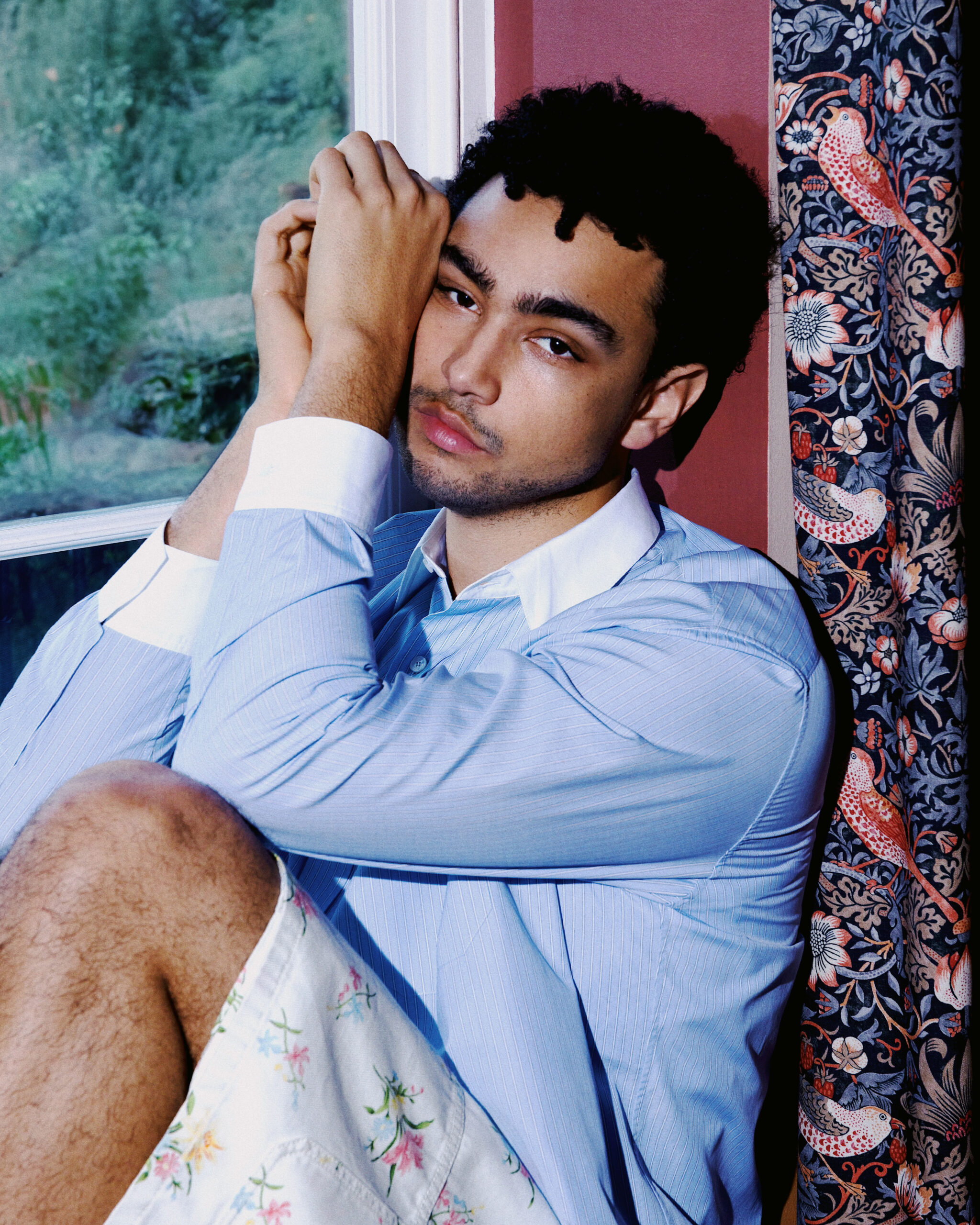
Rewrite
With Saltburn and Lurker sharpening his ascent, Dior muse, London lad, and madcap actor Archie Madekwe arrives at a new threshold of attention: BAFTA-nominated. His friend, pop queen Lily Allen, gets the A–Z on arthouse cinema’s latest crush.
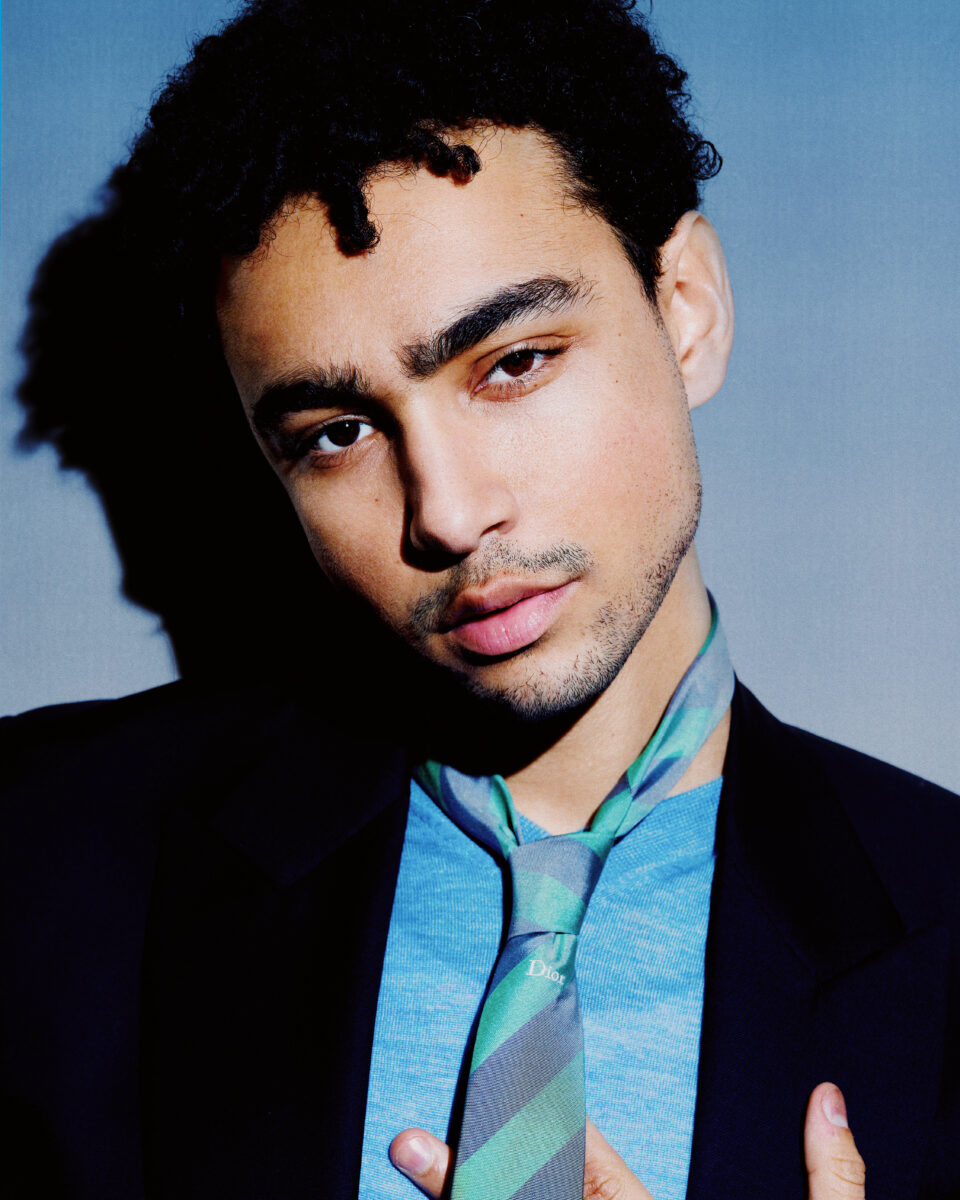
Archie Madekwe knows how to keep a secret. Even from one of the biggest pop stars in the world, or, as the 30-year-old actor knows her, dear friend, Lime-bike partner in crime and fellow Second World War history obsessive, Lily Allen. But with news of his EE BAFTA Rising Star nomination now public, London’s hottest rising actor is ready to talk. And Lily is listening.
“It’s very exciting and cool,” she tells him from the back of a London taxi because it’s, “the only way I could sit in a quiet place for half an hour.”
“Do you know what you’re going to wear?” she asks.
Archie pauses, a beat that implies this, too, is classified information. “Well, we’re working on that,” he laughs. It’s January, and he’s sitting in his London flat, a neatly made bed behind him, an overflowing bookcase to his right. “It’s going to stay a secret in case it changes.” Off-screen or on, Archie always commits to the bit. In this instance, to protect the important identity of a career-shifting red carpet look.
A growing list of directors seem to agree. Early roles – from a ritual execution as Simon in Ari Aster’s Midsommar to the devious Kai in Neil Burger’s existential sci-fi adventure Voyagers – announced a performer willing to sit with discomfort and contradiction, unafraid of the strange or the unsettling. Gran Turismo followed, a sharp left turn into physical transformation, learning to drive at speed in a matter of weeks, and for that he made a vow: through sickness, and sickness, and more sickness. Next up was Saltburn, which pushed him into wider view as Barry Keoghan’s acid-tongued counterpart, the devilishly puffed-up Farleigh, a performance that proved impossible to look away from.
Then came his turn as up-and-coming musician Oliver in Alex Russell’s psychological-thriller Lurker, the role that pulled everything into focus, earning him the EE BAFTA Rising Star nomination and a reputation for being, at once, irresistibly alluring and unequivocally chilling. It is a double register that is hard to find, let alone sustain. Upcoming projects point towards something bigger without sanding down what made him compelling in the first place. There is Steal, alongside Sophie Turner, and Arrival, opposite Kingsley Ben-Adir. The mainstream beckons, but the off-kilter edges remain intact.
To unpack it all, Archie spends over an hour on the phone with Lily, one British darling reflecting on another. They talk serendipity, scriptwriting, and surviving the court of Henry VIII.
Archie Madekwe: Where are you?
Lily Allen: I’m in London until Saturday, and then I’m going back to LA, and then Mexico the next day.
AM: For a holiday?
LA: No, I rented a villa there because I’m a rich pop star again [laughs]. And I am doing a writing retreat with five female friends and producers that I know.
AM: You’ve not wasted any time.
LA: Well, you know.
AM: The juices are flowing.
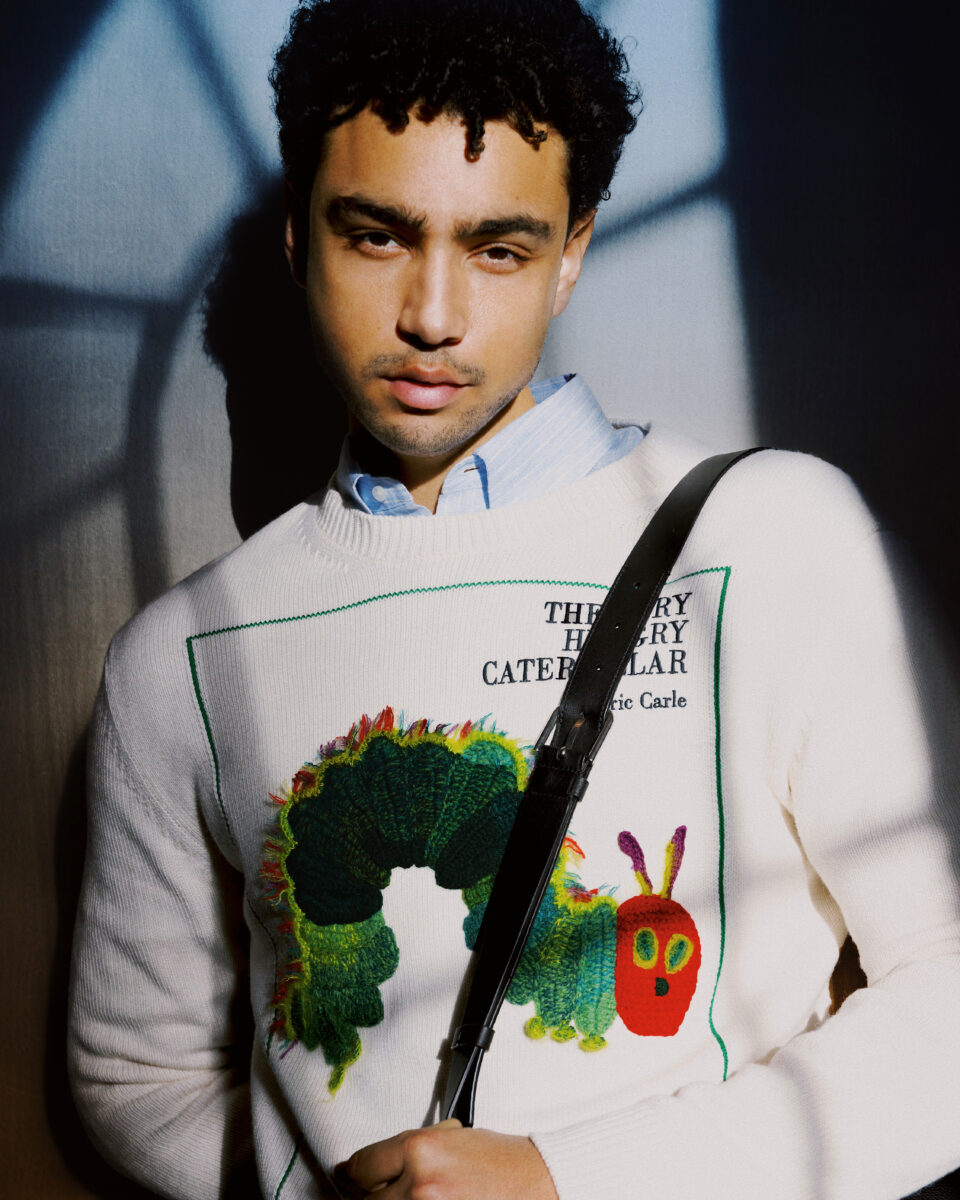
LA: There’s a lot to be said. Less about me though. Shall I just roll straight into these questions?
AM: Sure. It’s just occurred to me now that you actually are really qualified for this because you’ve got a podcast.
LA: [Laughs] No, we never had guests, and I would never ask Miquita [Oliver] anything.
AM: I feel like you’ve always got guests on now though.
LA: They do now that it’s Miquita and Jordan [Stephens], but we never had before. The main reason for that was, I don’t know if you get this, but you know when you go to industry social events, the podcasters just zoom in on you and are just like, ‘Hey, so nice to see you.’ ‘Oh, I have this podcast, would you ever want to come on?’ And I always just thought, I don’t want to go to everything thinking who can I get, like Pokémon or something.
AM: At this press event yesterday, someone said to me, ‘I’m working on this podcast. Real quick, do you have any questions on the top of your mind about puberty?’ I was like, what? I’m actually not in that headspace right now. I’m actually really thinking about me and the EE Rising Star BAFTA nomination [laughs]. But I’ll circle back if I do. But go off, sis.
LA: [Laughs] How did we first meet?
AM: We met for the very first time because I did a film with your ex. I was at Chiltern Firehouse, sitting at the bar, and a waiter came over and said, ‘Hey, here’s a glass of champagne from the lady over there.’ You said, ‘Hi, I just wanted to say congrats on the film.’ It was just so sweet and kind of you. We had a chat, and then I would just see you around London lots. We have a few mutual friends.
LA: I’m going to make a couple of corrections. It was a bottle of champagne [laughs]. And also, it was because the film had just come out and you’d had very good numbers.
AM: Both of those corrections could be corrected. Still a very lovely thing.
LA: I don’t want people to think I’m just sending glasses of champagne around to random men because I vaguely know them through someone else [laughs].
AM: It was a really sweet and kind thing to do. I think it just set the tone for the way that I viewed you. I had obviously known about you growing up, but then knowing you personally, it was just like, she’s a real one.
LA: I really believe in gratitude and generosity as an art form. I love writing thank you notes, and I love sending people presents, if I’ve got enough money in the bank to do so.
AM: I love cards. I don’t always need a present, but I think when somebody takes the time to write you a really thoughtful card, it really means a lot.
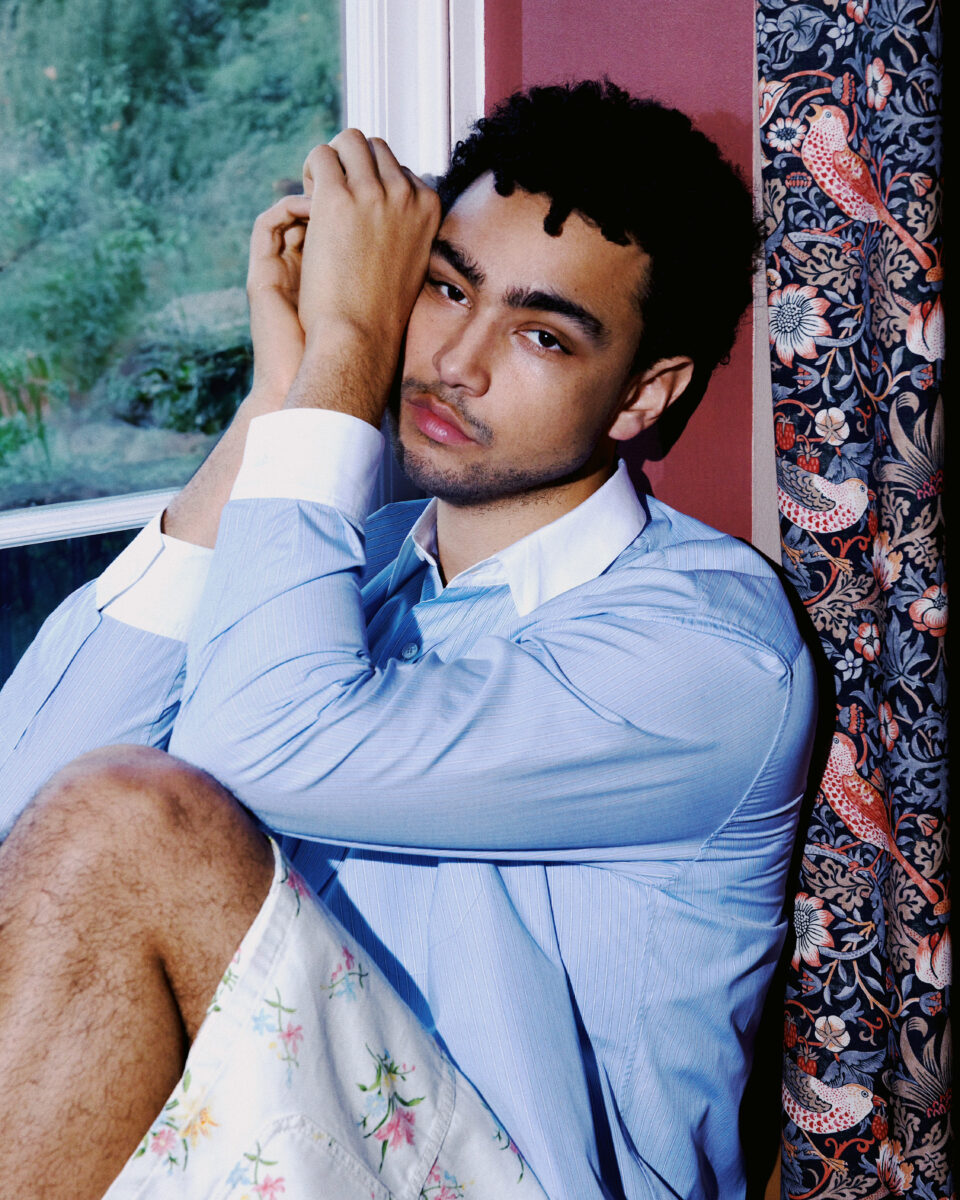
LA: It hits home. What do we admire in each other as artists and performers?
AM: What I’ve always loved about you is you’re such an amazing storyteller, and your writing is not only so honest, transparent, and vulnerable, but also so funny. It’s always laced with humour and something that catches you off guard. And to me, that feels quite distinctly British. I think that’s a really beautiful and special quality to have as an artist. Have you seen any of my films?
LA: Thank you so much. I saw you in Saltburn. I watched Gran Turismo. I’ve seen you in a few things. I feel like when you’re trying to convey something important, it never feels too big. It feels subtle and grounded. It doesn’t feel contrived. I feel like I believe you.
AM: [Laughs] That’s a nice quality to have as an actor.
LA: I believe what you’re doing.
AM: I’m turning my camera off because no one else’s is on.
LA: Wait, hang on. I’ll turn mine on. How do I do that? I’m so bad with technology.
AM: Press the little video icon.
LA: I can’t even see that.
AM: Does it say ‘Start video’, ‘Turn on video’? You might have to swipe. You’ve muted yourself. And again. OK, it’s not the microphone, it’s the video, Lily.
LA: Yeah, it’s not letting me do it. I don’t look particularly hot today, so… moving on. When did acting enter the picture for you? Do you remember who first believed in you and made an impact on your sense of self as an actor?
AM: I was also really lucky that I had a lot of belief and a lot of freedom as a young person. My parents never limited me. They never tried to get me to do something else. I was never particularly sporty or academic; I really kind of gravitated towards the arts. It wasn’t necessarily just acting as a young person. It was music, writing, storytelling and dance. I just did anything that felt slightly creative. I guess along the way you have those people that liberate you, or enable you, or believe in you – [Lily turns on her video] oh, there you are, well done. One of the people was my cousin Ashley, who is an actor, and she did a lot of theatre growing up. I remember seeing her in a Roy Williams play, Little Sweet Thing. That really felt like a world that I knew. I hadn’t had many of those experiences, and then going to the BRIT School kind of changed my life completely. It was the first time that, as a kid, adults really believed that you could do the thing you were saying you could do, and really wanted you to achieve it. Then the last shout-out I’ll give is to Cush Jumbo. Cush Jumbo is a very prolific, very talented actor who I would always kind of say is my mentor. Cush went to BRIT, but years before me. She came in and did a talk once, and I went over to her. I was quite precocious and was like, ‘You know, I want to be an actor, and my name’s Archie, I follow you on Twitter.’ We kept in touch, and I would send her these rambling emails telling her I’m applying for drama school, or I feel stressed about this part of my journey. She always took the time to respond to me in paragraphs and saw me as an equal, saw me as somebody who was worth responding to, and saw me as somebody who was an actor alongside her. I didn’t feel like I was a kid messaging her. That was really liberating; when people in positions of power see a young person and allow them to be themselves.
LA: Yeah, that’s interesting. I mean, just at the top of what you said about having adults supporting you has transported me back. I dropped out of secondary school very early. I think I was like 14 or 15. I remember I had this headmistress, and I got in trouble with her, and I was pulled into her office, and she said, ‘What is it that you want to do in life?’ I said, ‘I want to be a singer.’ And she just stared at me over her glasses, and she went, ‘Now, babe, you know it’s very unlikely that it’s going to happen.’ I was like, I’m 15. What are you talking about?
AM: I mean, it’s crazy. At that age, you should just support anything that a young person is excited about doing. You should just be stoking the fire. I’m glad you didn’t listen to her.
LA: I actually thanked her in my first album, Sheezus, for the encouragement. It really stuck with me. It really made me convinced for a while. I was like, maybe I have missed the boat on this. Maybe I should be more accomplished at the age of 15. Did you like the BRIT School?
AM: Oh, it was one of the most special places in the world. It completely changed my life. I think not only was it empowering me, but also the lessons that it teaches you outside of the arts are so important. You wear your own clothes, you call your teachers by their first name. We had Black History Month assemblies and LGBTQ+ assemblies every month. We were just constantly celebrating the differences in people and recognising that everyone in our class, everyone in the school, was very distinctly different, and that’s something to be celebrated. And it’s completely free, which is unbelievable, especially today with the way arts funding is being cut. It’s a really important place.
LA: Do they give you media training at the BRIT School?
AM: No, they actually do the opposite. You’re not allowed to audition for things, and they don’t really prepare you for the industry at all. The only time I remember feeling different was when Tom Holland, who was a year below me, came in while he was on the press tour for The Impossible. It was a big deal, because other students had been told they couldn’t take auditions or jobs, so everyone definitely felt a type of way about it. When I got my agent, I was pretty clueless. In our final year, we had this showcase evening where agents and producers came to watch monologues and duologues, and that’s how I met Olivia Woodward, who’s still my agent. I genuinely thought, ‘Right, that’s just what happens.’ I didn’t realise how oversubscribed the industry is, or how rare it is to land a brilliant agent that young. I went into meetings with this odd confidence, like I was choosing them, not realising they had to choose me too. I had no idea how lucky I was that someone believed in me.
LA: Gosh, it’s so great that it’s free, isn’t it? It’s such a brilliant place.
AM: Have you been there?
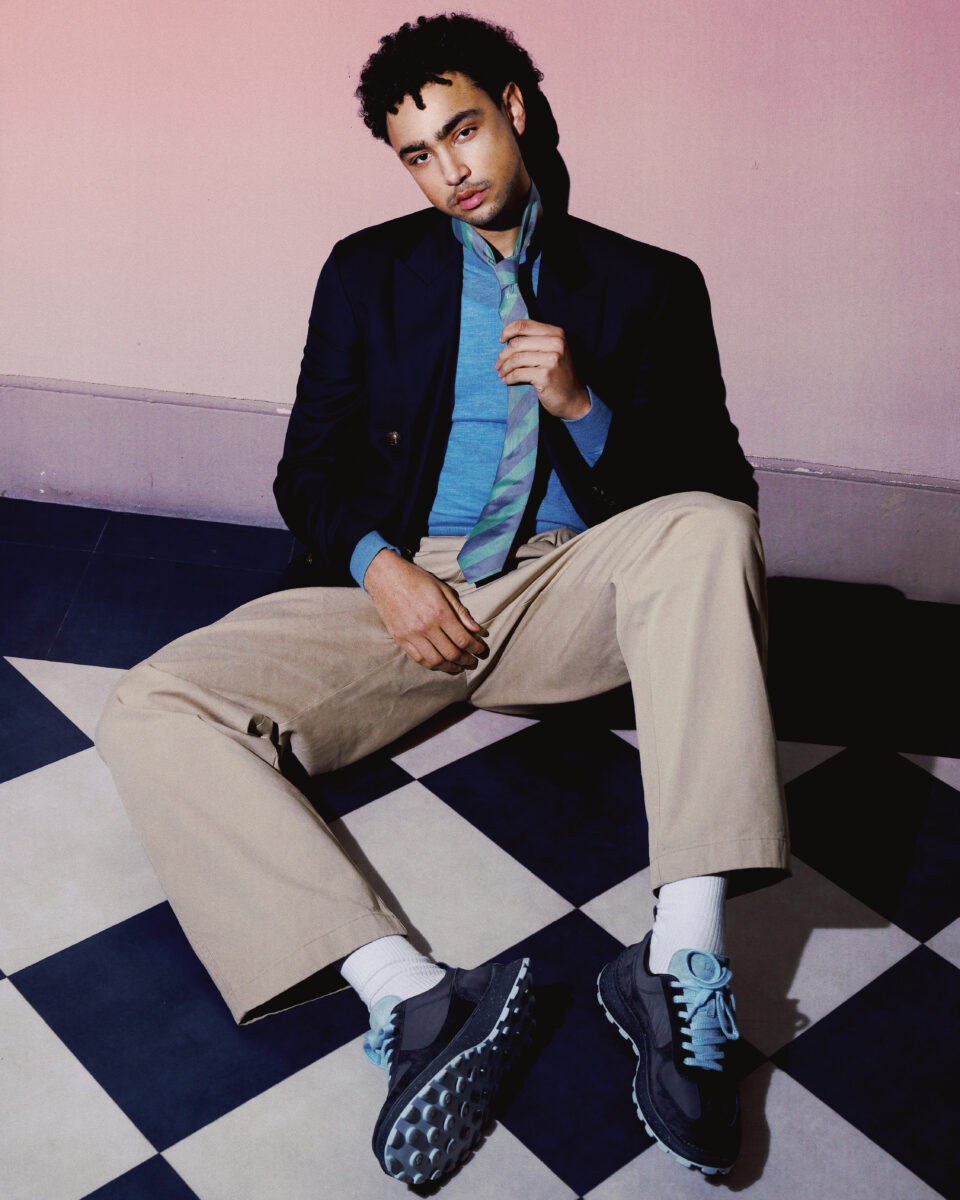
LA: I’ve never been. I’m quite scared of people who are formally trained, because I left school at 15, I don’t have a single GCSE, and I don’t really play any musical instruments. I can work things out, but I don’t play live. So I feel like if I went to the BRIT School, everyone would just think I was a fraud.
AM: You’re so, so wrong about that. Loads of your contemporaries went to BRIT, like Kate Nash and Adele, and Adele isn’t on stage playing piano. That’s not really the emphasis there. BRIT isn’t a classical training school; it’s not about studying Bach and Mozart. It’s more a place that supports whatever creative energy you’re bringing to it. It’s really difficult for a lot of young people to find their way into the industry now, especially young people of colour and those from diverse or marginalised backgrounds. That’s at the heart of the school’s ethos, supporting those voices. Any spotlight we can shine on it feels really important. That’s my BRIT School love. I honestly think you’d really like it.
LA: I think I’m too old to go there now [laughs]. If you hadn’t done acting, what do you think you would have done?
AM: I don’t know. There was a moment when I thought I might want to be an animal conservationist. I even worked in a lion orphanage in South-Africa, which feels so random now. And when I was really young, I wanted to be a journalist. I used to make fake newspapers at home and give them to my brother, my mum and dad, just reporting on the weekly drama of the house. What did you want to do?
LA: Well, I was a florist for a bit, right up until just before “LDN” and “Smile” came out. I worked at a florist called McQueens in East London. I trained there and then worked there for a year and a half. I didn’t feel like I had much going for me at the time, and I really loved flowers. I loved how they looked, and I loved working in a medium that doesn’t talk back or have a voice, so you’re completely in control of it. There have also been moments in my life when things haven’t been going so well professionally, and I’ve thought, ‘Do I need to pivot?’ I’ve considered being a lawyer. I think I’d be quite a good defamation lawyer; I’ve got a lot of experience in that area and could have helped a few people. And for a while, I also wanted to be a midwife. I seriously thought about going off and training in midwifery.
AM: How long are we talking?
LA: Not to put a downer on this interview, but I had a son who died during birth in 2010. He was stillborn. At the time, I didn’t think I could ever do anything public-facing again.
AM: I’m sorry Lily.
LA: I was really inspired by the women who helped me through that experience, and I felt that, having been through something so harrowing myself, I might be able to help others going through something similar. That was the thinking behind it. I even signed up for a bunch of courses that I never actually did, but I still sometimes get calls saying, ‘Hello, are you still interested in the midwifery course starting in September?’ And I’m like, no, I’m good.
AM: Do you know who does that? Erykah Badu is a doula. I got in an Uber once in LA, and this woman was telling me how she was about to give birth and Erykah Badu was her doula. I was like, ‘What the hell?’ Pretty mad.
LA: I love Erykah Badu, but I don’t know if I’d want her in the room when I was giving birth, quite frankly [laughs]. Where were you when you found out about the EE BAFTA Rising Star Award? Who did you tell, and how did you celebrate?
AM: I was actually sitting on the floor outside 180 House, having a therapy session on Zoom. I couldn’t get anywhere else in time. The first person I told was my ex, and the second was my mum. She didn’t really know how to respond at first. I think she wanted to respect my job, so she went very quiet and said, ‘Oh, what can I say?’ I could hear she was crying, and then she started screaming. We weren’t really supposed to tell anyone, but I was going for dinner with our mutual friend Saffron [Hocking], and I said, ‘I’ve got a secret. We have to celebrate tonight, because I’ve just been nominated for a BAFTA.’ And then we had a really big, fun night.
LA: That wasn’t the same night with the Lime bike, was it?
AM: No, oh my God. Separate night. We put poor Saffron on a bike for the first time, and she must have told us a hundred times that evening, ‘I’m not good on a Lime. I don’t want to get on one. I’ve never done it before. I’m not confident on a bike.’ We kept saying, ‘Oh, you’ll be fine.’ The second she got on, she fell straight into a pile of Lime bikes, and they all came down like dominoes.
LA: It was one of the funniest things I’ve ever seen. That clip on Instagram deserves a BAFTA nomination in itself. The fact that you got it from two different angles just makes it even better. I like that you’re just taking random girls around London and showing them Lime bikes for the first time though, because my first Lime bike ride was with you too.
AM: You send champagne to random boys, I take people on Lime bikes. That’s all we have.
LA: Ours was weird. We had to carry the Lime bikes and pass them over the fence because they were locked in a compound.
AM: It was after the end of the festival and we were trying to sneak out. Did we climb over a fence?
LA: I definitely climbed over a fence because I was the smallest. I can’t imagine that I was going to be lifting the Limes over, because I can’t even lift one off a curb, never mind over a fence.
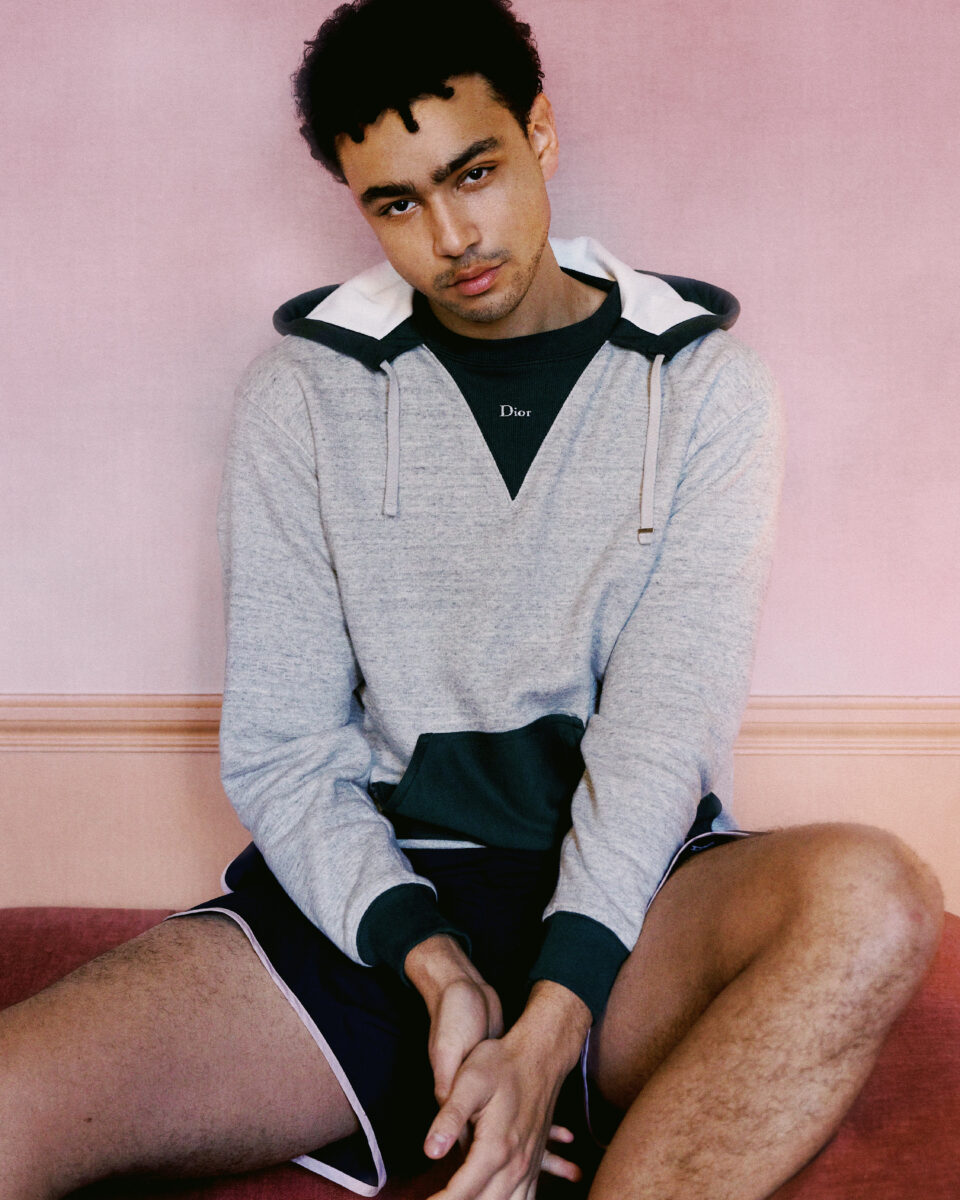
AM: I think we sent someone we didn’t know over the fence to try and pass the Limes to us, then realised she couldn’t. So we climbed over ourselves and cycled the bikes out. It was such a fun night, one of those beautiful summer evenings where it’s still warm and still late. We cycled down the canal, and you can’t ride a bike through London with Lily Allen without thinking: ‘Riding through the city on my bike all day.’
LA: [Laughs] Every night I’ve had out with you has been lovely. You’re a lovely boy. What message do you have for the voters out there, apart from ‘vote for me’?
AM: Everyone in this category is so brilliant, and honestly, the real win is the nomination itself. The people nominated each year tend to mark the next generation of incredible talent. I’ve been working for a long time now, and there was a year when Saltburn and Gran Turismo came out around the same time. My agent was so convinced I’d be nominated that she bought a dress and then had to return it. It’s just a reminder that everyone’s journey looks completely different. People get excited, promises get made, and you’re told your name will come up in certain conversations. When it doesn’t, the only thing you can really focus on is making good work and feeling proud of it. That’s what ends up driving you. To be recognised by your industry and your peers is such a beautiful thing, and it’s a deep honour. To actually win would be unbelievable, but I can’t think that far ahead. I’m just happy to be included.
LA: I think that’s a great way of looking at it. Now, I haven’t seen Lurker – not for want of trying. I tried to go a couple of weeks before Christmas, but it was fully booked at all my local cinemas. Me and [journalist] Olivia Singer even tried to go together, but we ended up seeing Die My Love instead, which was interesting. What first drew you to the script for Lurker? I know roughly what it’s about, but tell the readers.
AM: I think to make a film about music that doesn’t feel false is really hard, and this just instantly felt real and recognisable. It felt like an era of music I knew and grew up with, without being corny or try-hard. It was grounded in reality. A lot of that comes from Alex Russell, the writer-director. Before writing for things like The Bear, Dave, and Beef, he was a hip-hop and R&B music journalist for years, so it’s a world he knows intimately, and that really came through on the page. It had this kinetic energy. It was funny, fun, cringey, and every page felt like it could tip into a different genre at any moment. As soon as I read it, I wanted to be part of it. I taped for it and genuinely thought I’d smashed it. My agent was texting me saying, ‘You crushed that tape,’ and then…nothing. Total silence. They ended up casting Théo [Pellerin]. I’d originally auditioned for the other role, Matthew, and years went by while the film took on different lives. Then my agent called and said Alex was in New York and wanted to meet me about Lurker. I assumed the film had already been made, but he said, ‘No, he wants you to play Oliver.’ It turns out Alex had seen me in a coffee shop in LA, watched me for about half an hour, and thought, ‘I think he could play Oliver in my film.’
LA: That’s quite lurkery in itself, isn’t it?
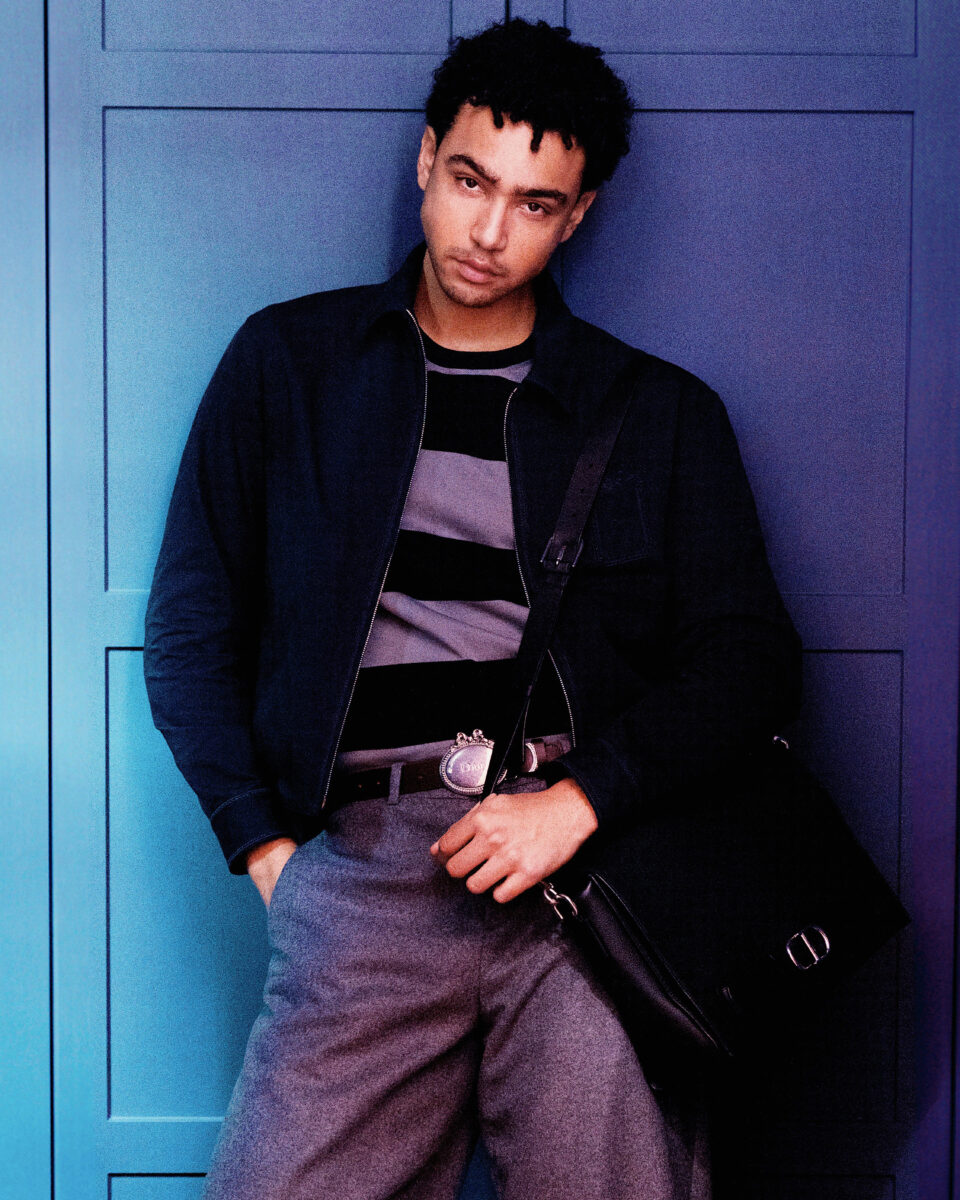
AM: It’s a little bit lurkery. He hates it every time I tell that story and is always like, ‘Just shut up.’ But I think it’s a really beautiful, full-circle, what’s-meant-for-you-will-find-you moment. It nearly passed me by. He never even saw my tape. It was only someone mentioning my name, and then him seeing me in that coffee shop, that led me to the part.
LA: That’s so crazy. Were you obsessed with movie or music stars as a kid? Were you a big fan? Did you have posters on your wall of people?
AM: I remember having a poster of Blazin’ Squad as a kid. And they were actually the first people I saw live.
LA: I respect that.
AM: I think I was always deeply in love with Beyoncé.
LA: Have you ever seen Beyoncé play in a concert?
AM: Yeah, I have. Beyoncé actually held my hands and sang “Halo” once. A crazy story.
LA: Wow.
AM: I was never like a crazy fanboy for anyone in particular though.
LA: Yeah, I dunno. You were waiting outside the theatre when I did a play. You wanted to have a quick chat.
AM: I was waiting because you were taking so fucking long to get ready.
LA: [Laughs] What is your latest obsession?
AM: I’m really into English folklore and mythology at the moment. I’ve been reading all these books about medieval Britain, and I’m fascinated by the myths and stories that shape ideas of England and what makes it feel “British”. I’ve been deep in that world recently. What about you?
LA: I’m big into stickers.
AM: What kind of stickers?
LA: There’s a place in LA called Sticker Planet, and whenever I’m there, it’s like a pilgrimage. It’s the first thing I do. I go to Sticker Planet at the farmers’ market and drop a couple of hundred dollars on stickers for my collection.
AM: Two follow-up questions: what kind of stickers are they, and where do you stick them?
LA: All kinds of stickers. They live in a big Prada pouch, like a wash bag, that I carry around with me everywhere. I take them all over the world. Sometimes I put them on thank you notes, sometimes I decorate my notebooks. If I’m working with writers I really like, I’ll sometimes make them a notebook and personalise it with stickers I think suit them.
AM: Are you going to do that for the girls in Mexico?
LA: Yeah, I probably will. I’ve also always been interested in evacuee stories from the Second World War.
AM: That’s so funny, same.
LA: I’m really excited about Narnia. I had this book, When Hitler Stole Pink Rabbit, when I was a kid, and I loved Carrie’s War. I devoured those stories. Make what you will of that. I think I had quite a turbulent childhood, and there was something about the idea of being taken out of your home and sent to live with strangers in the countryside that really appealed to me.
AM: Well, that’s probably one to unpack another time.
LA: The other thing I’m quite obsessed with is the court of Henry VIII. I always thought I’d do well.
AM: Oh, did you really? You thought that you’d survive?
LA: I think that Henry would be intrigued by me.
AM: I think so.
LA: I think we’d get on for a couple of years and then I’d be beheaded.
AM: You think you would have acted out a little bit?
LA: As a woman in those days, there was a lot of scheming involved in simply surviving. I’m interested in the bravery of that, especially knowing there were real consequences. Life was mapped out for you as a woman, a path chosen not by you. But if you were scheming enough, you might be able to carve out something different for yourself. I see a lot of parallels in my own life [laughs]. And I love the clothes. I think the clothes are great. I would have happily worn some of those mad dresses made with French silks.
AM: Did you see 1536 at the Almeida?
LA: No, I did not. But I heard great things.
AM: It was so fucking good. I think it’s going to transfer. We’ll go and scratch the Henry VIII itch.
LA: You have to take me. I can’t believe I’ve just revealed my World War evacuee and Tudor obsession. What a strange person I am. In acting generally, how instinctive is your process versus intellectual?
AM: It’s a bit of both, and it really depends on the part. It always starts with the work. Preparing is quite intellectual for me, doing the research, which is often the fun bit. You’re sticking stickers in your notebook [laughs], filling things in, inventing and discovering, playing make-believe for a moment. Then you reach a point where you have to throw all of that away and just go with your gut and your instincts. But the measurements of that are different for every role. Everything kind of takes something a little bit different. What about you? What do you feel when you’re acting?
LA: What do I feel when I’m acting? I don’t know, I just feel like I’m walking off a cliff. Quite often, I don’t really feel like I fully understand the script, so I just make up a story in my own head that makes sense [laughs].
AM: Right. So nothing intellectual, just pure gut instinct.
LA: Listen, I don’t know if I consider myself a technical actress.
AM: Do you still not?
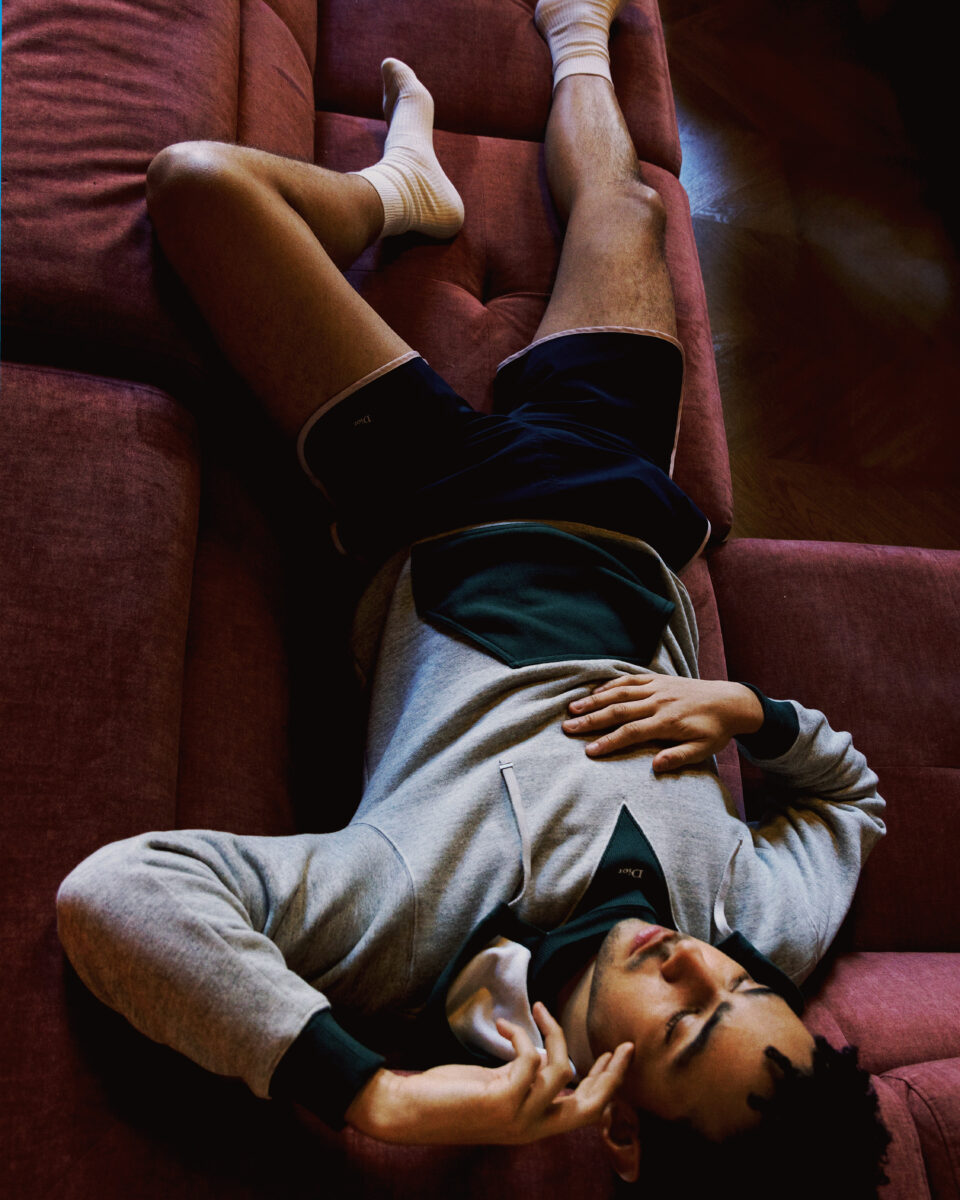
LA: No, I don’t. I really enjoy acting, but I don’t love being on camera. I don’t love the waiting around that comes with film and TV; it sort of takes me out of it. What I really love is writing songs. That’s my favourite thing. I don’t even love singing them that much. I love having a story to tell and trying to make it work within a specific amount of time. In pop music, that’s three and a half minutes or whatever. That’s why theatre feels similar to me. You’re trying to tell a story over a set period of time, whether it’s two and a half hours or three, and you just want the audience to believe it. I feel like I’m trying to do the same thing with a song. People often assume performing as a singer and being on stage in theatre must be similar, but it’s completely different. There’s a fourth wall in the theatre that doesn’t exist when I’m on stage being Lily Allen. I really love theatre. I love biting off more than I can chew and throwing myself into the deep end. I love being part of a company and learning a new process, and I love how the piece keeps changing for me from the start of rehearsals right through to the final show. My understanding of it is always evolving. I don’t have the attention span or brain capacity for the method approach, but I do think I can access certain emotions, though.
AM: I would say that you are an actor, by the way. Just because you don’t have the same process as someone who works ‘method’ doesn’t make you any less of one. If you’re doing it, you’re an actor.
LA: Thank you. I appreciate that. Tell all your friends.
AM: Welcome, welcome, welcome.
LA: How did you and Sophie work together to build the chemistry and trust that underpins your relationship as best friends in your new Amazon Prime series, Steal?
AM: Me and Sophie got really lucky. A week before we started shooting, we bumped into each other on holiday in Italy and ended up having this really fun time together, going out for dinners and hanging out. So we started the job with a friendship already in place. She’s the funniest, loveliest person, and that bond became very real, very quickly. We also had to rely on each other a lot. The days were long, spent inside a studio, and in the height of summer, everything felt even more lethargic. As you said, there’s so much waiting around on set, so much doing nothing, and we were shooting in this fake office where we were basically working an office job all day. On and off camera, we leaned on that friendship to lift each other and get through it. But it was so much fun.
LA: Good, pleased to hear that. What can you tell me about your upcoming project, The Arrival, in which you star alongside Kingsley Ben-Adir, and what can audiences expect from it?
AM: It’s a really special project, a film by director Bijan Sheibani. It centres on two brothers who are estranged and meet for the first time in adulthood, trying to connect, find friendship, and build a relationship over the course of several years. When I read the script, I just thought, wow, what a beautiful opportunity to act. Some of the scenes are around 18-pages long, and we’re doing them in single takes. For the most part, the film is Kingsley and me in these big, long, meaty scenes. It felt like a real chance to properly dig into something, and it absolutely was. I also really love working with first-time directors. When you trust someone and feel like you’re taking a risk together, believing in their vision, I love that feeling.
LA: Do you want to write and direct?
AM: I am in the process of working on my debut right now.
LA: I did actually know that [laughs]. Do you want to talk about it?
AM: I probably don’t want to say too much, but it’s the thing I’m feeling most inspired and excited by right now. It’s really working my brain, and it feels good to be back in a space where I’m deeply challenged, problem-solving, learning, and genuinely excited by the process. I’m also working with an incredible group of people, and it feels like we’re all on the same journey, telling the same story together. I still can’t quite believe that people have read something I’ve written, think it’s good, and actually want to make it with me.
LA: And responding to your work – that’s the best feeling. I’m going to give you two more questions. Is there a type of role you’re actively resisting, or one you haven’t been offered yet that you’d love to do?
AM: No, actually. It’s really boring, but it’s always a surprise. That’s the best feeling, when something really catches you off guard. You read something, maybe a bit reluctantly, because you’re tired or not quite in the headspace, and then suddenly you can’t put it down. Or you’re surprised by how you see yourself in it, or how it hits you emotionally. It’s not genre-specific or about a particular type of character. I’m always trying to surprise myself, challenge myself, and do something I haven’t done before. You do something like Saltburn and suddenly five Saltburn’s land in your inbox. I’m trying to do the opposite of that. But honestly, everything’s on the table.
LA: Does it matter to you how people perceive your body of work a decade from now, or are you just on your own journey and you don’t give a fuck?
AM: I don’t necessarily know what that story is yet. What I am very aware of, as a person of colour, is that there aren’t always many people who get the opportunity to tell the kinds of stories I’ve been lucky enough to be part of. I’m conscious of how the roles speak to each other in relation to who I am, what I look like, and the people who’ve come before me. I do want a story to be told, but I think I’m still in the middle of writing it. I’m not sure what it says yet.
LA: This has been an absolute pleasure. Sorry it was half in a taxi and half in a basement.
AM: Don’t be silly, mate. It was so lovely. Thank you so much for doing this.
LA: My pleasure. I’ll hit you up and ask you for one in return someday.
AM: One hundred per cent. I’ve got you.
Photography by Axle Jozeph
Styling by Abigail Hazard
Interview by Lily Allen
Words by Ella Bardsley
Grooming by Maya Man at Stella Creative Artists using Dior Backstage Foundation and Dior Homme Dermo System
Fashion Assistant Scarlett Milroy
Videography by Roy Brandys
Senior Editor Ella Bardsley
Features Editor Ben Tibbits
Assistant Editor Aswan Magumbe
Art Director Mike Morton
Assistant Art Director Beth Griffiths
Junior Art Director Natasha Lesiakowska
Fashion Director Abigail Hazard
Production Director Lola Randall
Production Director Clemmie Hyde
in HTML format, including tags, to make it appealing and easy to read for Japanese-speaking readers aged 20 to 40 interested in fashion. Organize the content with appropriate headings and subheadings (h1, h2, h3, h4, h5, h6), translating all text, including headings, into Japanese. Retain any existing
tags from
With Saltburn and Lurker sharpening his ascent, Dior muse, London lad, and madcap actor Archie Madekwe arrives at a new threshold of attention: BAFTA-nominated. His friend, pop queen Lily Allen, gets the A–Z on arthouse cinema’s latest crush.
Archie Madekwe knows how to keep a secret. Even from one of the biggest pop stars in the world, or, as the 30-year-old actor knows her, dear friend, Lime-bike partner in crime and fellow Second World War history obsessive, Lily Allen. But with news of his EE BAFTA Rising Star nomination now public, London’s hottest rising actor is ready to talk. And Lily is listening.
“It’s very exciting and cool,” she tells him from the back of a London taxi because it’s, “the only way I could sit in a quiet place for half an hour.”
“Do you know what you’re going to wear?” she asks.
Archie pauses, a beat that implies this, too, is classified information. “Well, we’re working on that,” he laughs. It’s January, and he’s sitting in his London flat, a neatly made bed behind him, an overflowing bookcase to his right. “It’s going to stay a secret in case it changes.” Off-screen or on, Archie always commits to the bit. In this instance, to protect the important identity of a career-shifting red carpet look.
A growing list of directors seem to agree. Early roles – from a ritual execution as Simon in Ari Aster’s Midsommar to the devious Kai in Neil Burger’s existential sci-fi adventure Voyagers – announced a performer willing to sit with discomfort and contradiction, unafraid of the strange or the unsettling. Gran Turismo followed, a sharp left turn into physical transformation, learning to drive at speed in a matter of weeks, and for that he made a vow: through sickness, and sickness, and more sickness. Next up was Saltburn, which pushed him into wider view as Barry Keoghan’s acid-tongued counterpart, the devilishly puffed-up Farleigh, a performance that proved impossible to look away from.
Then came his turn as up-and-coming musician Oliver in Alex Russell’s psychological-thriller Lurker, the role that pulled everything into focus, earning him the EE BAFTA Rising Star nomination and a reputation for being, at once, irresistibly alluring and unequivocally chilling. It is a double register that is hard to find, let alone sustain. Upcoming projects point towards something bigger without sanding down what made him compelling in the first place. There is Steal, alongside Sophie Turner, and Arrival, opposite Kingsley Ben-Adir. The mainstream beckons, but the off-kilter edges remain intact.
To unpack it all, Archie spends over an hour on the phone with Lily, one British darling reflecting on another. They talk serendipity, scriptwriting, and surviving the court of Henry VIII.
Archie Madekwe: Where are you?
Lily Allen: I’m in London until Saturday, and then I’m going back to LA, and then Mexico the next day.
AM: For a holiday?
LA: No, I rented a villa there because I’m a rich pop star again [laughs]. And I am doing a writing retreat with five female friends and producers that I know.
AM: You’ve not wasted any time.
LA: Well, you know.
AM: The juices are flowing.
LA: There’s a lot to be said. Less about me though. Shall I just roll straight into these questions?
AM: Sure. It’s just occurred to me now that you actually are really qualified for this because you’ve got a podcast.
LA: [Laughs] No, we never had guests, and I would never ask Miquita [Oliver] anything.
AM: I feel like you’ve always got guests on now though.
LA: They do now that it’s Miquita and Jordan [Stephens], but we never had before. The main reason for that was, I don’t know if you get this, but you know when you go to industry social events, the podcasters just zoom in on you and are just like, ‘Hey, so nice to see you.’ ‘Oh, I have this podcast, would you ever want to come on?’ And I always just thought, I don’t want to go to everything thinking who can I get, like Pokémon or something.
AM: At this press event yesterday, someone said to me, ‘I’m working on this podcast. Real quick, do you have any questions on the top of your mind about puberty?’ I was like, what? I’m actually not in that headspace right now. I’m actually really thinking about me and the EE Rising Star BAFTA nomination [laughs]. But I’ll circle back if I do. But go off, sis.
LA: [Laughs] How did we first meet?
AM: We met for the very first time because I did a film with your ex. I was at Chiltern Firehouse, sitting at the bar, and a waiter came over and said, ‘Hey, here’s a glass of champagne from the lady over there.’ You said, ‘Hi, I just wanted to say congrats on the film.’ It was just so sweet and kind of you. We had a chat, and then I would just see you around London lots. We have a few mutual friends.
LA: I’m going to make a couple of corrections. It was a bottle of champagne [laughs]. And also, it was because the film had just come out and you’d had very good numbers.
AM: Both of those corrections could be corrected. Still a very lovely thing.
LA: I don’t want people to think I’m just sending glasses of champagne around to random men because I vaguely know them through someone else [laughs].
AM: It was a really sweet and kind thing to do. I think it just set the tone for the way that I viewed you. I had obviously known about you growing up, but then knowing you personally, it was just like, she’s a real one.
LA: I really believe in gratitude and generosity as an art form. I love writing thank you notes, and I love sending people presents, if I’ve got enough money in the bank to do so.
AM: I love cards. I don’t always need a present, but I think when somebody takes the time to write you a really thoughtful card, it really means a lot.
LA: It hits home. What do we admire in each other as artists and performers?
AM: What I’ve always loved about you is you’re such an amazing storyteller, and your writing is not only so honest, transparent, and vulnerable, but also so funny. It’s always laced with humour and something that catches you off guard. And to me, that feels quite distinctly British. I think that’s a really beautiful and special quality to have as an artist. Have you seen any of my films?
LA: Thank you so much. I saw you in Saltburn. I watched Gran Turismo. I’ve seen you in a few things. I feel like when you’re trying to convey something important, it never feels too big. It feels subtle and grounded. It doesn’t feel contrived. I feel like I believe you.
AM: [Laughs] That’s a nice quality to have as an actor.
LA: I believe what you’re doing.
AM: I’m turning my camera off because no one else’s is on.
LA: Wait, hang on. I’ll turn mine on. How do I do that? I’m so bad with technology.
AM: Press the little video icon.
LA: I can’t even see that.
AM: Does it say ‘Start video’, ‘Turn on video’? You might have to swipe. You’ve muted yourself. And again. OK, it’s not the microphone, it’s the video, Lily.
LA: Yeah, it’s not letting me do it. I don’t look particularly hot today, so… moving on. When did acting enter the picture for you? Do you remember who first believed in you and made an impact on your sense of self as an actor?
AM: I was also really lucky that I had a lot of belief and a lot of freedom as a young person. My parents never limited me. They never tried to get me to do something else. I was never particularly sporty or academic; I really kind of gravitated towards the arts. It wasn’t necessarily just acting as a young person. It was music, writing, storytelling and dance. I just did anything that felt slightly creative. I guess along the way you have those people that liberate you, or enable you, or believe in you – [Lily turns on her video] oh, there you are, well done. One of the people was my cousin Ashley, who is an actor, and she did a lot of theatre growing up. I remember seeing her in a Roy Williams play, Little Sweet Thing. That really felt like a world that I knew. I hadn’t had many of those experiences, and then going to the BRIT School kind of changed my life completely. It was the first time that, as a kid, adults really believed that you could do the thing you were saying you could do, and really wanted you to achieve it. Then the last shout-out I’ll give is to Cush Jumbo. Cush Jumbo is a very prolific, very talented actor who I would always kind of say is my mentor. Cush went to BRIT, but years before me. She came in and did a talk once, and I went over to her. I was quite precocious and was like, ‘You know, I want to be an actor, and my name’s Archie, I follow you on Twitter.’ We kept in touch, and I would send her these rambling emails telling her I’m applying for drama school, or I feel stressed about this part of my journey. She always took the time to respond to me in paragraphs and saw me as an equal, saw me as somebody who was worth responding to, and saw me as somebody who was an actor alongside her. I didn’t feel like I was a kid messaging her. That was really liberating; when people in positions of power see a young person and allow them to be themselves.
LA: Yeah, that’s interesting. I mean, just at the top of what you said about having adults supporting you has transported me back. I dropped out of secondary school very early. I think I was like 14 or 15. I remember I had this headmistress, and I got in trouble with her, and I was pulled into her office, and she said, ‘What is it that you want to do in life?’ I said, ‘I want to be a singer.’ And she just stared at me over her glasses, and she went, ‘Now, babe, you know it’s very unlikely that it’s going to happen.’ I was like, I’m 15. What are you talking about?
AM: I mean, it’s crazy. At that age, you should just support anything that a young person is excited about doing. You should just be stoking the fire. I’m glad you didn’t listen to her.
LA: I actually thanked her in my first album, Sheezus, for the encouragement. It really stuck with me. It really made me convinced for a while. I was like, maybe I have missed the boat on this. Maybe I should be more accomplished at the age of 15. Did you like the BRIT School?
AM: Oh, it was one of the most special places in the world. It completely changed my life. I think not only was it empowering me, but also the lessons that it teaches you outside of the arts are so important. You wear your own clothes, you call your teachers by their first name. We had Black History Month assemblies and LGBTQ+ assemblies every month. We were just constantly celebrating the differences in people and recognising that everyone in our class, everyone in the school, was very distinctly different, and that’s something to be celebrated. And it’s completely free, which is unbelievable, especially today with the way arts funding is being cut. It’s a really important place.
LA: Do they give you media training at the BRIT School?
AM: No, they actually do the opposite. You’re not allowed to audition for things, and they don’t really prepare you for the industry at all. The only time I remember feeling different was when Tom Holland, who was a year below me, came in while he was on the press tour for The Impossible. It was a big deal, because other students had been told they couldn’t take auditions or jobs, so everyone definitely felt a type of way about it. When I got my agent, I was pretty clueless. In our final year, we had this showcase evening where agents and producers came to watch monologues and duologues, and that’s how I met Olivia Woodward, who’s still my agent. I genuinely thought, ‘Right, that’s just what happens.’ I didn’t realise how oversubscribed the industry is, or how rare it is to land a brilliant agent that young. I went into meetings with this odd confidence, like I was choosing them, not realising they had to choose me too. I had no idea how lucky I was that someone believed in me.
LA: Gosh, it’s so great that it’s free, isn’t it? It’s such a brilliant place.
AM: Have you been there?
LA: I’ve never been. I’m quite scared of people who are formally trained, because I left school at 15, I don’t have a single GCSE, and I don’t really play any musical instruments. I can work things out, but I don’t play live. So I feel like if I went to the BRIT School, everyone would just think I was a fraud.
AM: You’re so, so wrong about that. Loads of your contemporaries went to BRIT, like Kate Nash and Adele, and Adele isn’t on stage playing piano. That’s not really the emphasis there. BRIT isn’t a classical training school; it’s not about studying Bach and Mozart. It’s more a place that supports whatever creative energy you’re bringing to it. It’s really difficult for a lot of young people to find their way into the industry now, especially young people of colour and those from diverse or marginalised backgrounds. That’s at the heart of the school’s ethos, supporting those voices. Any spotlight we can shine on it feels really important. That’s my BRIT School love. I honestly think you’d really like it.
LA: I think I’m too old to go there now [laughs]. If you hadn’t done acting, what do you think you would have done?
AM: I don’t know. There was a moment when I thought I might want to be an animal conservationist. I even worked in a lion orphanage in South-Africa, which feels so random now. And when I was really young, I wanted to be a journalist. I used to make fake newspapers at home and give them to my brother, my mum and dad, just reporting on the weekly drama of the house. What did you want to do?
LA: Well, I was a florist for a bit, right up until just before “LDN” and “Smile” came out. I worked at a florist called McQueens in East London. I trained there and then worked there for a year and a half. I didn’t feel like I had much going for me at the time, and I really loved flowers. I loved how they looked, and I loved working in a medium that doesn’t talk back or have a voice, so you’re completely in control of it. There have also been moments in my life when things haven’t been going so well professionally, and I’ve thought, ‘Do I need to pivot?’ I’ve considered being a lawyer. I think I’d be quite a good defamation lawyer; I’ve got a lot of experience in that area and could have helped a few people. And for a while, I also wanted to be a midwife. I seriously thought about going off and training in midwifery.
AM: How long are we talking?
LA: Not to put a downer on this interview, but I had a son who died during birth in 2010. He was stillborn. At the time, I didn’t think I could ever do anything public-facing again.
AM: I’m sorry Lily.
LA: I was really inspired by the women who helped me through that experience, and I felt that, having been through something so harrowing myself, I might be able to help others going through something similar. That was the thinking behind it. I even signed up for a bunch of courses that I never actually did, but I still sometimes get calls saying, ‘Hello, are you still interested in the midwifery course starting in September?’ And I’m like, no, I’m good.
AM: Do you know who does that? Erykah Badu is a doula. I got in an Uber once in LA, and this woman was telling me how she was about to give birth and Erykah Badu was her doula. I was like, ‘What the hell?’ Pretty mad.
LA: I love Erykah Badu, but I don’t know if I’d want her in the room when I was giving birth, quite frankly [laughs]. Where were you when you found out about the EE BAFTA Rising Star Award? Who did you tell, and how did you celebrate?
AM: I was actually sitting on the floor outside 180 House, having a therapy session on Zoom. I couldn’t get anywhere else in time. The first person I told was my ex, and the second was my mum. She didn’t really know how to respond at first. I think she wanted to respect my job, so she went very quiet and said, ‘Oh, what can I say?’ I could hear she was crying, and then she started screaming. We weren’t really supposed to tell anyone, but I was going for dinner with our mutual friend Saffron [Hocking], and I said, ‘I’ve got a secret. We have to celebrate tonight, because I’ve just been nominated for a BAFTA.’ And then we had a really big, fun night.
LA: That wasn’t the same night with the Lime bike, was it?
AM: No, oh my God. Separate night. We put poor Saffron on a bike for the first time, and she must have told us a hundred times that evening, ‘I’m not good on a Lime. I don’t want to get on one. I’ve never done it before. I’m not confident on a bike.’ We kept saying, ‘Oh, you’ll be fine.’ The second she got on, she fell straight into a pile of Lime bikes, and they all came down like dominoes.
LA: It was one of the funniest things I’ve ever seen. That clip on Instagram deserves a BAFTA nomination in itself. The fact that you got it from two different angles just makes it even better. I like that you’re just taking random girls around London and showing them Lime bikes for the first time though, because my first Lime bike ride was with you too.
AM: You send champagne to random boys, I take people on Lime bikes. That’s all we have.
LA: Ours was weird. We had to carry the Lime bikes and pass them over the fence because they were locked in a compound.
AM: It was after the end of the festival and we were trying to sneak out. Did we climb over a fence?
LA: I definitely climbed over a fence because I was the smallest. I can’t imagine that I was going to be lifting the Limes over, because I can’t even lift one off a curb, never mind over a fence.
AM: I think we sent someone we didn’t know over the fence to try and pass the Limes to us, then realised she couldn’t. So we climbed over ourselves and cycled the bikes out. It was such a fun night, one of those beautiful summer evenings where it’s still warm and still late. We cycled down the canal, and you can’t ride a bike through London with Lily Allen without thinking: ‘Riding through the city on my bike all day.’
LA: [Laughs] Every night I’ve had out with you has been lovely. You’re a lovely boy. What message do you have for the voters out there, apart from ‘vote for me’?
AM: Everyone in this category is so brilliant, and honestly, the real win is the nomination itself. The people nominated each year tend to mark the next generation of incredible talent. I’ve been working for a long time now, and there was a year when Saltburn and Gran Turismo came out around the same time. My agent was so convinced I’d be nominated that she bought a dress and then had to return it. It’s just a reminder that everyone’s journey looks completely different. People get excited, promises get made, and you’re told your name will come up in certain conversations. When it doesn’t, the only thing you can really focus on is making good work and feeling proud of it. That’s what ends up driving you. To be recognised by your industry and your peers is such a beautiful thing, and it’s a deep honour. To actually win would be unbelievable, but I can’t think that far ahead. I’m just happy to be included.
LA: I think that’s a great way of looking at it. Now, I haven’t seen Lurker – not for want of trying. I tried to go a couple of weeks before Christmas, but it was fully booked at all my local cinemas. Me and [journalist] Olivia Singer even tried to go together, but we ended up seeing Die My Love instead, which was interesting. What first drew you to the script for Lurker? I know roughly what it’s about, but tell the readers.
AM: I think to make a film about music that doesn’t feel false is really hard, and this just instantly felt real and recognisable. It felt like an era of music I knew and grew up with, without being corny or try-hard. It was grounded in reality. A lot of that comes from Alex Russell, the writer-director. Before writing for things like The Bear, Dave, and Beef, he was a hip-hop and R&B music journalist for years, so it’s a world he knows intimately, and that really came through on the page. It had this kinetic energy. It was funny, fun, cringey, and every page felt like it could tip into a different genre at any moment. As soon as I read it, I wanted to be part of it. I taped for it and genuinely thought I’d smashed it. My agent was texting me saying, ‘You crushed that tape,’ and then…nothing. Total silence. They ended up casting Théo [Pellerin]. I’d originally auditioned for the other role, Matthew, and years went by while the film took on different lives. Then my agent called and said Alex was in New York and wanted to meet me about Lurker. I assumed the film had already been made, but he said, ‘No, he wants you to play Oliver.’ It turns out Alex had seen me in a coffee shop in LA, watched me for about half an hour, and thought, ‘I think he could play Oliver in my film.’
LA: That’s quite lurkery in itself, isn’t it?
AM: It’s a little bit lurkery. He hates it every time I tell that story and is always like, ‘Just shut up.’ But I think it’s a really beautiful, full-circle, what’s-meant-for-you-will-find-you moment. It nearly passed me by. He never even saw my tape. It was only someone mentioning my name, and then him seeing me in that coffee shop, that led me to the part.
LA: That’s so crazy. Were you obsessed with movie or music stars as a kid? Were you a big fan? Did you have posters on your wall of people?
AM: I remember having a poster of Blazin’ Squad as a kid. And they were actually the first people I saw live.
LA: I respect that.
AM: I think I was always deeply in love with Beyoncé.
LA: Have you ever seen Beyoncé play in a concert?
AM: Yeah, I have. Beyoncé actually held my hands and sang “Halo” once. A crazy story.
LA: Wow.
AM: I was never like a crazy fanboy for anyone in particular though.
LA: Yeah, I dunno. You were waiting outside the theatre when I did a play. You wanted to have a quick chat.
AM: I was waiting because you were taking so fucking long to get ready.
LA: [Laughs] What is your latest obsession?
AM: I’m really into English folklore and mythology at the moment. I’ve been reading all these books about medieval Britain, and I’m fascinated by the myths and stories that shape ideas of England and what makes it feel “British”. I’ve been deep in that world recently. What about you?
LA: I’m big into stickers.
AM: What kind of stickers?
LA: There’s a place in LA called Sticker Planet, and whenever I’m there, it’s like a pilgrimage. It’s the first thing I do. I go to Sticker Planet at the farmers’ market and drop a couple of hundred dollars on stickers for my collection.
AM: Two follow-up questions: what kind of stickers are they, and where do you stick them?
LA: All kinds of stickers. They live in a big Prada pouch, like a wash bag, that I carry around with me everywhere. I take them all over the world. Sometimes I put them on thank you notes, sometimes I decorate my notebooks. If I’m working with writers I really like, I’ll sometimes make them a notebook and personalise it with stickers I think suit them.
AM: Are you going to do that for the girls in Mexico?
LA: Yeah, I probably will. I’ve also always been interested in evacuee stories from the Second World War.
AM: That’s so funny, same.
LA: I’m really excited about Narnia. I had this book, When Hitler Stole Pink Rabbit, when I was a kid, and I loved Carrie’s War. I devoured those stories. Make what you will of that. I think I had quite a turbulent childhood, and there was something about the idea of being taken out of your home and sent to live with strangers in the countryside that really appealed to me.
AM: Well, that’s probably one to unpack another time.
LA: The other thing I’m quite obsessed with is the court of Henry VIII. I always thought I’d do well.
AM: Oh, did you really? You thought that you’d survive?
LA: I think that Henry would be intrigued by me.
AM: I think so.
LA: I think we’d get on for a couple of years and then I’d be beheaded.
AM: You think you would have acted out a little bit?
LA: As a woman in those days, there was a lot of scheming involved in simply surviving. I’m interested in the bravery of that, especially knowing there were real consequences. Life was mapped out for you as a woman, a path chosen not by you. But if you were scheming enough, you might be able to carve out something different for yourself. I see a lot of parallels in my own life [laughs]. And I love the clothes. I think the clothes are great. I would have happily worn some of those mad dresses made with French silks.
AM: Did you see 1536 at the Almeida?
LA: No, I did not. But I heard great things.
AM: It was so fucking good. I think it’s going to transfer. We’ll go and scratch the Henry VIII itch.
LA: You have to take me. I can’t believe I’ve just revealed my World War evacuee and Tudor obsession. What a strange person I am. In acting generally, how instinctive is your process versus intellectual?
AM: It’s a bit of both, and it really depends on the part. It always starts with the work. Preparing is quite intellectual for me, doing the research, which is often the fun bit. You’re sticking stickers in your notebook [laughs], filling things in, inventing and discovering, playing make-believe for a moment. Then you reach a point where you have to throw all of that away and just go with your gut and your instincts. But the measurements of that are different for every role. Everything kind of takes something a little bit different. What about you? What do you feel when you’re acting?
LA: What do I feel when I’m acting? I don’t know, I just feel like I’m walking off a cliff. Quite often, I don’t really feel like I fully understand the script, so I just make up a story in my own head that makes sense [laughs].
AM: Right. So nothing intellectual, just pure gut instinct.
LA: Listen, I don’t know if I consider myself a technical actress.
AM: Do you still not?
LA: No, I don’t. I really enjoy acting, but I don’t love being on camera. I don’t love the waiting around that comes with film and TV; it sort of takes me out of it. What I really love is writing songs. That’s my favourite thing. I don’t even love singing them that much. I love having a story to tell and trying to make it work within a specific amount of time. In pop music, that’s three and a half minutes or whatever. That’s why theatre feels similar to me. You’re trying to tell a story over a set period of time, whether it’s two and a half hours or three, and you just want the audience to believe it. I feel like I’m trying to do the same thing with a song. People often assume performing as a singer and being on stage in theatre must be similar, but it’s completely different. There’s a fourth wall in the theatre that doesn’t exist when I’m on stage being Lily Allen. I really love theatre. I love biting off more than I can chew and throwing myself into the deep end. I love being part of a company and learning a new process, and I love how the piece keeps changing for me from the start of rehearsals right through to the final show. My understanding of it is always evolving. I don’t have the attention span or brain capacity for the method approach, but I do think I can access certain emotions, though.
AM: I would say that you are an actor, by the way. Just because you don’t have the same process as someone who works ‘method’ doesn’t make you any less of one. If you’re doing it, you’re an actor.
LA: Thank you. I appreciate that. Tell all your friends.
AM: Welcome, welcome, welcome.
LA: How did you and Sophie work together to build the chemistry and trust that underpins your relationship as best friends in your new Amazon Prime series, Steal?
AM: Me and Sophie got really lucky. A week before we started shooting, we bumped into each other on holiday in Italy and ended up having this really fun time together, going out for dinners and hanging out. So we started the job with a friendship already in place. She’s the funniest, loveliest person, and that bond became very real, very quickly. We also had to rely on each other a lot. The days were long, spent inside a studio, and in the height of summer, everything felt even more lethargic. As you said, there’s so much waiting around on set, so much doing nothing, and we were shooting in this fake office where we were basically working an office job all day. On and off camera, we leaned on that friendship to lift each other and get through it. But it was so much fun.
LA: Good, pleased to hear that. What can you tell me about your upcoming project, The Arrival, in which you star alongside Kingsley Ben-Adir, and what can audiences expect from it?
AM: It’s a really special project, a film by director Bijan Sheibani. It centres on two brothers who are estranged and meet for the first time in adulthood, trying to connect, find friendship, and build a relationship over the course of several years. When I read the script, I just thought, wow, what a beautiful opportunity to act. Some of the scenes are around 18-pages long, and we’re doing them in single takes. For the most part, the film is Kingsley and me in these big, long, meaty scenes. It felt like a real chance to properly dig into something, and it absolutely was. I also really love working with first-time directors. When you trust someone and feel like you’re taking a risk together, believing in their vision, I love that feeling.
LA: Do you want to write and direct?
AM: I am in the process of working on my debut right now.
LA: I did actually know that [laughs]. Do you want to talk about it?
AM: I probably don’t want to say too much, but it’s the thing I’m feeling most inspired and excited by right now. It’s really working my brain, and it feels good to be back in a space where I’m deeply challenged, problem-solving, learning, and genuinely excited by the process. I’m also working with an incredible group of people, and it feels like we’re all on the same journey, telling the same story together. I still can’t quite believe that people have read something I’ve written, think it’s good, and actually want to make it with me.
LA: And responding to your work – that’s the best feeling. I’m going to give you two more questions. Is there a type of role you’re actively resisting, or one you haven’t been offered yet that you’d love to do?
AM: No, actually. It’s really boring, but it’s always a surprise. That’s the best feeling, when something really catches you off guard. You read something, maybe a bit reluctantly, because you’re tired or not quite in the headspace, and then suddenly you can’t put it down. Or you’re surprised by how you see yourself in it, or how it hits you emotionally. It’s not genre-specific or about a particular type of character. I’m always trying to surprise myself, challenge myself, and do something I haven’t done before. You do something like Saltburn and suddenly five Saltburn’s land in your inbox. I’m trying to do the opposite of that. But honestly, everything’s on the table.
LA: Does it matter to you how people perceive your body of work a decade from now, or are you just on your own journey and you don’t give a fuck?
AM: I don’t necessarily know what that story is yet. What I am very aware of, as a person of colour, is that there aren’t always many people who get the opportunity to tell the kinds of stories I’ve been lucky enough to be part of. I’m conscious of how the roles speak to each other in relation to who I am, what I look like, and the people who’ve come before me. I do want a story to be told, but I think I’m still in the middle of writing it. I’m not sure what it says yet.
LA: This has been an absolute pleasure. Sorry it was half in a taxi and half in a basement.
AM: Don’t be silly, mate. It was so lovely. Thank you so much for doing this.
LA: My pleasure. I’ll hit you up and ask you for one in return someday.
AM: One hundred per cent. I’ve got you.
Photography by Axle Jozeph
Styling by Abigail Hazard
Interview by Lily Allen
Words by Ella Bardsley
Grooming by Maya Man at Stella Creative Artists using Dior Backstage Foundation and Dior Homme Dermo System
Fashion Assistant Scarlett Milroy
Videography by Roy Brandys
Senior Editor Ella Bardsley
Features Editor Ben Tibbits
Assistant Editor Aswan Magumbe
Art Director Mike Morton
Assistant Art Director Beth Griffiths
Junior Art Director Natasha Lesiakowska
Fashion Director Abigail Hazard
Production Director Lola Randall
Production Director Clemmie Hyde
and integrate them seamlessly into the new content without adding new tags. Ensure the new content is fashion-related, written entirely in Japanese, and approximately 1500 words. Conclude with a “結論” section and a well-formatted “よくある質問” section. Avoid including an introduction or a note explaining the process.