Rewrite
Creative Intelligence 2026
Gallery / 13 images
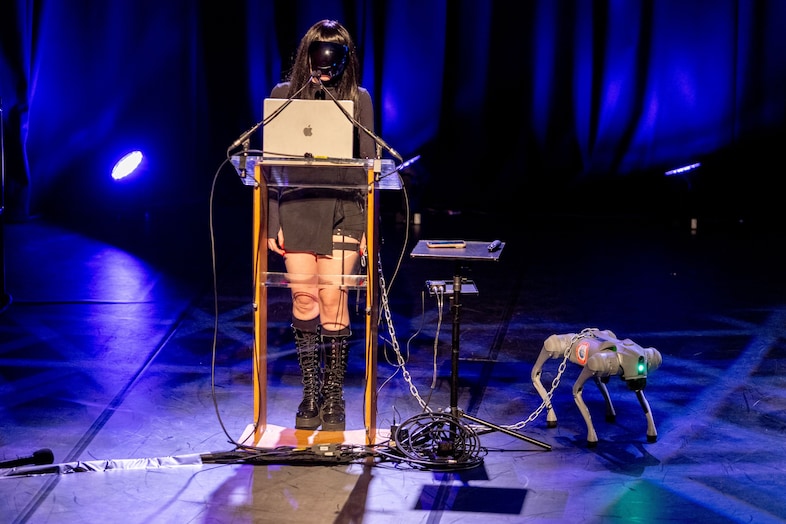
A robot dog is refusing to leave the stage at London’s Southbank Centre. It strains against its leash as its owner, dressed in all black with a cyborgian, voice-changing mask, tries to drag it backstage. This is easier said than done, because the robot dog is bred for fighting.
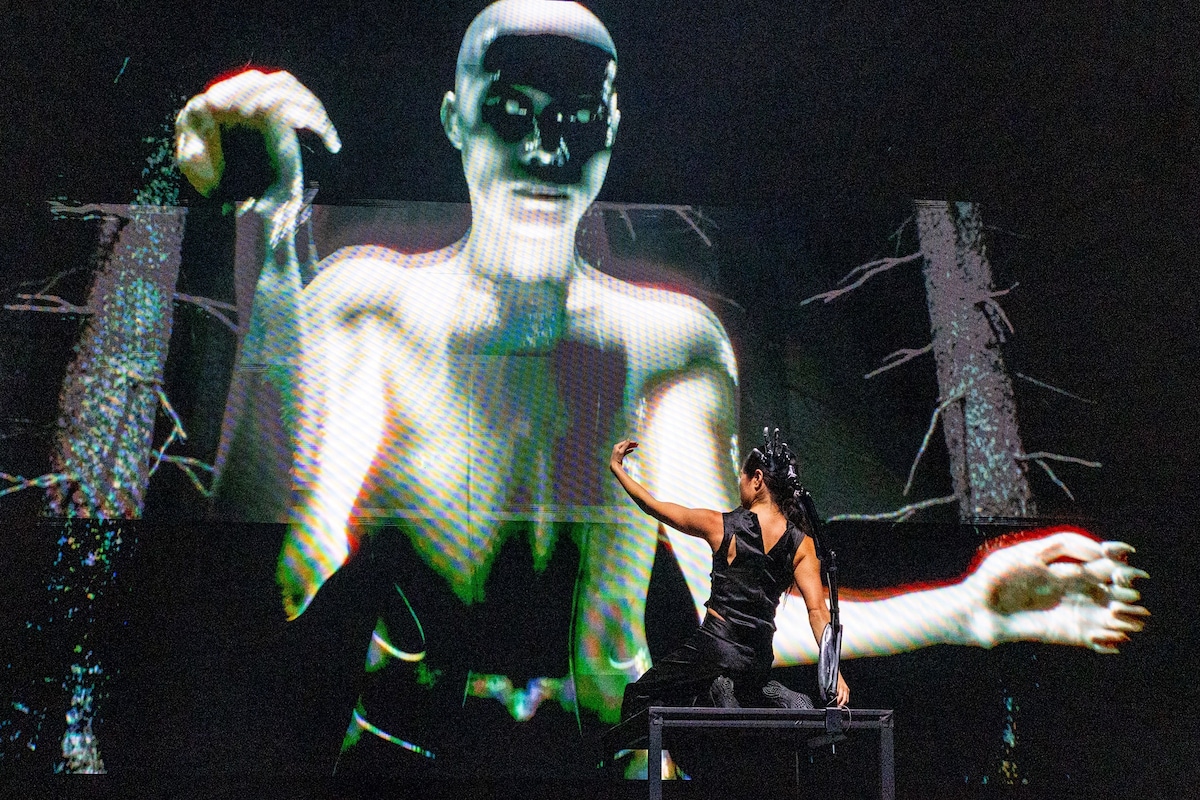
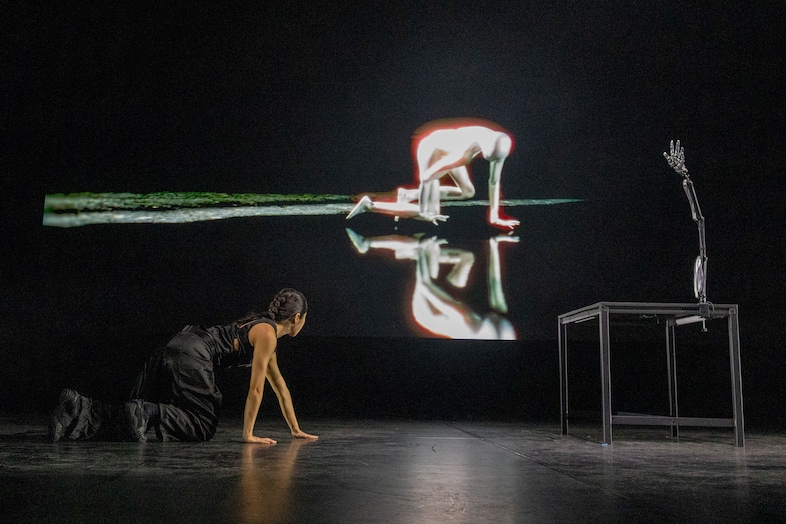
What we’re describing here is not the opening of a dystopian sci-fi film, or a scene from a new season of Black Mirror. It actually happened during a fast-paced showcase of new work from “cultural first movers” at the Southbank Centre’s inaugural Creative Intelligence festival. Running from September 11 to 13 (and already due to return in 2027) the event is built around the new ideas, art, and technologies shaping our future – a future that seems to come at us faster every day.
The mission statement makes Creative Intelligence a natural platform for the kinds of artists and technologists supported by the London-based incubator Restless Egg: the “cultural first movers” in question. And yes, that includes the team behind the “world’s first competitive robot dog fighting league”… but also others, like the artist-led team behind the creative platform Fuser, or the architect and editor Jack Self, whose latest project aims to reengineer the attention economy to define what’s actually contemporary and culturally relevant.
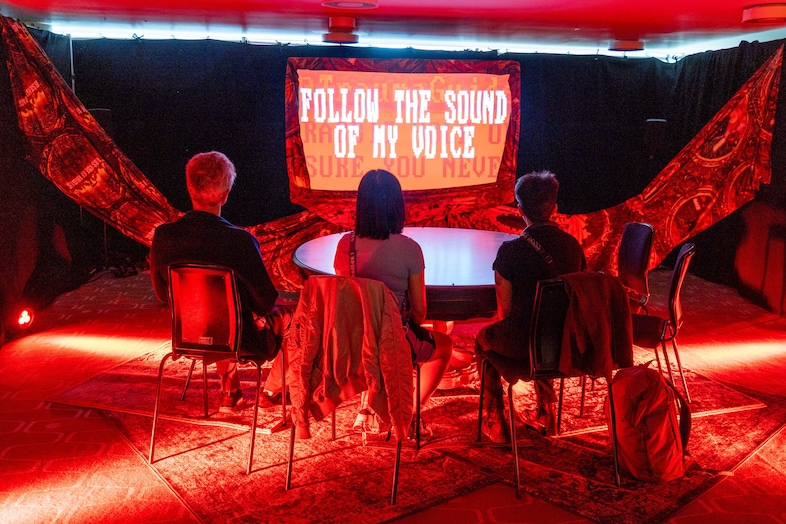
Speaking of cultural relevance, the broader Creative Intelligence programme – curated with PACT – also featured talks and installations by creative pioneers including Holly Herndon, Sougwen Chung, K Allado-McDowell and Kate Crawford. Hands-on exhibits, courtesy of Peckham Digital, included an anti-surveillance make-up demonstration by Lauren Bowker (founder of The Unseen and creator of lip balm from space) and PCs running Quantum Backrooms, a game using quantum computing tech by the quantum technology company Moth.
Needless to say, we learned a lot, with a few Dazed Clubbers also in attendance after grabbing discounted tickets via Dazed Club. Here are three of the main takeaways.
The romanticised image of the starving artist has done immeasurable damage to creative people’s bank accounts. Does it really have to be this way? Not according to many of the speakers at Creative Intelligence, who’ve found a way to balance making a living with not completely selling out on their own creative vision. In fact, this is central to Restless Egg’s vision for art, which (controversially) applies a Silicon Valley-style model to making and selling culture. As co-founder William Morgan describes it, this can even unlock new methods of getting your art seen and making a real impact: “Commercialisation as a force multiplier for creativity.”
You didn’t have to agree with this model, though, to glean something from Restless Egg’s conversation with the Mozilla Foundation and Diana Ayton-Shenker, CEO of Leonardo/ISAST, at Creative Intelligence. With old creative economies crumbling all around us, it was inspiring enough to hear from someone – anyone – who’s trying to build something better and facilitate “creative collaboration, experimentation, and inquiry” at a “transformative moment” for creatives and humanity at large.

An interesting counterpoint to the fast-paced, large-scale models presented in the morning session was an afternoon discussion on creative worldbuilding between directors Jenn Nkiru and Jordan Hemingway (collaborators of Beyoncé and FKA twigs, respectively), hosted by the artist Danielle Brathwaite-Shirley. This emphasised the importance of slow community-building and a mindful approach to working with brands – which often involves trading your personal values for cash and exposure – building on the personal experiences of each creator.
On a more traditional note, the three-day takeover also saw the launch of the Creative Intelligence Award, featuring £50,000 in project development grants for artists working at the crossroads of art and tech. Supported by CoSTAR National Lab, the Southbank Centre,and UKRI, the artist-first grant opens for applications this October.
AI is at the centre of almost every creative conversation today – and for good reason. Speakers at Creative Intelligence warned of the technology’s very real potential to upend the creative industries and flood our lives with meaningless slop. Others, however, stressed the need for artists to get involved with emerging tech like AI as soon as possible, instead of just “burying their head in the sand”. Why? Because, as William Morgan noted, it’s still the people who work with AI that set its course today – it hasn’t totally run away from us yet. And, he added: “If you change the people, which are the input, I’m willing to bet that the output will change.”
Having ‘collaborated’ with AI in their own work for many years, K Allado-Mcdowell was similar optimistic about changing the output of AI tools, saying in a conversation with Sougwen Chung and Jazia Hammoudi: “Most of what is called slop is people working with the core, default setting of the system.” And who’s best placed to bend the rules and push these systems past their default settings? Artists, of course.
Building on this idea, Moth Quantum founder Harry Kumar made a case for the early adoption of a technology that’s still in its embryonic phase: quantum computing. In conversation with Morgan and Lauren Bowker, he doubled down on the value of “bringing people in early, at a time the technology is still maturing” – both as a way to help shape the direction of the new technology, and to communicate to the public what’s going on behind closed doors.
Back in 1968, the Southbank Centre hosted a first-of-its-kind performance of computer music. At Creative Intelligence, almost 60 years later, Holly Herndon showed just how far things have come in the decades in-between, with a deep listening session that took fans through a variety of major projects with her partner and fellow artist Mat Dryhurst. From the groundbreaking album Frontier, through to work with local choirs to train bespoke AI voice models, Herndon sat in a comfy chair, playing music and talking the audience through her artistic process. We even got to hear some unreleased tracks, which proved just as interesting on the level of creative experimentation.
This share-as-you-go approach checks out with the idea of protocol art (a term popularised by Herndon and Dryhurst), where creativity has just as much to do with curating data, designing frameworks and shaping new tech as it does with playing an instrument or painting a picture. As Herndon herself put it: “Each step is an art-making moment.”
If Creative Intelligence proved one thing, it’s that these “art-making moments” are everywhere once you know what you’re looking out for. From video games, to make-up that resists state surveillance, to inventions from the cross-disciplinary research company Termite, to music by the London Community Laptop Orchestra, creativity is very much alive and well – it just looks a little bit different to before.
in HTML format, including tags, to make it appealing and easy to read for Japanese-speaking readers aged 20 to 40 interested in fashion. Organize the content with appropriate headings and subheadings (h1, h2, h3, h4, h5, h6), translating all text, including headings, into Japanese. Retain any existing
tags from
Creative Intelligence 2026
Gallery / 13 images
A robot dog is refusing to leave the stage at London’s Southbank Centre. It strains against its leash as its owner, dressed in all black with a cyborgian, voice-changing mask, tries to drag it backstage. This is easier said than done, because the robot dog is bred for fighting.
What we’re describing here is not the opening of a dystopian sci-fi film, or a scene from a new season of Black Mirror. It actually happened during a fast-paced showcase of new work from “cultural first movers” at the Southbank Centre’s inaugural Creative Intelligence festival. Running from September 11 to 13 (and already due to return in 2027) the event is built around the new ideas, art, and technologies shaping our future – a future that seems to come at us faster every day.
The mission statement makes Creative Intelligence a natural platform for the kinds of artists and technologists supported by the London-based incubator Restless Egg: the “cultural first movers” in question. And yes, that includes the team behind the “world’s first competitive robot dog fighting league”… but also others, like the artist-led team behind the creative platform Fuser, or the architect and editor Jack Self, whose latest project aims to reengineer the attention economy to define what’s actually contemporary and culturally relevant.
Speaking of cultural relevance, the broader Creative Intelligence programme – curated with PACT – also featured talks and installations by creative pioneers including Holly Herndon, Sougwen Chung, K Allado-McDowell and Kate Crawford. Hands-on exhibits, courtesy of Peckham Digital, included an anti-surveillance make-up demonstration by Lauren Bowker (founder of The Unseen and creator of lip balm from space) and PCs running Quantum Backrooms, a game using quantum computing tech by the quantum technology company Moth.
Needless to say, we learned a lot, with a few Dazed Clubbers also in attendance after grabbing discounted tickets via Dazed Club. Here are three of the main takeaways.
The romanticised image of the starving artist has done immeasurable damage to creative people’s bank accounts. Does it really have to be this way? Not according to many of the speakers at Creative Intelligence, who’ve found a way to balance making a living with not completely selling out on their own creative vision. In fact, this is central to Restless Egg’s vision for art, which (controversially) applies a Silicon Valley-style model to making and selling culture. As co-founder William Morgan describes it, this can even unlock new methods of getting your art seen and making a real impact: “Commercialisation as a force multiplier for creativity.”
You didn’t have to agree with this model, though, to glean something from Restless Egg’s conversation with the Mozilla Foundation and Diana Ayton-Shenker, CEO of Leonardo/ISAST, at Creative Intelligence. With old creative economies crumbling all around us, it was inspiring enough to hear from someone – anyone – who’s trying to build something better and facilitate “creative collaboration, experimentation, and inquiry” at a “transformative moment” for creatives and humanity at large.
An interesting counterpoint to the fast-paced, large-scale models presented in the morning session was an afternoon discussion on creative worldbuilding between directors Jenn Nkiru and Jordan Hemingway (collaborators of Beyoncé and FKA twigs, respectively), hosted by the artist Danielle Brathwaite-Shirley. This emphasised the importance of slow community-building and a mindful approach to working with brands – which often involves trading your personal values for cash and exposure – building on the personal experiences of each creator.
On a more traditional note, the three-day takeover also saw the launch of the Creative Intelligence Award, featuring £50,000 in project development grants for artists working at the crossroads of art and tech. Supported by CoSTAR National Lab, the Southbank Centre,and UKRI, the artist-first grant opens for applications this October.
AI is at the centre of almost every creative conversation today – and for good reason. Speakers at Creative Intelligence warned of the technology’s very real potential to upend the creative industries and flood our lives with meaningless slop. Others, however, stressed the need for artists to get involved with emerging tech like AI as soon as possible, instead of just “burying their head in the sand”. Why? Because, as William Morgan noted, it’s still the people who work with AI that set its course today – it hasn’t totally run away from us yet. And, he added: “If you change the people, which are the input, I’m willing to bet that the output will change.”
Having ‘collaborated’ with AI in their own work for many years, K Allado-Mcdowell was similar optimistic about changing the output of AI tools, saying in a conversation with Sougwen Chung and Jazia Hammoudi: “Most of what is called slop is people working with the core, default setting of the system.” And who’s best placed to bend the rules and push these systems past their default settings? Artists, of course.
Building on this idea, Moth Quantum founder Harry Kumar made a case for the early adoption of a technology that’s still in its embryonic phase: quantum computing. In conversation with Morgan and Lauren Bowker, he doubled down on the value of “bringing people in early, at a time the technology is still maturing” – both as a way to help shape the direction of the new technology, and to communicate to the public what’s going on behind closed doors.
Back in 1968, the Southbank Centre hosted a first-of-its-kind performance of computer music. At Creative Intelligence, almost 60 years later, Holly Herndon showed just how far things have come in the decades in-between, with a deep listening session that took fans through a variety of major projects with her partner and fellow artist Mat Dryhurst. From the groundbreaking album Frontier, through to work with local choirs to train bespoke AI voice models, Herndon sat in a comfy chair, playing music and talking the audience through her artistic process. We even got to hear some unreleased tracks, which proved just as interesting on the level of creative experimentation.
This share-as-you-go approach checks out with the idea of protocol art (a term popularised by Herndon and Dryhurst), where creativity has just as much to do with curating data, designing frameworks and shaping new tech as it does with playing an instrument or painting a picture. As Herndon herself put it: “Each step is an art-making moment.”
If Creative Intelligence proved one thing, it’s that these “art-making moments” are everywhere once you know what you’re looking out for. From video games, to make-up that resists state surveillance, to inventions from the cross-disciplinary research company Termite, to music by the London Community Laptop Orchestra, creativity is very much alive and well – it just looks a little bit different to before.
and integrate them seamlessly into the new content without adding new tags. Ensure the new content is fashion-related, written entirely in Japanese, and approximately 1500 words. Conclude with a “結論” section and a well-formatted “よくある質問” section. Avoid including an introduction or a note explaining the process.