Rewrite

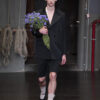
Emilie Wenckstern. Photo credit: Serena Gallorini.
Florence on a June evening has a way of making things feel significant, and the Polimoda Graduate Show 2026 did not waste the occasion. As Pitti Uomo 110 officially opens this week, the square in front of the Manifattura Tabacchi campus filled with guests waiting for twenty emerging designers to present the work of four long years. The school’s iconic clock tower provided a stunning backdrop, and Schön! was there to witness a new generation of designers step forward into the fashion scene.
Polimoda marks its 40th anniversary this year, a milestone that creative director Massimiliano Giornetti describes with characteristic understatement. “The anniversary is a nice coincidence,” he says. “Every year is an anniversary, every year there’s a celebration. For me, it’s not a special year, simply a symbolic one for the school.” What gives it weight, he adds, is continuity rather than commemoration: the faculty that has been there since the beginning, the renewed partnership with the Fashion Institute of Technology (FIT) in New York that originally helped bring Polimoda into existence in 1986, and a 90% graduate placement rate that says something concrete about what four decades of this kind of education actually produces.
New to the 2026 edition was the mentorship of creative directors Luke and Lucie Meier, who returned to the school where they trained and met 25 years ago, joining Giornetti and An Vandevorst in guiding the development of the collections.
What came down the runway covered a considerable amount of emotional and aesthetic ground. Over 100 looks from 20 designers representing 15 nationalities, and the range was, as Giornetti puts it, entirely the point. “I never make them look for inspiration,” he says. “Inspiration is something that comes very naturally. I always tell them: ‘You must nourish yourselves with anything: politics, music, performance, art, cinema. Everything, once absorbed, is released and transformed.’” The collections that resulted moved between super-minimal and full maximalism, between personal grief and philosophical provocation, between the deeply intimate and the cinematically referential. “There must be no diktat,” he adds. “There must be depth and what we look for each time is precisely this capacity to truly be themselves. You must be leaders and not followers.”

Isabella ‘Zaz’ Alvarino, Lisa Criaco.

Matteo Bardi, Idan David Segal.
The most personally charged work of the evening came from Lisa Criaco, whose ‘The Pressure’ drew from the loss of her diver father, transforming the ocean into a metaphor for descent and resurfacing through diving suit silhouettes, helmet-inspired hardware and a dark palette broken only by a single white look. Isabella ‘Zaz’ Alvarino’s ‘Hot Nerds’ arrived with a different grief, dedicated to her late friend Jay: the tension between an inherited masculine shoulder and a dramatically cinched waist became both silhouette and metaphor, suiting fabrics combined with unexpected textures to mirror a transformation that felt still ongoing.
Meanwhile, Matteo Bardi’s ‘VULNERA’ staged a dialogue between the hardened, punkish biker and the delicate figure he derides, arguing with conviction that tenderness is the more demanding position. Homaging the maximalism of the 1980s, Idan David Segal put on a drama show with ‘Frame Me If You Can,’ staging a museum heist starring a group of wealthy elderly, classy women. A single, total black look by Mari Enomoto also appeared on the runway as a last-minute addition, featuring an embellished floral-inspired silhouette.

Mari Enomoto, Victor Brial.

Victor Brial.
It was a genuine pleasure to realise how thoroughly menswear outpaced its counterpart, something that has not always been the case at graduate shows (and fashion in general, really) and was all the more welcome for it. After years of menswear that played it safe, the construction, palette and texture play on display felt like an overdue exhale. Victor Brial’s ‘Souvenirs of Wandering’ was among the most complete collections of the night: oversized and rounded silhouettes drawn from the sculptural language of Henry Moore, a palette of volcanic landscapes and humid mountains drawn from Réunion Island, where his character retreats to escape the noise of modern life. The materials felt instinctive and the whole collection moved with the kind of nonchalant confidence that is very difficult to manufacture.
Jirat Jitdee’s ‘Cool Back Home’ followed proudly anachronistic young men from the Thai countryside arriving in Bangkok, the colour palette taken from traditional Thai day-of-the-week colours, proportions shifted and references ranging from early 2000s Helmut Lang to Carol Christian Poell. Jakob Nittmann’s ‘Unlearning Neutral’ made the case that colour in men’s dress is not frivolous but historically informed and long overdue for reclamation, translating 18th-century embroidery and silhouettes into contemporary bombers and trench coats with a palette inspired by interior design and gardens. Matilde Terranova’s ‘Teenager Boys,’ channelling Walter Hill’s ‘The Warriors’ through hybrid silhouettes suspended between rebellion and urban elegance, completed a menswear quartet that gave the evening much of its energy.

Jirat Jitdee, Jakob Nittmann.

Matilde Terranova, Diana Avetisian.
Diana Avetisian’s ‘Another Role’ followed an actress lost between performance and reality through structured silhouettes drawn from vintage automobiles, waxed fabrics and a showpiece coat adorned with Preciosa crystals over a crashed car print. Aaron Dillworth’s ‘SUN IS HIGH SO AM I’ rooted itself in the warmth of Miami and his Jamaican heritage, an instinctive wardrobe built entirely for tropical heat and open air. Emily Horton’s ‘Jew…ish’ resolved the tension between Jewish identity and the desire to belong on the baseball field, merging athletic aesthetics with cultural tradition in cotton, heavy wool and canvas. Evelina Kryvopust’s ‘UN’ took the piano teacher as its archetype, exploring conservative ambiguity with British wool, crinkled silk taffeta and cinematic references that included Michael Haneke and Chantal Akerman.
Elsewhere, Anson Lorence Lin’s ‘Packages’ captured the unglamorous backstage moment before a show through deep patternmaking experimentation drawn from Cy Twombly’s box constructions, treating garments as sculptural objects. Vincenzo Marrazzo’s ‘Il Latte delle Vergini’ drew from Pasolini and Bataille to examine purity and its inevitable contamination, in deliberately aged silks and cottons that made complicity feel inescapable. Isabel Antonia Richter’s ‘Simulation’ explored the blurring boundary between the digital and the real in leather, nylon and laminations. Francesca Valivano’s ‘Nel silenzio dell’attimo’ used chess as a central metaphor for time frozen between decision and consequence, with a lineup of sharp, geometric silhouettes.

Aaron Dillworth, Emily Horton.

Anson Lorence Lin, Evelina Kryvopust.
Of the favourites, Lusine Mkrtchyan’s ‘The Parajanov Street’ was devotional in the best sense, its palette of green, navy, gold and deep purple lifted directly from Sergei Parajanov’s cinematic scenes, its shapes drawn from the shells and sculptural forms of his museum in Yerevan. Lucia Romagnoli’s ‘Ab Umbra Lumen’ worked through the act of stepping out of another’s shadow, structured 1970s silhouettes combining wool, leather and coated denim with three-dimensional florals in a collection about becoming visible on your own terms. Emilie Wenckstern closed with ‘No Longer Human,’ masterfully mixing the human and the constructed through a palette of synthetic skin tones, cracked porcelain surfaces and leather moulding: fashion and sculpture in uncomfortable, compelling proximity.

Vincenzo Marrazzo, Isabel Antonia Richter.

Francesca Valivano, Lusine Mkrtchyan.
A jury that includes Eva Cavalli, Tuomas A. Laitinen, Danae Mercer, StyleZeitgeist founder Eugene Rabkin and actress Simona Tabasco will elect the Best Collection 2026, with the winner to be announced in the days following the show.
“What we look for is talent,” says Giornetti, “talent that must express itself freely and unconditionally. What counts here is the depth of thought.” On the evidence of last night, that depth he speaks of was not difficult to find.

Lucia Romagnoli.

Emilie Wenckstern.
Discover more here.
photography. courtesy of Polimoda, Serena Gallorini
words. Gennaro Costanzo
in HTML format, including tags, to make it appealing and easy to read for Japanese-speaking readers aged 20 to 40 interested in fashion. Organize the content with appropriate headings and subheadings (h1, h2, h3, h4, h5, h6), translating all text, including headings, into Japanese. Retain any existing
tags from
Emilie Wenckstern. Photo credit: Serena Gallorini.
Florence on a June evening has a way of making things feel significant, and the Polimoda Graduate Show 2026 did not waste the occasion. As Pitti Uomo 110 officially opens this week, the square in front of the Manifattura Tabacchi campus filled with guests waiting for twenty emerging designers to present the work of four long years. The school’s iconic clock tower provided a stunning backdrop, and Schön! was there to witness a new generation of designers step forward into the fashion scene.
Polimoda marks its 40th anniversary this year, a milestone that creative director Massimiliano Giornetti describes with characteristic understatement. “The anniversary is a nice coincidence,” he says. “Every year is an anniversary, every year there’s a celebration. For me, it’s not a special year, simply a symbolic one for the school.” What gives it weight, he adds, is continuity rather than commemoration: the faculty that has been there since the beginning, the renewed partnership with the Fashion Institute of Technology (FIT) in New York that originally helped bring Polimoda into existence in 1986, and a 90% graduate placement rate that says something concrete about what four decades of this kind of education actually produces.
New to the 2026 edition was the mentorship of creative directors Luke and Lucie Meier, who returned to the school where they trained and met 25 years ago, joining Giornetti and An Vandevorst in guiding the development of the collections.
What came down the runway covered a considerable amount of emotional and aesthetic ground. Over 100 looks from 20 designers representing 15 nationalities, and the range was, as Giornetti puts it, entirely the point. “I never make them look for inspiration,” he says. “Inspiration is something that comes very naturally. I always tell them: ‘You must nourish yourselves with anything: politics, music, performance, art, cinema. Everything, once absorbed, is released and transformed.’” The collections that resulted moved between super-minimal and full maximalism, between personal grief and philosophical provocation, between the deeply intimate and the cinematically referential. “There must be no diktat,” he adds. “There must be depth and what we look for each time is precisely this capacity to truly be themselves. You must be leaders and not followers.”
Isabella ‘Zaz’ Alvarino, Lisa Criaco.
Matteo Bardi, Idan David Segal.
The most personally charged work of the evening came from Lisa Criaco, whose ‘The Pressure’ drew from the loss of her diver father, transforming the ocean into a metaphor for descent and resurfacing through diving suit silhouettes, helmet-inspired hardware and a dark palette broken only by a single white look. Isabella ‘Zaz’ Alvarino’s ‘Hot Nerds’ arrived with a different grief, dedicated to her late friend Jay: the tension between an inherited masculine shoulder and a dramatically cinched waist became both silhouette and metaphor, suiting fabrics combined with unexpected textures to mirror a transformation that felt still ongoing.
Meanwhile, Matteo Bardi’s ‘VULNERA’ staged a dialogue between the hardened, punkish biker and the delicate figure he derides, arguing with conviction that tenderness is the more demanding position. Homaging the maximalism of the 1980s, Idan David Segal put on a drama show with ‘Frame Me If You Can,’ staging a museum heist starring a group of wealthy elderly, classy women. A single, total black look by Mari Enomoto also appeared on the runway as a last-minute addition, featuring an embellished floral-inspired silhouette.
Mari Enomoto, Victor Brial.
Victor Brial.
It was a genuine pleasure to realise how thoroughly menswear outpaced its counterpart, something that has not always been the case at graduate shows (and fashion in general, really) and was all the more welcome for it. After years of menswear that played it safe, the construction, palette and texture play on display felt like an overdue exhale. Victor Brial’s ‘Souvenirs of Wandering’ was among the most complete collections of the night: oversized and rounded silhouettes drawn from the sculptural language of Henry Moore, a palette of volcanic landscapes and humid mountains drawn from Réunion Island, where his character retreats to escape the noise of modern life. The materials felt instinctive and the whole collection moved with the kind of nonchalant confidence that is very difficult to manufacture.
Jirat Jitdee’s ‘Cool Back Home’ followed proudly anachronistic young men from the Thai countryside arriving in Bangkok, the colour palette taken from traditional Thai day-of-the-week colours, proportions shifted and references ranging from early 2000s Helmut Lang to Carol Christian Poell. Jakob Nittmann’s ‘Unlearning Neutral’ made the case that colour in men’s dress is not frivolous but historically informed and long overdue for reclamation, translating 18th-century embroidery and silhouettes into contemporary bombers and trench coats with a palette inspired by interior design and gardens. Matilde Terranova’s ‘Teenager Boys,’ channelling Walter Hill’s ‘The Warriors’ through hybrid silhouettes suspended between rebellion and urban elegance, completed a menswear quartet that gave the evening much of its energy.
Jirat Jitdee, Jakob Nittmann.
Matilde Terranova, Diana Avetisian.
Diana Avetisian’s ‘Another Role’ followed an actress lost between performance and reality through structured silhouettes drawn from vintage automobiles, waxed fabrics and a showpiece coat adorned with Preciosa crystals over a crashed car print. Aaron Dillworth’s ‘SUN IS HIGH SO AM I’ rooted itself in the warmth of Miami and his Jamaican heritage, an instinctive wardrobe built entirely for tropical heat and open air. Emily Horton’s ‘Jew…ish’ resolved the tension between Jewish identity and the desire to belong on the baseball field, merging athletic aesthetics with cultural tradition in cotton, heavy wool and canvas. Evelina Kryvopust’s ‘UN’ took the piano teacher as its archetype, exploring conservative ambiguity with British wool, crinkled silk taffeta and cinematic references that included Michael Haneke and Chantal Akerman.
Elsewhere, Anson Lorence Lin’s ‘Packages’ captured the unglamorous backstage moment before a show through deep patternmaking experimentation drawn from Cy Twombly’s box constructions, treating garments as sculptural objects. Vincenzo Marrazzo’s ‘Il Latte delle Vergini’ drew from Pasolini and Bataille to examine purity and its inevitable contamination, in deliberately aged silks and cottons that made complicity feel inescapable. Isabel Antonia Richter’s ‘Simulation’ explored the blurring boundary between the digital and the real in leather, nylon and laminations. Francesca Valivano’s ‘Nel silenzio dell’attimo’ used chess as a central metaphor for time frozen between decision and consequence, with a lineup of sharp, geometric silhouettes.
Aaron Dillworth, Emily Horton.
Anson Lorence Lin, Evelina Kryvopust.
Of the favourites, Lusine Mkrtchyan’s ‘The Parajanov Street’ was devotional in the best sense, its palette of green, navy, gold and deep purple lifted directly from Sergei Parajanov’s cinematic scenes, its shapes drawn from the shells and sculptural forms of his museum in Yerevan. Lucia Romagnoli’s ‘Ab Umbra Lumen’ worked through the act of stepping out of another’s shadow, structured 1970s silhouettes combining wool, leather and coated denim with three-dimensional florals in a collection about becoming visible on your own terms. Emilie Wenckstern closed with ‘No Longer Human,’ masterfully mixing the human and the constructed through a palette of synthetic skin tones, cracked porcelain surfaces and leather moulding: fashion and sculpture in uncomfortable, compelling proximity.
Vincenzo Marrazzo, Isabel Antonia Richter.
Francesca Valivano, Lusine Mkrtchyan.
A jury that includes Eva Cavalli, Tuomas A. Laitinen, Danae Mercer, StyleZeitgeist founder Eugene Rabkin and actress Simona Tabasco will elect the Best Collection 2026, with the winner to be announced in the days following the show.
“What we look for is talent,” says Giornetti, “talent that must express itself freely and unconditionally. What counts here is the depth of thought.” On the evidence of last night, that depth he speaks of was not difficult to find.
Lucia Romagnoli.
Emilie Wenckstern.
Discover more here.
photography. courtesy of Polimoda, Serena Gallorini
words. Gennaro Costanzo
and integrate them seamlessly into the new content without adding new tags. Ensure the new content is fashion-related, written entirely in Japanese, and approximately 1500 words. Conclude with a “結論” section and a well-formatted “よくある質問” section. Avoid including an introduction or a note explaining the process.