Rewrite
Staged on the Grand Canal in Venice, the artist and poet’s bewitching new exhibition is underpinned by age-old philosophy and confessional poetry
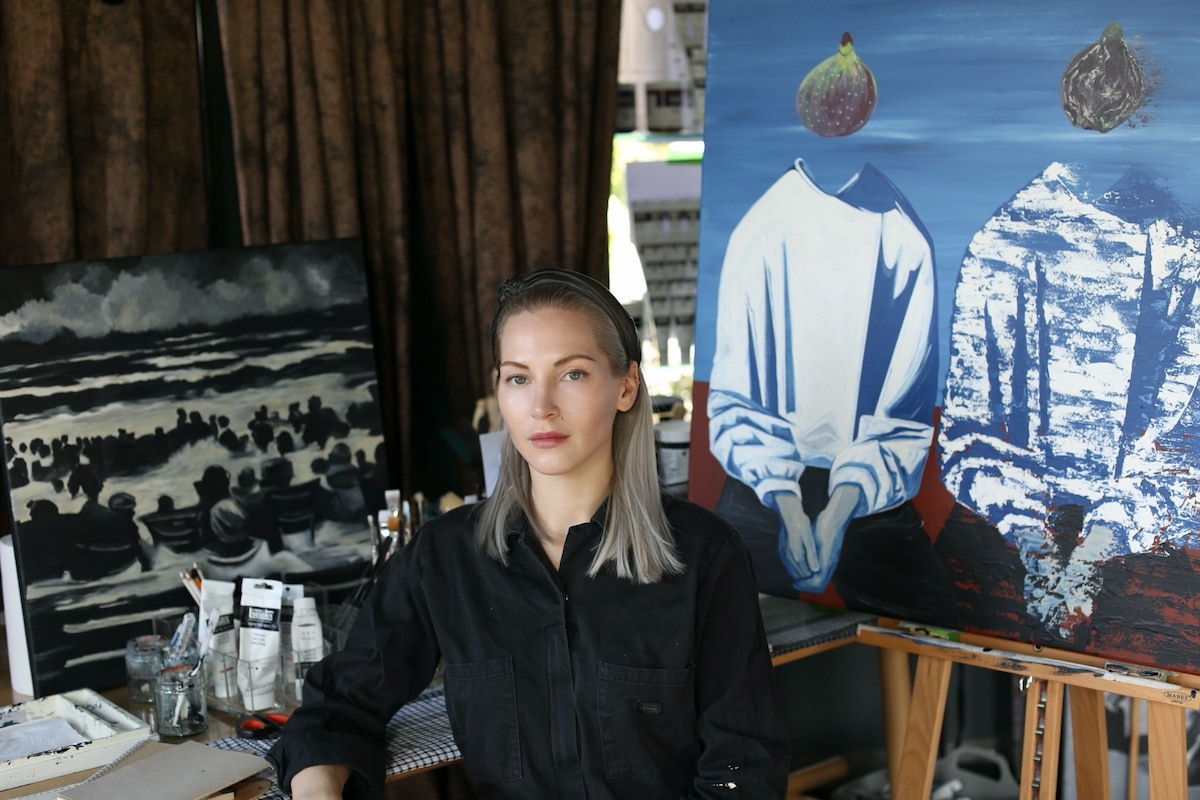
Venice is never short of hidden histories, but the Scoletta Battioro e Tiraoro di Venezia, with its sun-faded pink facade and teal-green shutters opening onto the floating city’s Grand Canal, has a particularly evocative one: it was once home to the battiloro, artisans who hammered gold into threads finer than human hair, used to weave damasks and velvets for the shoulders of European royalty and nobility. The building was placed under the protection of a handful of saints – and although it’s now a deconsecrated space, that feels entirely fitting for the bewitching new exhibition, encompassing site-specific painting, immersive sculpture and soundscapes that currently fills its three floors. Artist and poet Arch Hades may not be religious herself, but she has faith; in our shared humanity, and in art’s ability to bridge the distances between us.

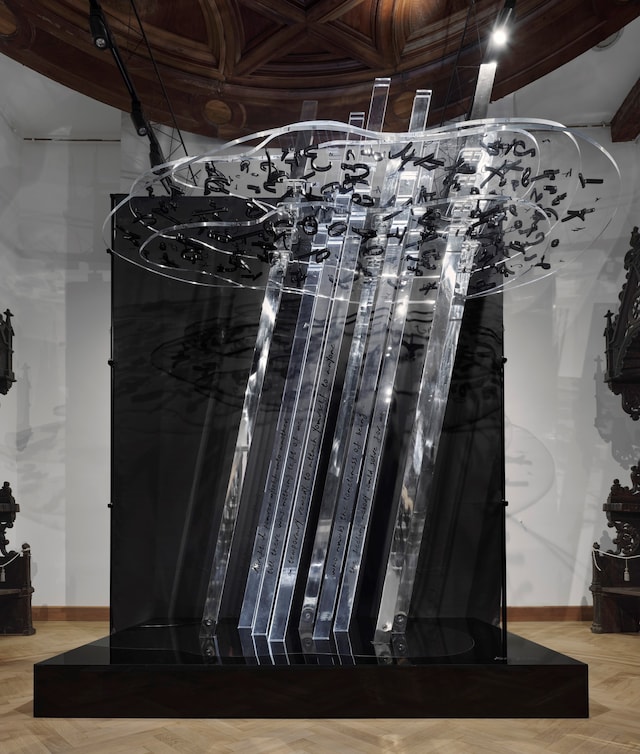
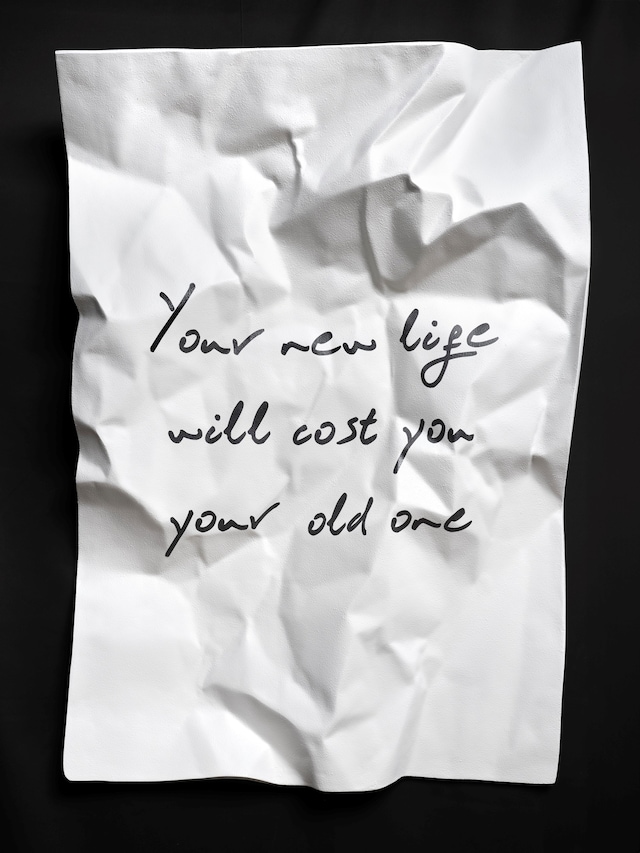
Titled Return, Hades’ follow-up to last year’s London show We Are All Just Passing Through, had been a year in the making when the tall wooden doors of the Scoletta opened during the first week of the Venice Biennale. Hades’ presence here, alongside the Biennale’s “In Minor Keys” exhibition (curated by the late Koyo Kouoh), with its invitation to shift into a slower gear and tune into the subtler frequencies of life, felt like a fitting accomplice; in Return, trees murmur poetry from beneath silver hardwood, sound showers engulf listeners in Hades’ lyrical stanzas, acrylic clouds rain her words into pooling aluminium puddles on the floor, and an enigmatic Sphinx, rendered in mirrored chrome, asks us to pause and dwell honestly for a moment on all our messy desires, impulses and contradictions. But if Hades requires her visitors to do a little soul searching, she offers up her most private thoughts made public in return – unearthed from the crumpled discards of the journals she has scribbled in since childhood, they are blown up into undeniable, concrete-finished slabs that act like invitations. “I’ve heard other poets say that poetry is the redistribution of melancholy,” she says as we wander the airy space. “I find that often when I write something that makes me feel a little too exposed, too vulnerable, often I want to get rid of it – if it’s too sad or it makes me feel too pathetic or lonely. But actually it’s at exactly that point that it might resonate the most with other people. So every time I discard something, I go back to rediscover it, unfurl it, and make what was once a fleeting emotion quite literally permanent. Even at your lowest, no one has ever been alone in any of these feelings.”
![Arch Hades, Return, 2025 [in progress 1]](https://images-prod.anothermag.com/786/azure/another-prod/470/3/473814.JPG)
The written word underpins Hades‘ practice: “Every single sculpture, every single artwork begins with poetry or a journal entry – and only then it manifests into something more physical,” she says. As visitors enter the space, one wall streams footage of a London performance of her extraordinary narrative poem Arcadia, a 648-line, freewheeling exploration of late-capitalist maladies – anxiety, depression, overwork, overconsumption – to which she offers the antidote of existential philosophy. Ranging fluidly from Jean-Paul Sartre to Susan Sontag, Albert Camus to Jean Baudrillard – writings she says she devoured through deeply miserable school years – Arcadia finds its solace in the acceptance of our own cosmic irrelevance. She was 30 in 2022 when the work won her the title of “world’s highest-paid living poet”: it sold at Christie’s for $525,000. She has since performed the poem in venues large and intimate, as a living artwork that continues to evolve. “That was a catalyst, the success of Arcadia,” she says. “That’s when I realised I could do both poetry and art.”
Return culminates in a giant triptych – three metres tall, 13 metres across – that wraps around the building’s high-ceilinged third floor, rendered in deep-sea blue and red the shade of dried blood. Hades took inspiration from Gustav Klimt’s huge, allegorical murals known as the Faculty Paintings. With their erotic nudes and unblinking depiction of human suffering, the works were so scandalous back in the early 1900s they were pulled from their intended home on the ceiling of the University of Vienna’s Great Hall. (A wealthy patron stepped in to buy them instead; the paintings later burned when retreating German SS forces set fire to Austria’s Schloss Immendorf castle in 1945). More than a century on, Hades’ own take on Klimt’s collective river of life encompasses 63 life-sized figures twisting and merging, drawn irrevocably towards the abyss at its centre – or perhaps exploding from it. There are references to classical sculpture, to romantic love and platonic friendship, to grief and joy and the galaxy of emotions in between. “It’s presented like an altar triptych,” she says, “we are in a decommissioned church after all. But you won’t see any depictions of heaven and hell and Jesus. The main subject here is death, our only inevitable fate.”
![Arch Hades, Return, 2025 [in progress 5]](https://images-prod.anothermag.com/786/azure/another-prod/470/3/473816.jpeg)
You may, however, spot Lucifer: “Lucifer of Liège,” she says, pointing to a well-built figure on the right wall. “In the 1840s, one of the Geefs brothers was commissioned to create a Lucifer for the pulpit of a Belgian cathedral, but he made his Lucifer nude, and there were complaints immediately that he was far too attractive and distracting, so the cathedral removed the statue. They then commissioned his brother to make another Lucifer, but he made his even sexier. At this point they ran out of money, so they had to keep the statue as it was.” It’s the kind of art historical anecdote Hades delights in – it’s no surprise that she used part of the money she earned from Arcadia to create a dream library in her home for her sprawling collection of books. For Return, she found her thoughts orbiting around a parable by Benedictine monk St Bede: “He once compared human life to a tiny sparrow flying in from the darkness into a brightly lit banqueting hall full of festivity, and just as quickly flying out the other end, back into the darkness. This painting here is really the core philosophical stance of the entire exhibition – the fleeting nature of human life and insignificance in the grand scheme, countered on the insistence on living fully in the moment, in the time allotted. Yes, we’re all returning into the abyss and yet at the same time there’s such a range of human experiences, such a range of human emotion that we get to feel. I hope it encourages even just a moment of quiet reflection – that there are so many experiences behind you, and ahead of you.”
Return/Ritorno is on show until 30 October at Scoletta Battioro e Tiraoro in Venice.
in HTML format, including tags, to make it appealing and easy to read for Japanese-speaking readers aged 20 to 40 interested in fashion. Organize the content with appropriate headings and subheadings (h1, h2, h3, h4, h5, h6), translating all text, including headings, into Japanese. Retain any existing
tags from
Staged on the Grand Canal in Venice, the artist and poet’s bewitching new exhibition is underpinned by age-old philosophy and confessional poetry
Venice is never short of hidden histories, but the Scoletta Battioro e Tiraoro di Venezia, with its sun-faded pink facade and teal-green shutters opening onto the floating city’s Grand Canal, has a particularly evocative one: it was once home to the battiloro, artisans who hammered gold into threads finer than human hair, used to weave damasks and velvets for the shoulders of European royalty and nobility. The building was placed under the protection of a handful of saints – and although it’s now a deconsecrated space, that feels entirely fitting for the bewitching new exhibition, encompassing site-specific painting, immersive sculpture and soundscapes that currently fills its three floors. Artist and poet Arch Hades may not be religious herself, but she has faith; in our shared humanity, and in art’s ability to bridge the distances between us.
Titled Return, Hades’ follow-up to last year’s London show We Are All Just Passing Through, had been a year in the making when the tall wooden doors of the Scoletta opened during the first week of the Venice Biennale. Hades’ presence here, alongside the Biennale’s “In Minor Keys” exhibition (curated by the late Koyo Kouoh), with its invitation to shift into a slower gear and tune into the subtler frequencies of life, felt like a fitting accomplice; in Return, trees murmur poetry from beneath silver hardwood, sound showers engulf listeners in Hades’ lyrical stanzas, acrylic clouds rain her words into pooling aluminium puddles on the floor, and an enigmatic Sphinx, rendered in mirrored chrome, asks us to pause and dwell honestly for a moment on all our messy desires, impulses and contradictions. But if Hades requires her visitors to do a little soul searching, she offers up her most private thoughts made public in return – unearthed from the crumpled discards of the journals she has scribbled in since childhood, they are blown up into undeniable, concrete-finished slabs that act like invitations. “I’ve heard other poets say that poetry is the redistribution of melancholy,” she says as we wander the airy space. “I find that often when I write something that makes me feel a little too exposed, too vulnerable, often I want to get rid of it – if it’s too sad or it makes me feel too pathetic or lonely. But actually it’s at exactly that point that it might resonate the most with other people. So every time I discard something, I go back to rediscover it, unfurl it, and make what was once a fleeting emotion quite literally permanent. Even at your lowest, no one has ever been alone in any of these feelings.”
The written word underpins Hades‘ practice: “Every single sculpture, every single artwork begins with poetry or a journal entry – and only then it manifests into something more physical,” she says. As visitors enter the space, one wall streams footage of a London performance of her extraordinary narrative poem Arcadia, a 648-line, freewheeling exploration of late-capitalist maladies – anxiety, depression, overwork, overconsumption – to which she offers the antidote of existential philosophy. Ranging fluidly from Jean-Paul Sartre to Susan Sontag, Albert Camus to Jean Baudrillard – writings she says she devoured through deeply miserable school years – Arcadia finds its solace in the acceptance of our own cosmic irrelevance. She was 30 in 2022 when the work won her the title of “world’s highest-paid living poet”: it sold at Christie’s for $525,000. She has since performed the poem in venues large and intimate, as a living artwork that continues to evolve. “That was a catalyst, the success of Arcadia,” she says. “That’s when I realised I could do both poetry and art.”
Return culminates in a giant triptych – three metres tall, 13 metres across – that wraps around the building’s high-ceilinged third floor, rendered in deep-sea blue and red the shade of dried blood. Hades took inspiration from Gustav Klimt’s huge, allegorical murals known as the Faculty Paintings. With their erotic nudes and unblinking depiction of human suffering, the works were so scandalous back in the early 1900s they were pulled from their intended home on the ceiling of the University of Vienna’s Great Hall. (A wealthy patron stepped in to buy them instead; the paintings later burned when retreating German SS forces set fire to Austria’s Schloss Immendorf castle in 1945). More than a century on, Hades’ own take on Klimt’s collective river of life encompasses 63 life-sized figures twisting and merging, drawn irrevocably towards the abyss at its centre – or perhaps exploding from it. There are references to classical sculpture, to romantic love and platonic friendship, to grief and joy and the galaxy of emotions in between. “It’s presented like an altar triptych,” she says, “we are in a decommissioned church after all. But you won’t see any depictions of heaven and hell and Jesus. The main subject here is death, our only inevitable fate.”
You may, however, spot Lucifer: “Lucifer of Liège,” she says, pointing to a well-built figure on the right wall. “In the 1840s, one of the Geefs brothers was commissioned to create a Lucifer for the pulpit of a Belgian cathedral, but he made his Lucifer nude, and there were complaints immediately that he was far too attractive and distracting, so the cathedral removed the statue. They then commissioned his brother to make another Lucifer, but he made his even sexier. At this point they ran out of money, so they had to keep the statue as it was.” It’s the kind of art historical anecdote Hades delights in – it’s no surprise that she used part of the money she earned from Arcadia to create a dream library in her home for her sprawling collection of books. For Return, she found her thoughts orbiting around a parable by Benedictine monk St Bede: “He once compared human life to a tiny sparrow flying in from the darkness into a brightly lit banqueting hall full of festivity, and just as quickly flying out the other end, back into the darkness. This painting here is really the core philosophical stance of the entire exhibition – the fleeting nature of human life and insignificance in the grand scheme, countered on the insistence on living fully in the moment, in the time allotted. Yes, we’re all returning into the abyss and yet at the same time there’s such a range of human experiences, such a range of human emotion that we get to feel. I hope it encourages even just a moment of quiet reflection – that there are so many experiences behind you, and ahead of you.”
Return/Ritorno is on show until 30 October at Scoletta Battioro e Tiraoro in Venice.
and integrate them seamlessly into the new content without adding new tags. Ensure the new content is fashion-related, written entirely in Japanese, and approximately 1500 words. Conclude with a “結論” section and a well-formatted “よくある質問” section. Avoid including an introduction or a note explaining the process.